
Conjunctival infection due to SARS-CoV-2 unlikely
Researchers at the Medical Center - University of Freiburg are investigating possible eye involvement in COVID-19 / no all-clear for medical precautions / study published in the Journal of Medical Virology
The novel coronavirus SARS-CoV-2 uses certain proteins on the surface of human cells as door openers to enter the cells and multiply. There have also been isolated reports of patients with inflammation of the conjunctiva of the eye with COVID-19 disease. Until now, it was unclear whether conjunctival cells are susceptible to the new virus and could therefore be a potential entry point for SARS-CoV-2 viruses. Researchers at the Medical Center - University of Freiburg have now shown in a study that infections of the conjunctiva by SARS-CoV-2 are unlikely. The results were published on May 6, 2020 in the Journal of Medical Virology.
"According to our research, it is unlikely that SARS-CoV-2 can cause a conjunctival infection," says Prof. Dr. Günther Schlunck, research group leader at the Medical Center - University of Freiburg's Department of Ophthalmology. Previous studies suggest that SARS-CoV-2 can infect several organs. Door-opener proteins such as the receptor ACE-2 and the enzyme TMPRSS2, through which the coronavirus can enter human cells, have already been detected in the liver, stomach and respiratory tract of infected people. Prof. Schlunck, Prof. Dr. Clemens Lange and other scientists at the Medical Center - University of Freiburg have now investigated whether these proteins are present on conjunctival cells. "At the moment, there is still a lot of uncertainty about how the novel coronavirus infects humans. We wanted to help clarify this," says Prof. Lange, first author of the study.
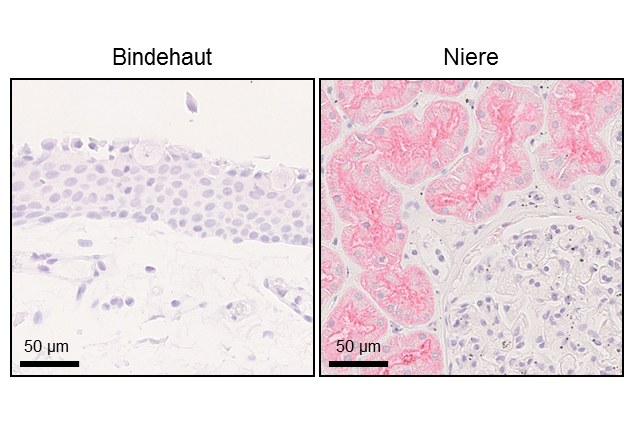
To this end, the researchers analyzed tissue samples from the conjunctiva of 46 patients who did not have COVID-19. The ophthalmologists used RNA sequencing to check whether precursor molecules (mRNA), which are used to produce the door-opening proteins, were present in the tissue samples. In addition, proteins present in the samples were visualized by immunohistochemical staining using labeled antibodies.
No relevant amounts of ACE-2 or TMPRSS2 were detected in any of the samples. This makes an infection of the conjunctiva by SARS-CoV-2 via binding to ACE-2 very unlikely. "However, it is possible for viruses to get into the tear film and enter the upper respiratory tract via the draining tear ducts and nasal mucosa, where they can trigger an infection," says Prof. Schlunck.
Although an infection of the conjunctiva with SARS-CoV-2 viruses is unlikely, comprehensive hygiene and protective measures are still appropriate. "Physicians who are in close contact with COVID-19 patients should still take care to effectively protect their mouth, nose and, if necessary, their eyes," says Prof. Lange.
Image: Immunohistochemical images show proteins present in tissue samples using antibodies. The conjunctival cell sample (left) shows no relevant amounts of ACE-2 protein, while antibodies bind to the ACE-2 protein present in the kidney tissue sample (right).
Image source: Medical Center - University of Freiburg
Original title of the study: Expression of the COVID-19 receptor ACE2 in the human conjunctiva
DOI: https://doi.org/10.1002/jmv.25981
Link to the study: https://onlinelibrary.wiley.com/doi/abs/10.1002/jmv.25981
Contact:
Prof. Dr. Clemens Lange
Senior Physician
Eye Center
Medical Center - University of Freiburg
Phone: 0761 270-40511
clemens.lange@uniklinik-freiburg.de
Prof. Dr. Günther Schlunck
Specialist
Eye Center
Medical Center - University of Freiburg
Phone: 0761 270-40966
guenther.schlunck@uniklinik-freiburg.de
Back
Medical Center - University of Freiburg
Central Information
Phone: 0761 270-0
info@uniklinik-freiburg.de
For press inquiries:
Corporate Communications
Breisacher Straße 153
79110 Freiburg
Phone: 0761 270-84830
kommunikation@uniklinik-freiburg.de