
Virtual fitness trainer for senior citizens to reduce the risk of falls
Study investigates the effectiveness of balance exercises for senior citizens using smart glasses / Approach enables training at home with professional control over distance / Test subjects wanted
Falls are common among older people and can have serious consequences, including the need for care. Physical activity as well as strength and balance training reduce the risk of falling, especially if they are well supervised. Researchers at the Medical Center - University of Freiburg are now investigating in an EU project whether older people could benefit from a virtual fitness trainer. Using semi-transparent data glasses, participants are shown games and exercises in their field of vision and receive instructions and tips on how to perform them better via a loudspeaker. In addition, the scientists can regularly check the progress of the exercises from a distance. Test subjects are currently being sought for the study.
"With the Holobalance study, we are investigating whether people at risk of falling benefit from training with data glasses and body sensors," says study leader Prof. Dr. Christoph Maurer, Senior Physician at the Department of Neurology and Neuroscience and Scientific Director of the Center for Geriatrics and Gerontology at the Medical Center - University of Freiburg. "Our expectation is that training will become more varied, more precise and therefore more efficient. But whether this is true remains to be seen." In addition to the Medical Center - University of Freiburg, University College London, King's College London and the University of Ioannina, Greece, are also involved in the "Holobalance" project, which is funded by the European Union.
Augmented reality enables training at a distance
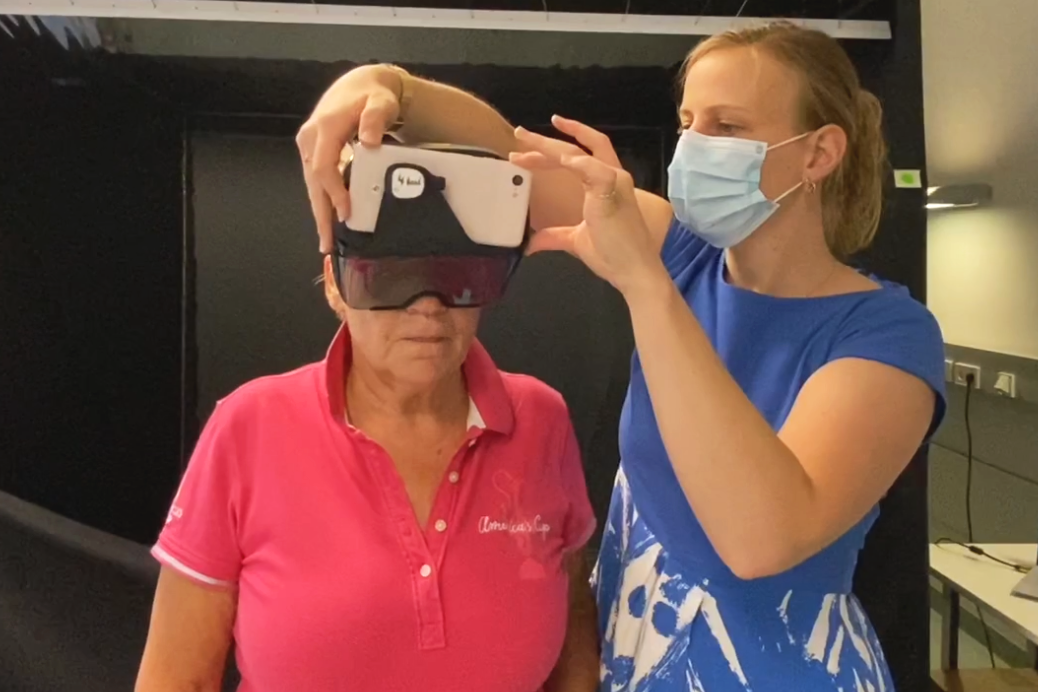
The data goggles consist of a holder for a smartphone and a semi-transparent screen through which the smartphone monitor is superimposed onto the field of vision. This makes it possible to merge real space and virtual reality. This is known as augmented reality (AR). In addition, users are equipped with small sensors during training that measure the execution in real time.
In the exercises, the test subjects have to follow a bird, for example, or walk along a path that is superimposed on their field of vision. This trains the coordination of complex head and body movements. If an exercise is performed incorrectly, the Holobalance app recognizes this and provides information on how to correct it. The training data is regularly sent from the user's home to the university hospital via a secure connection. "This gives us the opportunity to provide regular, qualified feedback on training. This sporting support for older people over distance is of course particularly valuable in times of corona," says Isabelle Walz, sports scientist and project coordinator at the Department of Neurology and Neuroscience at the Medical Center - University of Freiburg.
Test subjects between the ages of 65 and 80 are currently being sought in the Freiburg area. In order to test the effect of the AR-based training, test subjects in a second group will receive an already established balance training program. The assignment is done by lot.
Video caption: Researchers at the Medical Center - University of Freiburg are investigating whether older people could benefit from a virtual fitness trainer.
Image source: Medical Center - University of Freiburg
Contact for press inquiries and prospective students:
Isabelle Walz
Sports Scientist M.Sc.
Department of Neurology and Neuroscience
Medical Center - University of Freiburg
Phone: 0761 270-54794
isabelle.walz@uniklinik-freiburg.de
Back
Medical Center - University of Freiburg
Central Information
Phone: 0761 270-0
info@uniklinik-freiburg.de
For press inquiries:
Corporate Communications
Breisacher Straße 153
79110 Freiburg
Phone: 0761 270-84830
kommunikation@uniklinik-freiburg.de