
Deep brain stimulation prevents epileptic seizures in a mouse model
Experimental approach shows new ways to treat people with drug-resistant epilepsy
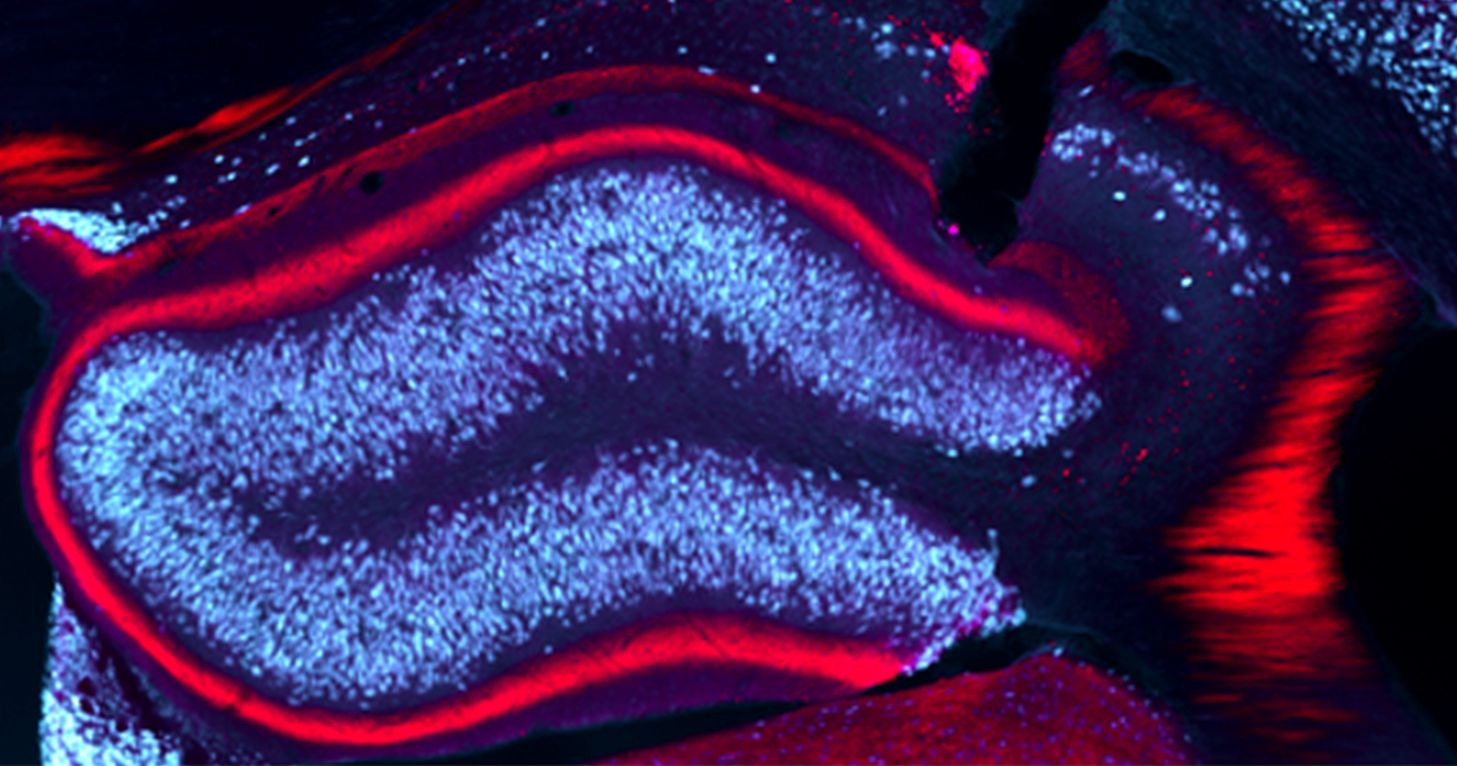
Epileptic activity originating from one or more diseased brain regions in the temporal lobe area is difficult to contain. Many patients with temporal lobe epilepsy often do not respond to treatment with anti-epileptic medication and the affected areas of the brain must therefore be surgically removed. Unfortunately, this procedure only provides freedom from seizures for around a third of patients, so the development of alternative therapeutic approaches is of great importance. Scientists led by neurobiologist Prof. Dr. Carola Haas, research group leaderat theDepartment of Neurosurgery at the Medical Center - University of Freiburg and the BrainLinks-BrainTools research center, have investigated a new therapeutic approach for the prevention of epileptic seizures in temporal lobe epilepsy. They showed in mice that low-frequency stimulation of certain areas of the brain can completely stop epileptic activity. Instead of using electricity, the researchers stimulated the cells with light. To do this, they had previously introduced a light-sensitive molecule into the cells that allows particularly precise stimulation. They published the results in the journal elife in December 2020.
"As soon as we stimulated the brain region with a frequency of one Hertz, the epileptic seizures disappeared. This effect was stable over several weeks," says Haas. There was no habituation, as can occur with drug therapy. The brain region was stimulated for one hour a day.
Circuits and cells identified
In temporal lobe epilepsy, the hippocampus is often pathologically altered and usually represents the so-called focus of epileptic activity. In previous studies, the fiber system and its synaptic contacts between the temporal lobe and hippocampus, which are typically preserved in temporal lobe epilepsy, could already be depicted based on precise genetic labeling techniques. The researchers used this fiber system to manipulate the activity of the hippocampus in a specific and temporally precise manner using light-dependent proteins. The measurement of brain waves showed that rhythmic activation of the diseased hippocampus at a low frequency of one Hertz suppresses epileptic activity and prevents it from spreading.
Haas and her colleagues demonstrated that the anti-epileptic effect is largely due to the repeated activation of the surviving granule cells in the seizure focus. Single-cell studies confirmed the assumption that the granule cells are less excitable due to the stimulation and that the epileptic seizure spreads less easily as a result. "It is also possible that we have a far-reaching network effect, as the stimulation can spread via the hippocampal circuits," says Haas. In the future, the team, together with the Medical Center - University of Freiburg's Medical Physics Department, would like to observe the entire brain during stimulation using magnetic resonance imaging. This technique could be used to identify other regions of the brain that are affected by the stimulation. The corresponding findings could provide information on how these are connected and what further consequences stimulation has.
Original title of the study: Hippocampal low-frequency stimulation prevents seizure generation in a mouse model of mesial temporal lobe epilepsy.
DOI: 10.7554/eLife.54518
Link to the study:https://elifesciences.org/articles/54518
Caption: Slow stimulation of the hippocampus resulted in no epileptic seizures in the mouse model.
Image source: Medical Center - University of Freiburg / AG Haas
Contact:
Prof. Dr. Carola Haas
Research Group Leader
Section for Experimental Epilepsy Research
Department of Neurosurgery
Medical Center - University of Freiburg
Phone: 0761 270-52950
carola.haas@uniklinik-freiburg.de
Back
Medical Center - University of Freiburg
Central Information
Phone: 0761 270-0
info@uniklinik-freiburg.de
For press inquiries:
Corporate Communications
Breisacher Straße 153
79110 Freiburg
Phone: 0761 270-84830
kommunikation@uniklinik-freiburg.de