
An egocentric spatial map in the human brain
Neuroscientists at the Medical Center - University of Freiburg discover a new cell type in the brain and find clues as to how it is involved in navigation and memory
How do we navigate in an environment and remember places later? Neuroscientists at the Faculty of Medicine - University of Freiburg and Columbia University, USA, have shown in a new study that nerve cells encode directions and distances relative to the navigating organism. They describe a previously unknown cell type in the human brain that presumably plays a key role in navigation and memory. The findings may help with research into neurodegenerative diseases such as Alzheimer's, whose common symptoms include both memory and orientation disorders. The study was published in the journal Neuron on July 14, 2021.
"The findings provide insights into the neuronal mechanisms of diseases that impair memory," says co-study leader Prof. Dr. Andreas Schulze-Bonhage, Head of the Department of Pre-Surgical Epilepsy Diagnostics - Epilepsy Center at the Department of Neurosurgery at the Medical Center - University of Freiburg.
Recording of egocentric directional cells
In order to investigate the cellular mechanisms, the neuroscientists recorded the activity of more than a thousand neurons in the human brain. This procedure was made possible by the inclusion of patients from the Epilepsy Center at the Medical Center - University of Freiburg who had electrodes implanted for diagnostic purposes. The test subjects solved tasks on the computer that tested their ability to navigate through virtual environments and remember spatial information.
The researchers were able to show that so-called egocentric directional cells were activated. These were found particularly frequently in the parahippocampal cortex. Previous studies had shown that patients with damage in this brain region have problems with spatial orientation - the egocentric directional cells may have been affected.
Nerve cells are activated during spatial navigation
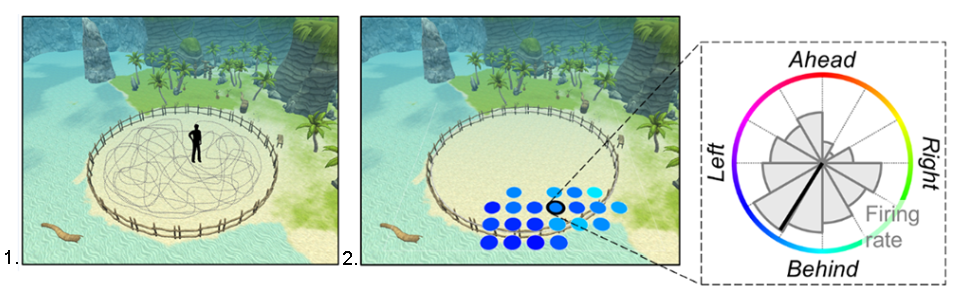
The results of the investigations showed that the activation of the egocentric directional cells depends on whether certain aspects of the virtual environments were positioned in front of, behind, to the right or to the left of the patients. Egocentric direction cells therefore encode spatial information in a coordinate system that is centered on the person navigating. "This is probably important in everyday life when people orient themselves in their surroundings and navigate on planned routes," says Schulze-Bonhage.
Nerve cells reactivate during memory recall
The researchers also investigated the activity of the egocentric memory cells while the patients were trying to remember the locations of objects in the virtual environment. "The neurons were reactivated during successful memory recall. This suggests that they are part of the neuronal basis for human memory," explains Dr. Lukas Kunz, first author of the study and postdoctoral researcher in the Department of Pre-Surgical Epilepsy Diagnostics - Epilepsy Center at the Medical Center - University of Freiburg and the Department of Biomedical Engineering at Columbia University, USA.
Caption: (1) The study participants navigated through a virtual environment while the activity of individual nerve cells was measured. (2) This showed that the cells were active differently when certain locations were in front of, next to or behind the test subjects.
Image source: Medical Center - University of Freiburg
Original title of the study: A neural code for egocentric spatial maps in the human medial temporal lobe.
DOI: 10.1016/j.neuron.2021.06.019
Link to the study: https://www.sciencedirect.com/science/article/abs/pii/S0896627321004608
Contact:
Prof. Dr. Andreas Schulze-Bonhage
Head
Pre-surgical Epilepsy Diagnostics - Epilepsy Center
Department of Neurosurgery
Uniklinik Freiburg
Phone: 0761 270-45250
andreas.schulze-bonhage@uniklinik-freiburg.de
Dr. Lukas Kunz
Department of Biomedical Engineering
Columbia University in The City of New York
USA
drlukaskunz@gmail.com
Back
Medical Center - University of Freiburg
Central Information
Phone: 0761 270-0
info@uniklinik-freiburg.de
For press inquiries:
Corporate Communications
Breisacher Straße 153
79110 Freiburg
Phone: 0761 270-84830
kommunikation@uniklinik-freiburg.de