
Reliably detect pathologically altered protein patterns
Protein patterns can provide information about many diseases / Researchers at the Medical Center - University of Freiburg now describe how these patterns can be reliably recorded in patient samples / Important for future diagnostics and therapy
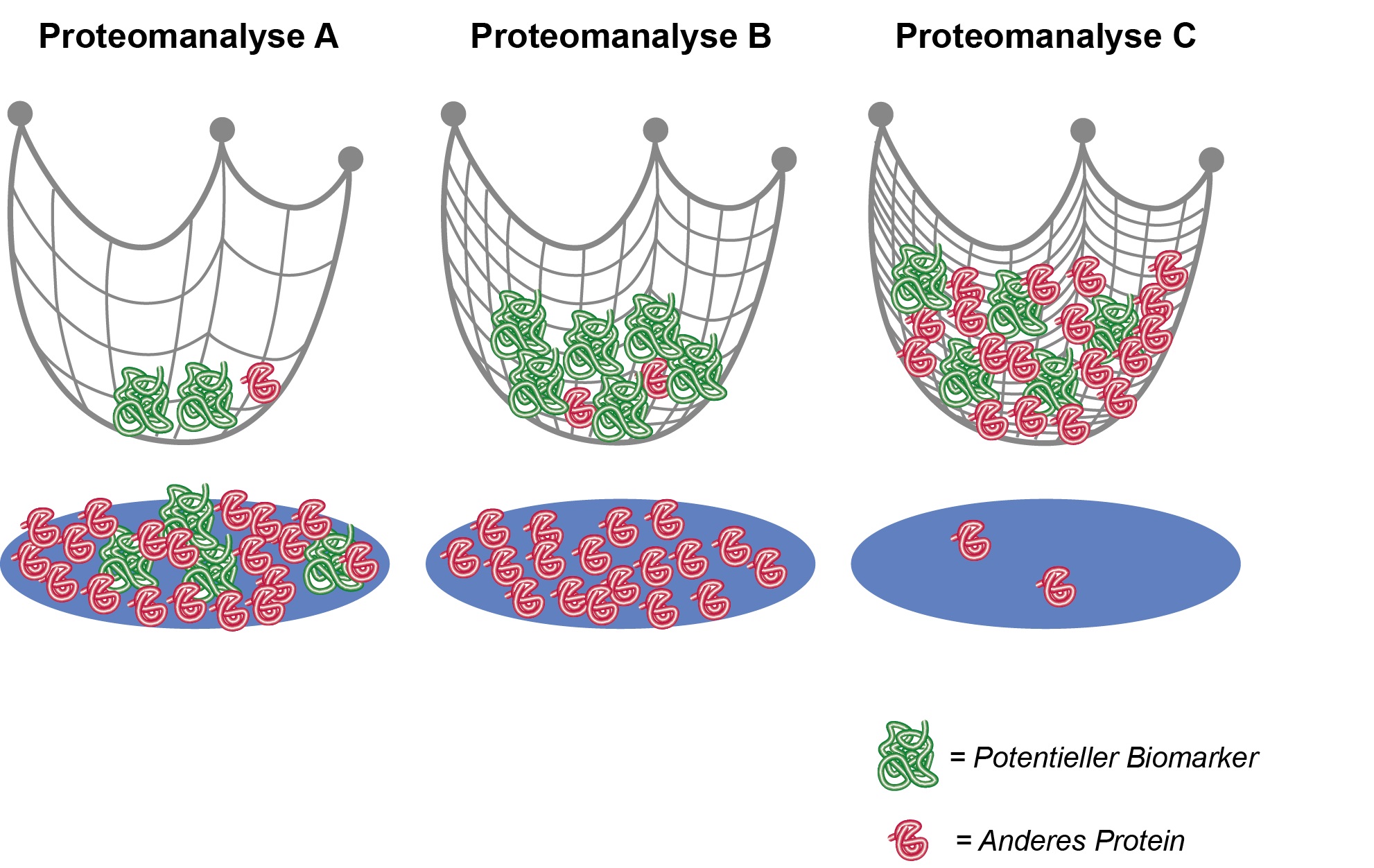
In diseases such as cancer, the diseased cells often exhibit significant differences in the type and quantity of proteins present. However, while genomic changes are increasingly being taken into account in diagnostics, this has only been possible to a limited extent in protein analysis due to its enormous complexity. However, rapid technical progress is opening up new opportunities, but only in combination with new, suitable analysis methods. However, the reliability and user-friendliness of the various methods can vary greatly, especially when examining real patient samples. Researchers at the Medical Center - University of Freiburg have now shown which combination of methods is particularly suitable for detecting the altered protein patterns in diseases. For the analysis, they compared almost three million evaluations. They were also able to show that certain open source programs can be used very successfully for the analysis of complex data. The study was published on May 12, 2022 in the journal Nature Communications.
"Our study shows very clearly that protein analysis can be a suitable tool to further refine diagnostics, for example for cancer, in the future. But this form of diagnostics could also become relevant for many other diseases such as cardiovascular diseases in the future," says co-study leader Prof. Dr. Oliver Schilling, Heisenberg Professor for Translational Proteomics at the Center for Pathology at the Medical Center - University of Freiburg.
Basis for new diagnostic approaches
The researchers examined lymph node tissue from 92 cancer patients. Using mass spectrometry, they determined the type and quantity of more than 7,000 proteins. They analyzed the measurement results together with scientists from the Institute of Biometry and Statistics at the Medical Center - University of Freiburg, comparing 1,400 available analysis programs in around 2,100 different data sets. In the study, they now show which of the approximately 1,400 combinations are suitable for analyzing human samples and which are not. "We have thus created an important basis for the development of new diagnostic procedures," adds co-study leader Dr. Clemens Kreutz, a scientist at the Institute of Medical Biometry and Statistics (IMBI) at the Medical Center - University of Freiburg. In international research networks, they are continuing to investigate the question of whether the course of the disease or a response to therapy can be predicted on the basis of correspondingly altered protein patterns.
Caption: With the right analysis methods, disease-relevant proteins, so-called biomarkers, can be found with very high precision.
Image source: Medical Center - University of Freiburg
Original title of the study: Benchmarking of analysis strategies for data-independent acquisition proteomics using a large-scale dataset comprising inter-patient heterogeneity
DOI: 10.1038/s41467-022-30094-0
Link to the study:www.nature.com/articles/s41467-022-30094-0
Contact:
Prof. Dr. Oliver Schilling
Heisenberg Professorship for Translational Proteomics
Center for Pathology
Medical Center - University of Freiburg
Phone: 0761 270-80610
oliver.schilling@uniklinik-freiburg.de
Dr. Clemens Kreutz
Head of Division
Institute of Medical Biometry and Statistics (IMBI)
Medical Center - University of Freiburg
Phone: 0761 203 54281
ckreutz@imbi.uni-freiburg.de
Back
Medical Center - University of Freiburg
Central Information
Phone: 0761 270-0
info@uniklinik-freiburg.de
For press inquiries:
Corporate Communications
Breisacher Straße 153
79110 Freiburg
Phone: 0761 270-84830
kommunikation@uniklinik-freiburg.de