Stroke therapy: time window for new catheter technology often larger than expected
Extent of brain damage often remains constant in the first few hours / Minimally invasive procedure can therefore be performed successfully even hours laterA stroke is usually triggered by a blood clot that blocks a cerebral artery. Until now, physicians have assumed that the longer this blockage persists, the more severe the brain damage becomes. Researchers at the Medical Center - University of Freiburg have now shown in the February issue of the journal Clinical Neuroradiology that this correlation does not necessarily exist. They analyzed data on blood flow and brain activity in patients who had suffered a severe stroke between one and six hours earlier. It was found that the degree of brain damage was not determined by whether the stroke had occurred only one or several hours previously. The decisive factor was apparently how well the affected areas of the brain were supplied with blood via smaller arteries. This also explains why mechanical removal of the blood clot can achieve good treatment results for up to six hours, and in some cases even significantly longer.
The previous formula 'time is brain' or 'the faster, the better' still applies in the acute phase, but is not the only decisive factor in minimally invasive treatment: "In the majority of patients, the condition can remain constant for up to twelve hours. During this time, it is also possible, if necessary, to transfer the patient to an appropriately equipped center in order to treat the stroke in a minimally invasive manner," says Prof. Dr. Horst Urbach, Medical Director of the Department of Neuroradiology at the Medical Center - University of Freiburg.
In the procedure known as thrombectomy, a catheter is inserted into the inguinal artery and advanced to the arterial occlusion in the brain. A small tube known as a stent is inserted into the catheter, which unfolds when the catheter is withdrawn and clamps the blood clot. The catheter, stent and blood clot are then pulled out. "The success of a thrombectomy depends less on the time elapsed and more on how the blood circulation in the brain looks," says Prof. Urbach. Using state-of-the-art imaging techniques, experienced physicians can determine how high the chances are for a successful procedure.
For their study, the researchers analyzed data from 155 patients in whom a carotid or cerebral artery was blocked and the brain was only supplied with some blood through small collateral arteries, so-called collaterals. "In these patients with occlusions of the large cerebral arteries, we have been able to double the chances of recovery from 30 percent to 60 percent compared to drug therapy in recent years thanks to thrombectomy," says Prof. Urbach.
The Medical Center - University of Freiburg is the only hospital in southern Baden that specializes in thrombectomies. It is one of the few pilot centers to be certified by the German Stroke Society. If required, partner clinics are supported telemedically by the Department of Neurology and Neuroscience and the Department of Neuroradiology at the Medical Center - University of Freiburg.
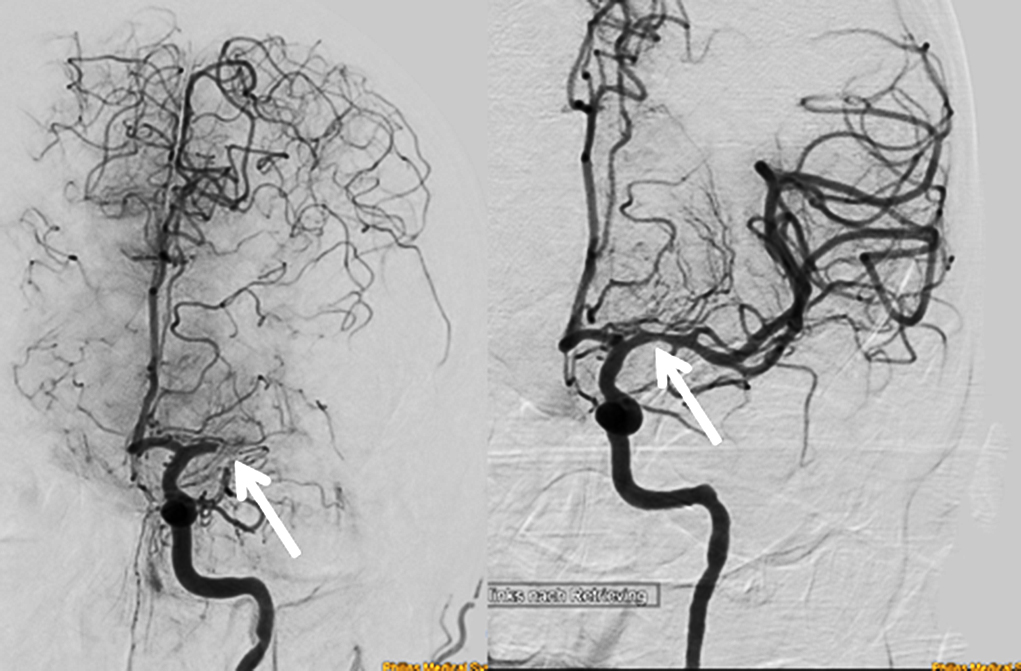
Caption: Left page: A blood clot (arrow) cuts off a large area of the brain from the oxygen supply. Right side: Reopened vessel after removal of the clot (arrow) with a vascular support.
Image source: Medical Center - University of Freiburg
Title of the original paper: Facing the time window in acute ischemic stroke: the infarct core
DOI: 10.1007/s00062-016-0501-8
Link to the publication: http://www.ncbi.nlm.nih.gov/pubmed/26846971