Fine-tuning your hearing
The Implant Centrum Freiburg (ICF) at the Department of Oto-Rhino-Laryngology at the Medical Center - University of Freiburg has a new wave field synthesis system for researching spatial hearing with cochlear implantsA road junction is a complex acoustic environment. The many ambient noises make it difficult to locate an approaching vehicle by hearing. Nevertheless, people with normal hearing can usually cope well with situations like this. However, children with severe hearing loss or adults who have regained their sense of hearing thanks to a cochlear implant (CI) have significantly reduced spatial hearing, especially in the presence of background noise. The Department of Oto-Rhino-Laryngology at the Medical Center - University of Freiburg's Implant Center Freiburg (ICF) will soon be using a new wave field synthesis system to investigate how the settings of CIs can be optimized in the presence of background noise. By fine-tuning the CIs, small and large CI wearers should achieve better spatial hearing in many everyday situations, such as in road traffic. The wave field synthesis system could be installed at the ICF thanks to significant support from the association "Taube Kinder lernen hören e.V." (TKLH e.V.).
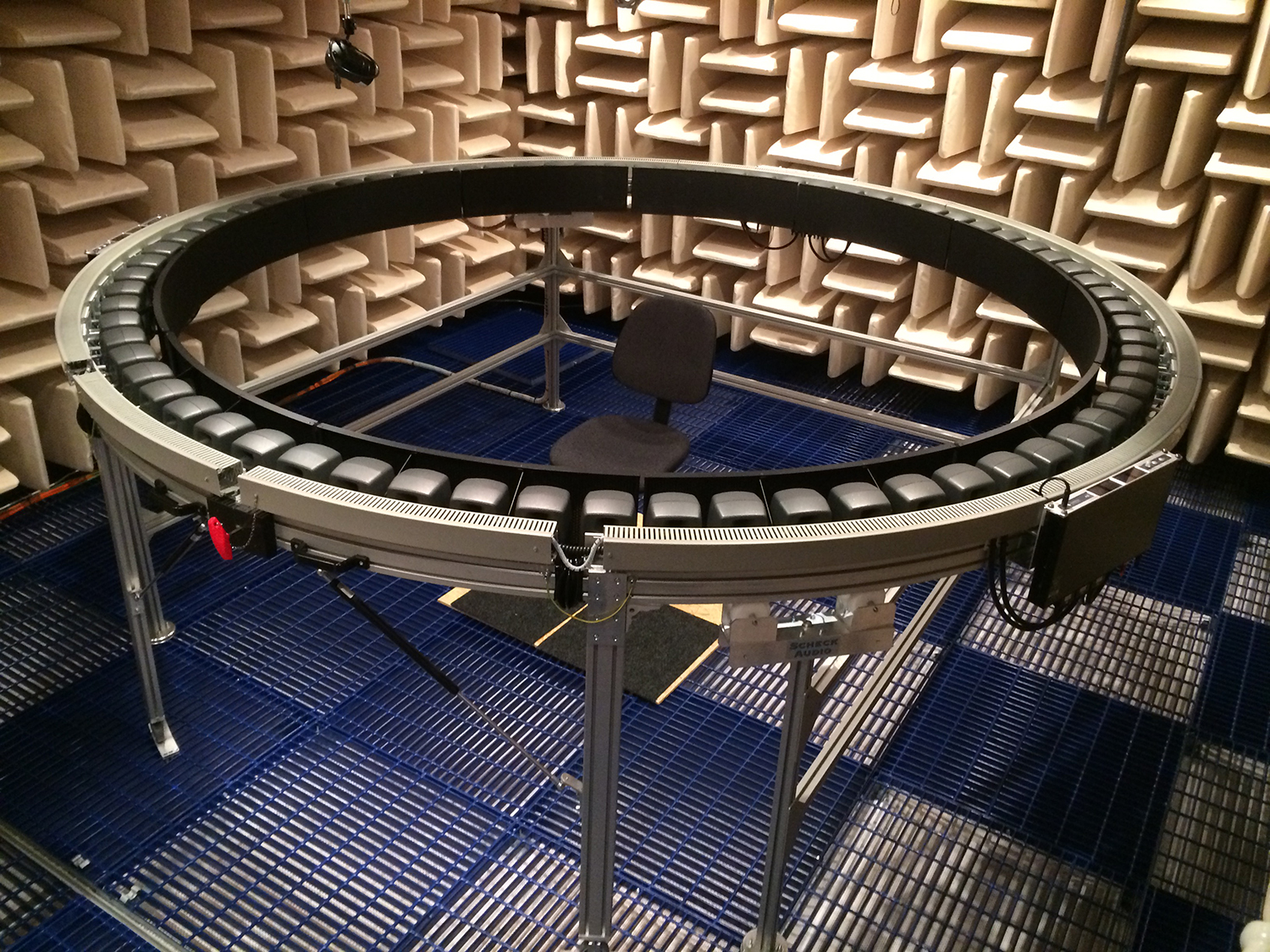
Wave field synthesis (WFS) is a spatial audio reproduction method with the aim of creating virtual acoustic environments. It is also known as sound field synthesis or holophony. The synthesis generates wavefronts that emanate from a virtual point. Its acoustic localization is not dependent on the listener's position or, as with conventional multi-channel methods, on psychoacoustic effects such as the formation of phantom sound sources. "The wave field synthesis system can be used in tests to generate a realistic perspective of the acoustic event that is independent of the listener's position," explains Prof. Dr. Roland Laszig, Medical Director of the Department of Oto-Rhino-Laryngology at the Medical Center - University of Freiburg. "This is important in order to better understand the spatial hearing of cochlear implant users."
Planning for the new wave field synthesis system at the ICF began back in November 2015 after the "Taube Kinder lernen hören e.V." (Deaf Children Learn to Hear) funding association pledged funding of around 250,000 euros. The system was installed in late summer 2016. The system is being prepared for operation from October 2016 until March 2017. As soon as the wave field synthesis system is ready for operation, extensive studies will begin at the Implant Centrum Freiburg. The researchers will focus on the benefits of microphones with directional characteristics for sound localization as well as studies on speech comprehension in noisy hearing situations. Patients with one or two cochlear implants will be selected from the almost 4,000 CI users treated in Freiburg. These studies are expected to continue into 2019 and will form the basis for further research applications.
What is the cochlear implant
The CI is an inner ear implant that enables children born deaf to learn to hear and use spoken language. Children and adults with profound hearing loss can also regain their sense of hearing thanks to the implant. The implant is inserted under the patient's scalp and extends into their inner ear. It converts spoken words and other acoustic signals into electrical impulses. These impulses stimulate the auditory nerve, which is located in the cochlea. Every CI system also includes the sound processor, which is worn behind the ear like a hearing aid, and the transmitter coil. The CI gives children born deaf and severely hearing-impaired children and adults access to the world of hearing and spoken words.
Further information at: www.uniklinik-freiburg.de/icf and www.taube-kinder-lernen-hoeren.de
Caption: The wave field synthesis system at the Medical Center - University of Freiburg is almost ready for operation: The ring of loudspeakers enables location-independent simulation of complex acoustic situations used in hearing studies for cochlear implant wearers.
Image rights: © Medical Center - University of Freiburg
Contact:
Prof. Dr. Dr. h.c. mult. Roland Laszig
Medical Director Department of Oto-Rhino-Laryngology
Medical Center - University of Freiburg
Phone: 0761 270-42060
roland.laszig@uniklinik-freiburg.de