Ultra-fast brain imaging to become even more precise
1.5 million euros for the further development of magnetic resonance imagingImaging techniques for the brain are either fast or detailed. Prof. Dr. Jürgen Hennig, Scientific Director of the Department of Medical Physics at the Medical Center - University of Freiburg, is researching how these factors can be combined in functional magnetic resonance imaging (fMRI). He is now receiving 1.5 million euros in funding from the German Research Foundation (DFG) as part of a Reinhard Koselleck project. A few years ago, researchers led by Prof. Hennig developed a method with which fMRI measurements for examining the brain are possible 25 times faster than before. The researchers now want to improve the spatial resolution of the method in order to be able to observe changes in anatomy and activity "live", for example shortly after a stroke. The DFG uses Koselleck projects to fund particularly innovative projects by outstanding scientists.
An MRI helmet enables fast measurements
Until now, a so-called gradual magnetic field has been required to visualize anatomical structures in MRI. This gradient has to be rebuilt after each measurement, which takes between a few seconds and several minutes, depending on the desired resolution. Fast processes are therefore difficult to visualize. A few years ago, Prof. Hennig's team developed an approach in which the gradual magnetic field is dispensed with and the MRI signals can be measured directly. The core of the method is a helmet with up to 95 small receiver coils. The signal from each coil can be assigned to the area of the brain directly under the coil. "This has enabled us to measure the entire brain with a resolution of three millimeters in a tenth of a second. We were surprised by this success ourselves," says Prof. Hennig.
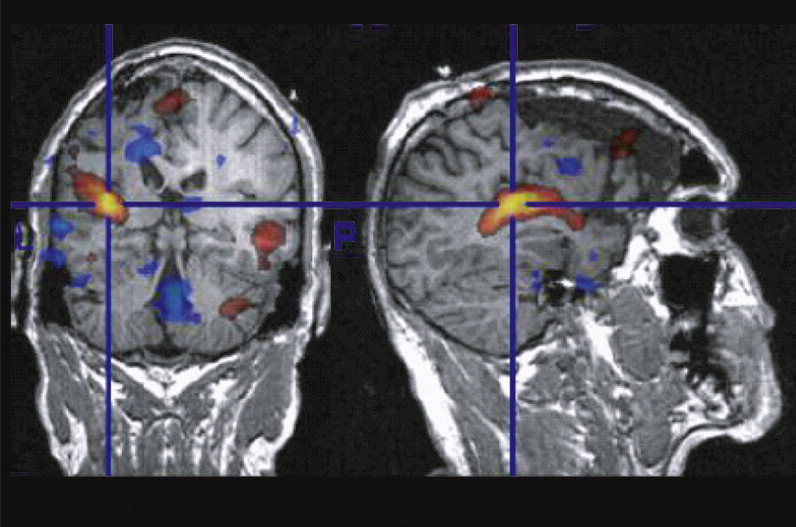
In the project that is now underway, the researchers want to visualize the structures of the brain to an accuracy of two millimetres. "That doesn't sound like much, but it opens up completely new areas of application, such as the detailed observation of the brain after a stroke," says Prof. Hennig. The researchers also want to clarify whether the method is fast and precise enough to control prostheses in real time. The method is already being used in epilepsy patients to localize the foci of seizures. Until now, patients have had to undergo neurosurgery to implant electrodes on the surface of the brain. "Our measurement method could help to spare patients this very complex procedure in the future," says Prof. Hennig.
In addition to Prof. Hennig, Prof. Dr. Julia Jacobs, Department of Neurosurgery, and Dr. Pierre Le Van, Department of Medical Physics at the Medical Center - University of Freiburg, were also significantly involved in the development. The researchers have already received a number of exceptional grants and awards for their work, including the EU's most highly endowed project grant and a German High Tech Championship Award for the development of the fMRI helmet. Prof. Hennig is internationally regarded as one of the leading developers of magnetic resonance imaging for clinical use.
Caption: Dangerous excitation patterns (yellow) of an epileptic seizure can be localized very precisely using the new MREG method. In the future, this could replace the neurosurgical intervention that has been necessary up to now.
Image source: Medical Center - University of Freiburg