
State-of-the-art surgical method for liver tumors used for the first time in South Baden
"Liver in-situ splitting" method successfully performed on 44-year-old patient / Liver surgery at the Medical Center - University of Freiburg is being further developed
If the liver is affected by tumors, surgical removal is usually the only chance of recovery. However, in the past, liver metastases - caused by bowel cancer, for example - could only be removed tumor-free in around 20 percent of patients. The new Medical Director of the Department of General and Visceral Surgery, Prof. Dr. Stefan Fichtner-Feigl, has now established a surgical method at the Medical Center - University of Freiburg that significantly increases the chances of successfully removing the tumor completely. Using the so-called "liver in-situ splitting" method, which was performed for the first time in Freiburg in recent weeks, a 44-year-old patient was successfully operated on.
"With this state-of-the-art form of liver surgery, we were able to help the patient and disprove the assessment of many surgeons who had been consulted by the patient in advance and completely remove the tumor," says Prof. Dr. Fichtner-Feigl. It was the first time that this surgical method had been performed in South Baden.
The surgical procedure consists of two separate operations. In the first step, the healthy liver tissue is separated from the affected tissue. The blood supply to the affected part is partially interrupted in the first step, but it remains in the body and partially fulfills the function of the liver. Over the next seven to ten days, the healthy, but actually too small, part of the liver almost doubles in size. Only then is the piece of liver with the tumor removed in a second operation. The liver that has grown back from the healthy part takes over all its vital functions to a sufficient extent.
"At the Medical Center - University of Freiburg, we now also use three-dimensional computer-controlled surgical planning methods to precisely define the positional relationship of individual tumor nodes to important structures such as bile ducts, veins and arteries," adds Prof. Dr. Sven A. Lang, Senior Consultant at the Department of General and Visceral Surgery. "This three-dimensional planning can then also be combined with an ultrasound examination during the operation in order to perform liver surgery as gently and effectively as possible." This technique leads to even greater safety during operations.
In addition to the new surgical techniques and the further development of three-dimensional imaging, a new type of measuring device for determining liver function is now also being used in Freiburg. Determining liver function is a key aspect of surgical planning and execution. Until now, liver function during an operation was only estimated indirectly by the size of the liver. "The new measuring device now available to us enables us to precisely determine liver function and also liver regeneration after the operation," emphasizes Prof. Fichtner-Feigl.
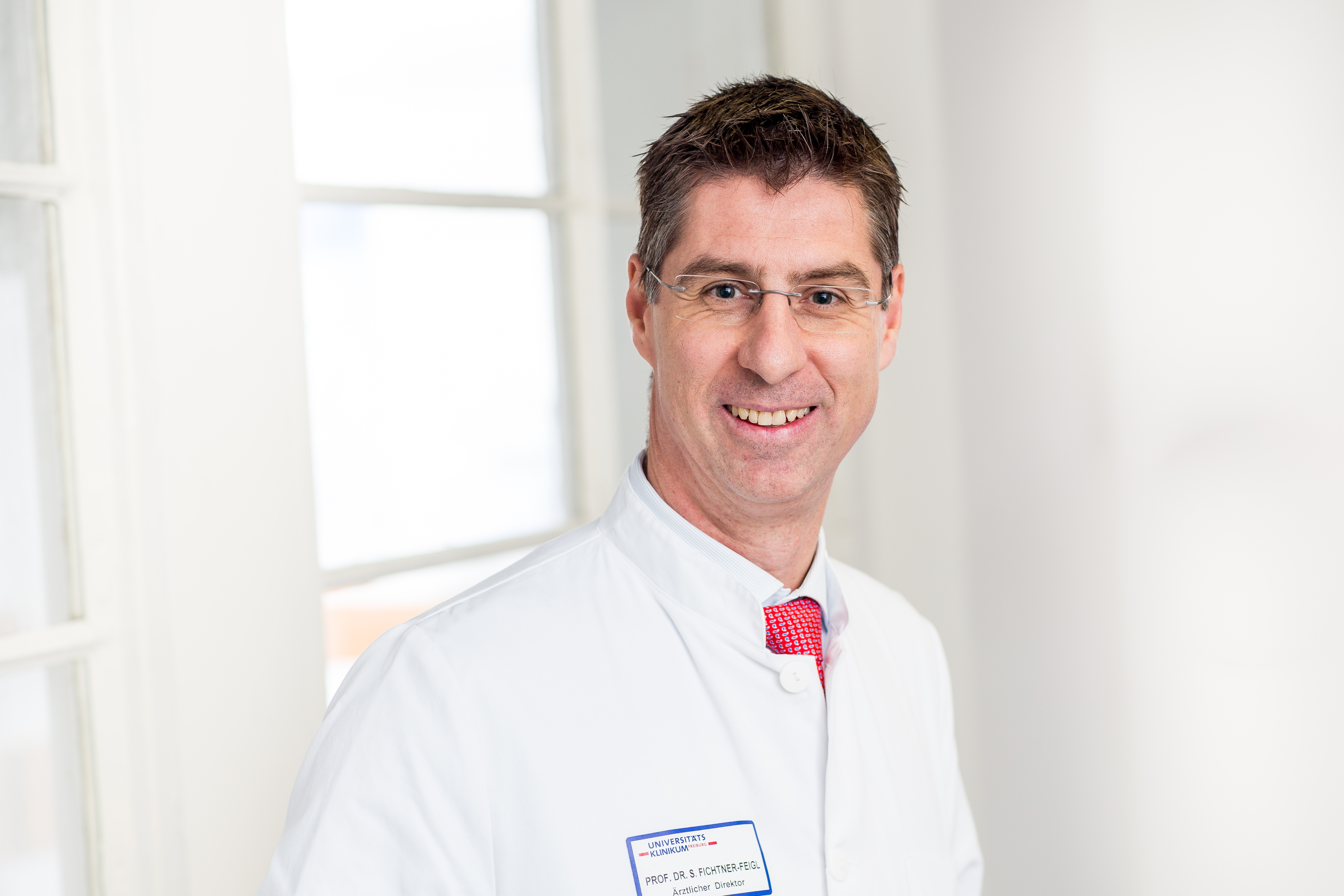
Photo: Portrait of Prof. Dr. Stefan Fichtner-Feigl
Image rights: Medical Center - University of Freiburg/Britt Schilling
Contact:
Prof. Dr. Stefan Fichtner-Feigl
Medical Director
Department of General and Visceral Surgery
Medical Center - University of Freiburg
Phone: 0761 270-28060
stefan.fichtner@uniklinik-freiburg.de
Back
Medical Center - University of Freiburg
Central Information
Phone: 0761 270-0
info@uniklinik-freiburg.de
For press inquiries:
Corporate Communications
Breisacher Straße 153
79110 Freiburg
Phone: 0761 270-84830
kommunikation@uniklinik-freiburg.de