
Physicists simplify the production of highly sensitive contrast agents for cancer diagnostics
Joint press release by the Medical Center - University of Freiburg and the German Consortium for Translational Cancer Research, DKTK
Important step towards imaging metabolic diagnostics in real time / New method could replace procedure costing several million euros / Publication in Nature Communications
Making the smallest tumor foci and other pathological metabolic processes visible with the help of magnetic resonance imaging (MRI): physicists from the German Consortium for Translational Cancer Research (DKTK) at the Medical Center - University of Freiburg have come a big step closer to this goal. The scientists used highly sensitive hyperpolarization MRI, which is many times more sensitive than conventional MRI due to the use of magnetic contrast agents. The Freiburg researchers have succeeded in extremely simplifying the previously very complex and expensive production of such contrast agents. In future, this could also be used to produce contrast agents that can be used to observe pathological metabolic processes in cancer in real time. The scientists published the process for producing the contrast agents in the journal "Nature Communications" on March 6, 2017.
"With the method we call SAMBADENA, we can produce contrast agents for hyperpolarization MRI much more cheaply, easily and quickly than before," says project leader PD Dr. Jan-Bernd Hövener, Emmy Noether research group leader at the Department of Radiology - Medical Center - University of Freiburg. Together with his doctoral students Andreas Schmidt and Stephan Berner, a decisive step has now been taken in the production of hyperpolarized contrast agents. "For the first time, it is possible to produce the injection solution with the contrast agent within a few seconds directly at the point of use, in the MRI machine itself," says first author Schmidt.
In hyperpolarization MRI, a magnetically marked contrast agent is injected into the body and emits signals that are much stronger than would be possible with a conventional MRI. This can significantly increase the sensitivity of the MRI and provide additional information that is crucial for diagnosis and treatment. To date, liquid hyperpolarized contrast media have primarily been produced using dynamic nuclear polarization (DNP). However, for this method, which is already being used on humans, scientists require a complex device costing up to 2.5 million euros. The new method opens up the possibility of drastically reducing these costs. "We hope that hyperpolarization MRI can be developed more intensively and comprehensively as a result," says Dr Hövener, who conducts research in the Radiotherapy and Imaging programme of the German Cancer Consortium and is part of the EUROPOL-ITN research network funded by the European Union.
Tracking molecules live in the body
As the researchers can generate the contrast agent directly in the MRI device, it will probably also be possible in future to use molecules as contrast agents whose labeling would otherwise have disintegrated during transport to the MRI device. "We are now working intensively on applying SAMBADENA to biomolecules that occur naturally in the body. We could then observe their degradation or remodeling in real time," says Dr. Hövener. Initial unpublished results point in this direction. Since cancer cells often have an altered metabolism, increased or decreased degradation of the contrast agent could indicate tumor tissue. This would allow metastases to be found earlier and tumours to be characterized more precisely. It also seems possible to use the change in cancer metabolism to recognize at an early stage whether a therapy is working or not. "Another advantage is that there are no allergies to the body's own substances, which is sometimes the case with previous MRI contrast agents," says Dr. Hövener. A series of suitable contrast agents are now to be developed in further studies.
The researchers summarize their development in a short film. You can find the video on the Internet at: https: //www.youtube.com/watch?v=N2Ekdk09fl4
Original title of the study: Liquid-state carbon-13 hyperpolarization generated in an MRI system for fast imaging
DOI: 10.1038/NCOMMS14535
Link to the study:www.nature.com/articles/ncomms14535
Further information:
24.09.2014 Optimal polarizationhttps://www.uniklinik-freiburg.de/nc/presse/pressemitteilungen/detailansicht/presse/313
17.12.2013 Fast MRI without expensive magnetshttps://www.uniklinik-freiburg.de/nc/presse/pressemitteilungen/detailansicht/presse/17
Research group PD Dr. Jan-Bernd Hövenerwww.hyperpolarization.net
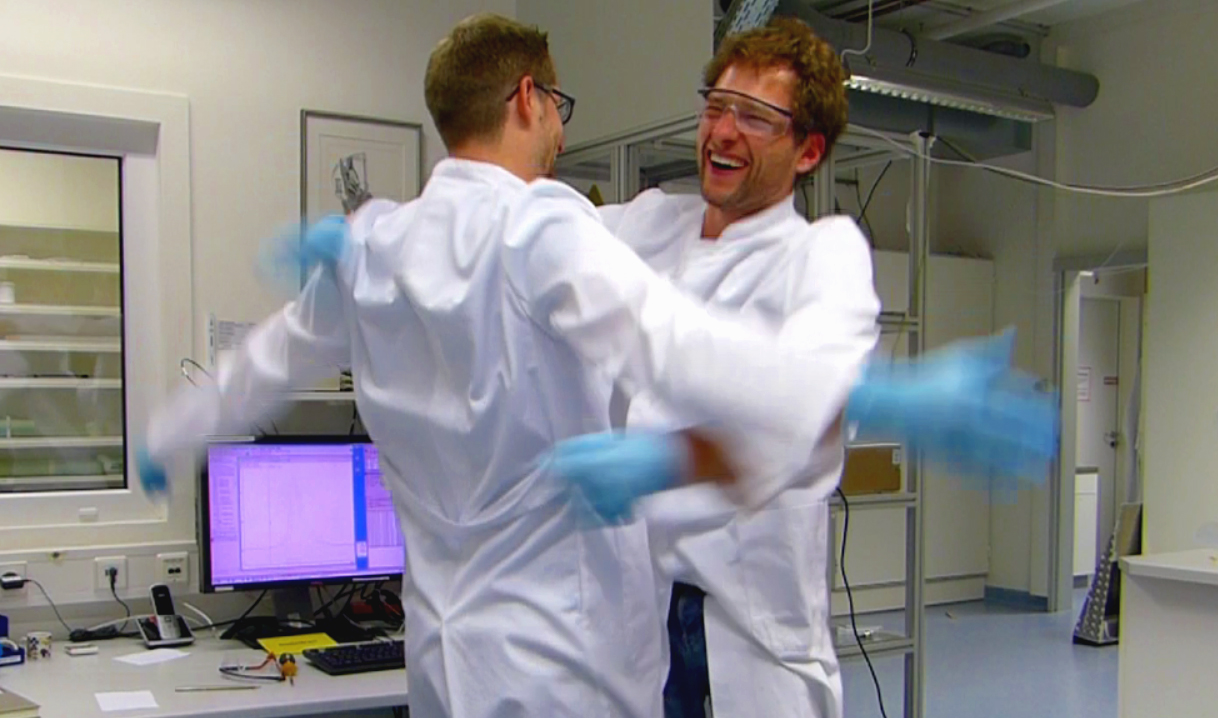
Caption: Research can be so beautiful: Andreas Schmidt (right) and Stephan Berner are delighted with the first confirmation that the SAMBADENA method works. The birth of the method was captured by chance during a film shoot.
Image rights: Medical Center - University of Freiburg
Contact:
PD Dr. Jan-Bernd Hövener
Research Group Leader
Department of Radiology - Medical Physics
Medical Center - University of Freiburg
Phone: 0761 270-93910
jan.hoevener@uniklinik-freiburg.de
Back
Medical Center - University of Freiburg
Central Information
Phone: 0761 270-0
info@uniklinik-freiburg.de
For press inquiries:
Corporate Communications
Breisacher Straße 153
79110 Freiburg
Phone: 0761 270-84830
kommunikation@uniklinik-freiburg.de