
Social control between immune cells helps to defend against infections
Immune cells activated by pathogens perceive each other and thus control their own proliferation / Findings could improve immunotherapies for cancer
After an infection, a simple mechanism ensures a balance between the rapid expansion of immune cells and an excessive self-damaging reaction. Scientists at the Medical Center - University of Freiburg and international colleagues have now deciphered this. The team has shown that activated T cells are able to perceive each other and regulate their activity - based on their density. The mechanism could help to improve cancer immunotherapies and was published on February 11 in the journal "Immunity".
A simple mechanism, previously known from bacteria, ensures that the immune system finds a balance between the rapid proliferation of immune cells and an excessive self-damaging reaction after an infection. This has now been deciphered by scientists at the Medical Center - University of Freiburg together with colleagues from the Netherlands and the UK. T cells are quickly activated by an infection, which leads to their proliferation. The research team has now shown that these cells can perceive each other and decide together on the basis of T cell density whether or not they will continue to multiply. The newly discovered mechanism could also contribute to improving cancer immunotherapies. The study was published on February 11, 2020 in the journal Immunity.
Cooperative immune cells
"We were able to show that these immune cells recognize each other and communicate with each other. The immune cells work as a team and not as lone wolves," says study leader Dr. Jan Rohr, a scientist at the Center for Immunodeficiency (CCI) at the Medical Center - University of Freiburg. "This principle of density control of immune cells is simple and very effective. This makes it reliable and at the same time hopefully accessible for therapeutic approaches," says Rohr. At low density, the T cells support each other in their proliferation. As soon as a threshold value of cell density is reached, the mutual support turns into mutual inhibition, which prevents further cell proliferation. This mechanism means that initially weak immune reactions are efficiently strengthened and, on the other hand, excessive and therefore potentially dangerous immune reactions are effectively slowed down.
Immunotherapies could become even more effective
This finding sheds new light on immunotherapy for cancer. Tumors protect themselves by suppressing the immune system. This is why, in certain immunotherapies, T cells are taken from patients, made fit against cancer in the laboratory, multiplied and then returned to the patient. Until now, high numbers of cells have usually been administered in order to make the therapy particularly effective. "It is possible that the immune cells switch each other off if they are administered once in high cell numbers, as has been the case up to now. Repeated administration of fewer immune cells could perhaps fight the tumor cells more effectively," says Rohr. The extent to which this could improve current therapeutic approaches must be examined in further studies.
From cells in the lab to computer models
For their investigations, the scientists studied the immune cells using microscopic time-lapse images and genetic analyses in the laboratory. Based on the findings, scientists from Leiden University in the Netherlands created a mathematical model of T cell interaction. This enabled them to confirm the quantitative relationship between the density of T cells and the growth-stimulating or growth-inhibiting signals that T cells send to each other. Finally, these models were tested in animal models. "The different research approaches complemented and supported each other very well," says the Freiburg study leader.
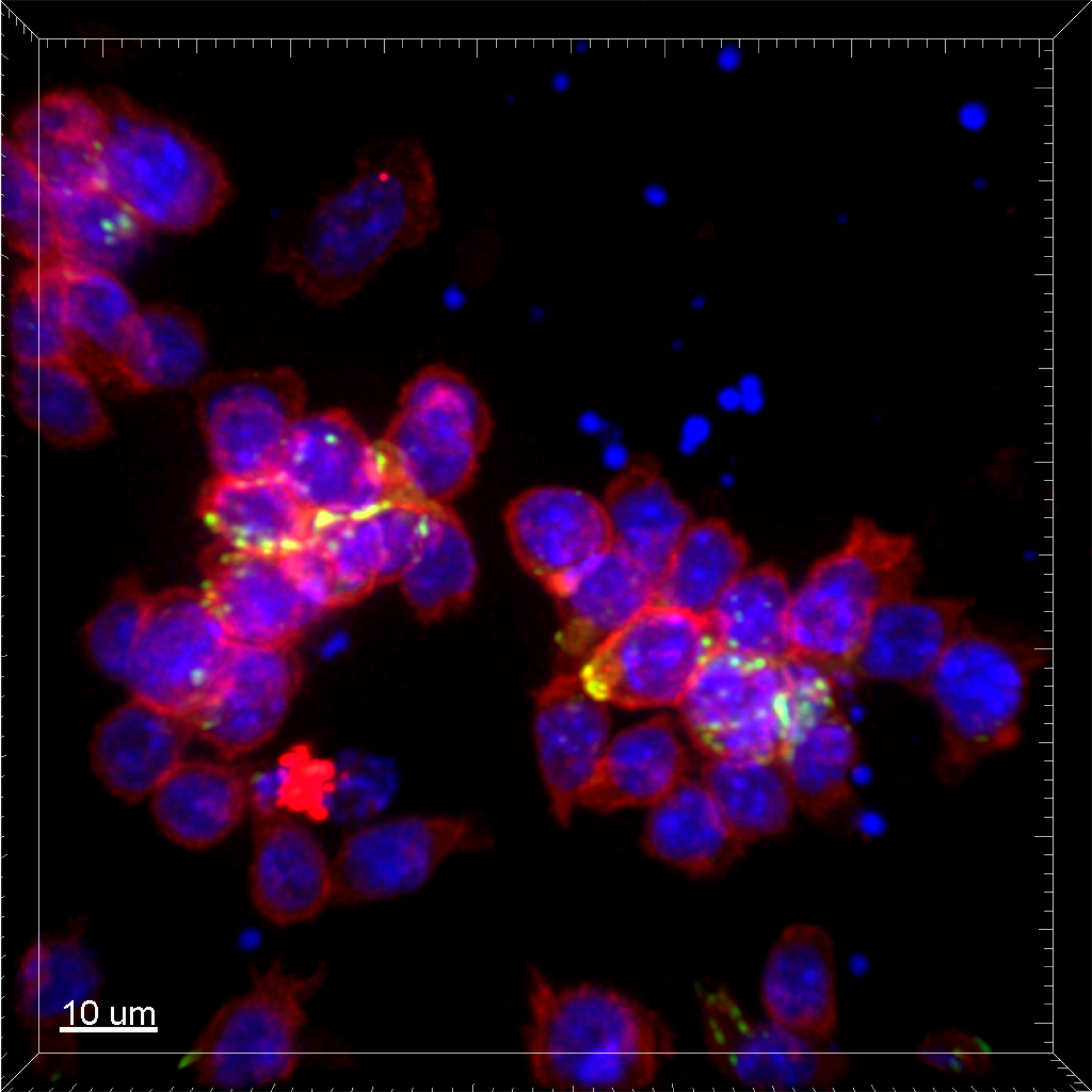
Caption: The image shows T cells interacting with each other, with the cell surface colored red, the cell nucleus blue and the receptors important for communication between the cells green.
Image source: Immunity
Original title of the study: Quorum-regulation mediated by nested antagonistic feedback circuits via CD28 and CTLA-4 confers robustness to CD8+ T cell population dynamics
DOI: 10.1016/j.immuni.2020
Link to the study: https://www.cell.com/immunity/fulltext/S1074-7613(20)30046-7
Contact:
Dr. Jan Rohr
Scientist
Center for Chronic Immunodeficiency (CCI)
& Center for Pediatrics
Medical Center - University of Freiburg
Phone: 0761 270-45293
jan.rohr@uniklinik-freiburg.de
Back
Medical Center - University of Freiburg
Central Information
Phone: 0761 270-0
info@uniklinik-freiburg.de
For press inquiries:
Corporate Communications
Breisacher Straße 153
79110 Freiburg
Phone: 0761 270-84830
kommunikation@uniklinik-freiburg.de