
Around 30 million euros for excellent research
New Collaborative Research Center 1425 investigates ways to "improve scar formation" in the heart under the leadership of the University of Freiburg - Bad Krozingen Heart Center / In addition, continuation of two Collaborative Research Centers on epigenet
The German Research Foundation (DFG) has approved a new proposal for a Collaborative Research Center (SFB 1425) under the leadership of the Institute for Experimental Cardiovascular Medicine (IEKM) at the University of Freiburg - Bad Krozingen Heart Center. The CRC "The heterocellular nature of cardiac lesions: Identities, Interactions, Implications" will be funded by the DFG for four years from July 1, 2020 with 11 million euros. The DFG also approved the extension of two research areas at the Medical Center - University of Freiburg. These are the CRC 992, which deals with the fundamentals and therapeutic possibilities of epigenetic mechanisms, and the CRC TRR 179, which investigates the course of viral infections. The Medical Center - University of Freiburg will receive a total of around 30 million euros in funding.
"My congratulations and thanks go to our scientists who have made this success possible with their research achievements and commitment," says Prof. Dr. Norbert Südkamp, Dean of the Faculty of Medicine - University of Freiburg.
Strong heart research
Traditional heart research is strongly focused on the muscle cells of the heart. These cardiomyocytes are the actual motors of the heart pump. Their activity determines clinical measurements such as blood pressure and electrocardiogram, or ECG for short. Around two thirds of the heart's volume is made up of cardiomyocytes. In terms of numbers, however, the significantly smaller non-myocytes - such as connective tissue and immune cells - make up the majority of cells in the heart. After tissue damage, such as a heart attack, non-myocytes are the key to repair and tissue remodeling. They support the structural integrity of the heart - but without pumping themselves. Their presence can also disrupt the normal electrical activity that precedes every heartbeat. "Knowledge about the cellular properties of non-myocytes, about their interactions with cardiomyocytes, and the use of this knowledge to control repair processes is still in its infancy," says CRC spokesperson Prof. Dr. Peter Kohl. "Make better scars!" is therefore the motto of the CRC 1425.
Influencing natural repair processes
In the long term, the concept should open up new possibilities for the diagnosis and treatment of heart disease. It is not primarily about avoiding scars or transforming them back into functioning muscle tissue, but rather about using a novel and complementary approach to influence the natural repair processes so that scars can perform their important repair function without causing harmful side effects.
The CRC 1425 brings together 26 scientists from the University Heart Center Freiburg - Bad Krozingen, the University Center - University of Freiburg, the Faculties of Medicine, Biology and Technology at the University of Freiburg, the Max Planck Institute of Immunobiology and Epigenetics in Freiburg, and the Universities of Heidelberg, Bonn and Frankfurt.
Continuation of two successful Collaborative Research Centers
SFB 992 "Medical Epigenetics - From Basic Mechanisms to Clinical Applications", continuation of the third and final funding: 14 million euros
Epigenetics is a field of research that deals with mechanisms of heredity that go beyond the genetic determination in DNA. These are dynamic changes in which changing external influences, such as nutrition, stress or medication, leave behind epigenetic changes that have the potential to be passed on. The analysis and interpretation of these epigenetic patterns can contribute to a better understanding of the development of diseases and point to new ways of diagnosis and treatment.
The spokesperson of the CRC 992 is Prof. Dr. Roland Schüle, Scientific Director of the Department of Urology and Head of Central Clinical Research at the Medical Center - University of Freiburg. Other scientists from various institutes and departments at the University of Freiburg and the Medical Center - University of Freiburg as well as the Max Planck Institute of Immunobiology and Epigenetics in Freiburg are also involved in the CRC.
Within the CRC 992, an Integrated Research Training Group will again be set up to provide doctoral students with specialized knowledge and methods of epigenetics. The research network is supported by two technology projects that enable epigenetic patterns to be analyzed by sequencing the genome. In addition, active substances against epigenetic proteins are identified, which can serve as a starting point for the development of new drugs. The long-term goals of CRC 992 are to implement epigenetic research results to improve the diagnosis and treatment of various diseases:
SFB/TRR 179 "Causes of Healing or Chronification of Infections with Hepatitis Viruses", funding amount: 11.4 million euros, of which around 3 million euros will go to Freiburg
A team led by Prof. Dr. Robert Thimme, Medical Director of the Department of Medicine II (focus: gastroenterology, hepatology, endocrinology and infectiology) at the Medical Center - University of Freiburg, is playing a leading role in the SFB/TRR 179 with five sub-projects. Using the example of the various hepatitis viruses, the project is investigating the question of what determines whether infections heal in some patients but take a chronic course in most. The scientists also want to find out how this knowledge can be used for new therapeutic approaches - which is of great clinical importance in view of the more than 500,000 chronically infected people with hepatitis in Germany.
Prof. Dr. Ralf Bartenschlager from Heidelberg University Hospital and the German Cancer Research Center is the spokesperson of the SFB/TRR, the co-spokesperson is Prof. Dr. Robert Thimme, other participating universities are Ludwig-Maximilians-Universität and the Technical University of Munich. The SFB/TRR is a further development of a DFG research group that was established at the Universities of Freiburg and Heidelberg.
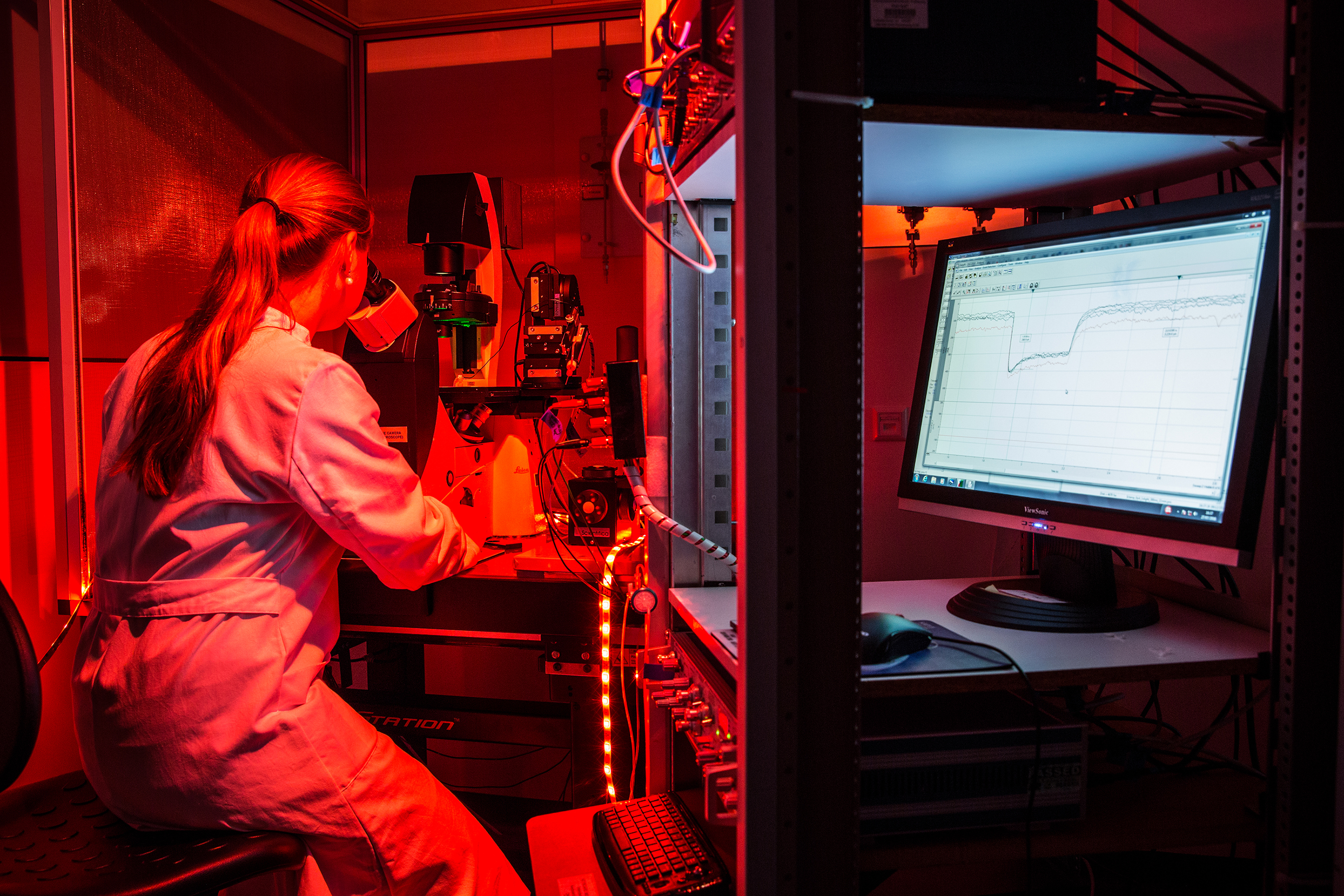
Caption: A doctoral student is working on a patch-clamp system in which new ion channels controlled by light stimuli are tested in order to influence the activity of heart muscle cells.
Image source: Medical Center - University of Freiburg / Britt Schilling
Contact:
Prof. Dr. Peter Kohl
Director
Institute for Experimental Cardiovascular Medicine
University Heart Center Freiburg - Bad Krozingen
Phone: 0761 270-63950
peter.kohl@universitaets-herzzentrum.de
Prof. Dr. Roland Schüle
Scientific Director
Department of Urology
Medical Center - University of Freiburg
Phone: 0761 270-63100
roland.schuele@uniklinik-freiburg.de
Prof. Dr. Robert Thimme
Medical Director
Department of Medicine II
Medical Center - University of Freiburg
Phone: 0761 270-34040
robert.thimme@uniklinik-freiburg.de
Back
Medical Center - University of Freiburg
Central Information
Phone: 0761 270-0
info@uniklinik-freiburg.de
For press inquiries:
Corporate Communications
Breisacher Straße 153
79110 Freiburg
Phone: 0761 270-84830
kommunikation@uniklinik-freiburg.de