
High-tech images for even more precise treatment
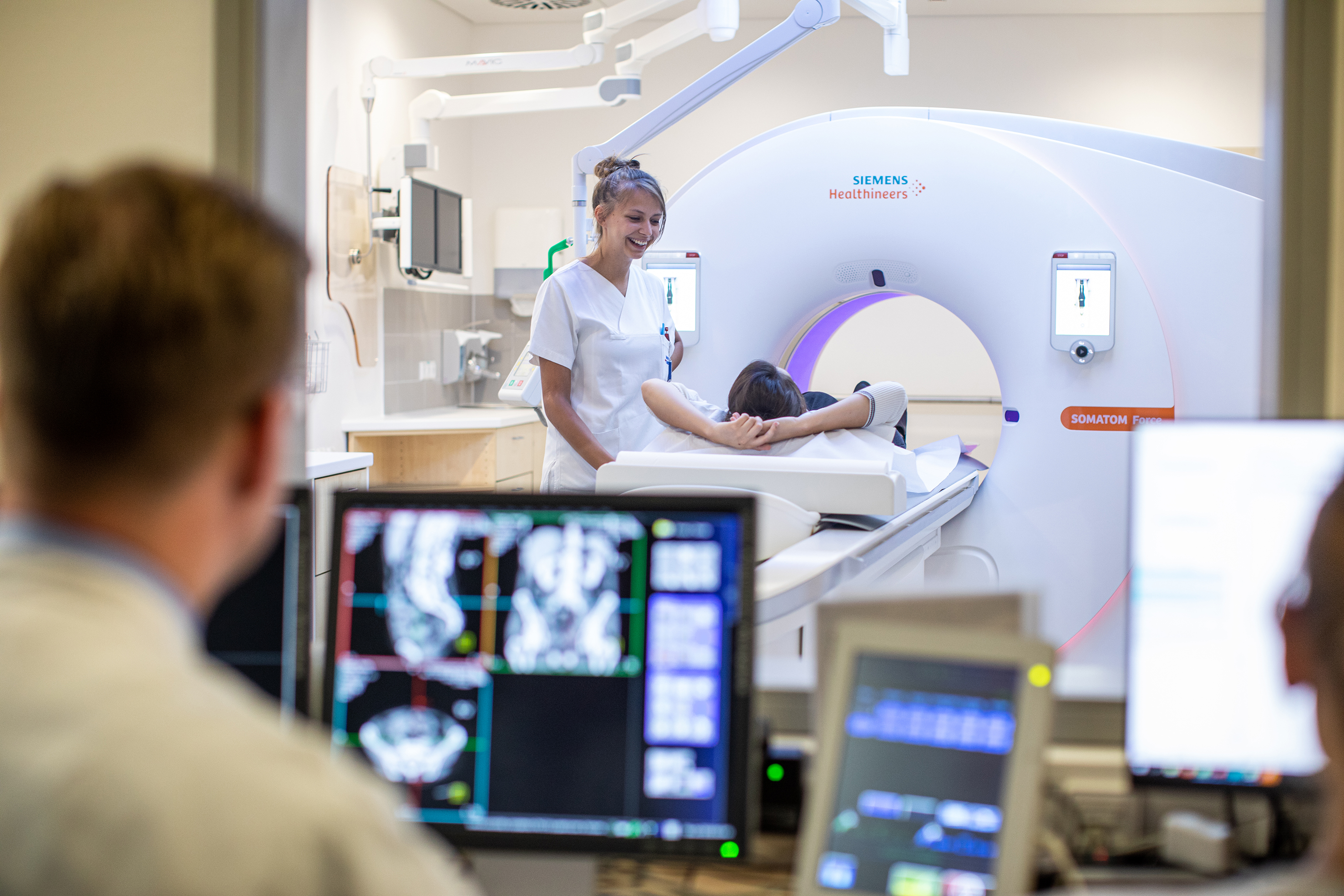
Three recently installed computer tomographs of the latest generation enable high-precision diagnostics and therapy with a greatly reduced radiation dose and less contrast medium / Great advantages for children and the elderly, among others
Almost all patients come into contact with imaging procedures and radiology sooner or later. The focus is always on highly precise and gentle treatment. To this end, the Department of Radiology at the Medical Center - University of Freiburg and the University Heart Center Freiburg - Bad Krozingen (UHZ) recently installed several latest-generation computed tomography (CT) scanners, which are now being put into operation. Innovative functions within the devices enable even more precise images with a significantly reduced radiation dose and reduced amount of contrast medium. Thanks to very fast imaging techniques and complex data processing, breathing and other body movements have less influence on the image quality. The radiologists in Freiburg are now also supported by artificial intelligence when evaluating the extensive CT data.
"We can offer our patients radiological imaging of a quality that was previously not possible in South Baden," says Prof. Dr. Fabian Bamberg, Medical Director of the Department of Radiology at the Medical Center - University of Freiburg. "Thanks to the new equipment, the examinations are even more comfortable for patients, have fewer side effects and the images are also much more informative," says Bamberg. The innovations are not only helpful for normal examinations, but also for particularly sensitive patients, such as children or the elderly.
"Radiological imaging plays a central role in medical care," says Prof. Dr. Frederik Wenz, Chief Medical Officer at the Medical Center - University of Freiburg. "With the new imaging techniques, we are living up to our claim of providing the best diagnoses and therapies for our patients." The new CT scanners can achieve up to 90 percent lower radiation doses. The images have a resolution of less than a quarter of a millimeter. This means that physicians can not only image extremely small structures of the human body, such as coronary arteries, but also very precisely assess changes over time, such as the blood flow characteristics of tumors. "The high level of detail allows us to assess complex diseases even better and thus work out the best therapy with our clinical partners: Interventions can simply be planned better and this is how we achieve the best outcome for patients," says Bamberg. "The new devices also represent significant innovations in the training and advanced training of radiology physicians and medical-technical radiology assistants, which will become increasingly popular in the future."
Picture caption: Three recently installed computer tomographs of the latest generation enable high-precision diagnostics and therapy with a greatly reduced radiation dose.
Image source: Medical Center - University of Freiburg / Britt Schilling
Contact:
Prof. Dr. Fabian Bamberg
Medical Director
Department of Radiology
Medical Center - University of Freiburg
Phone: 0761 270-38050
fabian.bamberg@uniklinik-freiburg.de
Back
Medical Center - University of Freiburg
Central Information
Phone: 0761 270-0
info@uniklinik-freiburg.de
For press inquiries:
Corporate Communications
Breisacher Straße 153
79110 Freiburg
Phone: 0761 270-84830
kommunikation@uniklinik-freiburg.de