
How mysterious immune cells escape cell death
Tumor-like proliferating immune cells provide insights into the regulatory mechanisms of the immune system
Immune cells that cause lymph nodes to swell uncontrollably like tumors: This phenomenon is known from a very rare disease, but also allows insights into the healthy immune system and its regulatory mechanisms. This was demonstrated by Freiburg researchers in a research project funded by the Wilhelm Sander Foundation: studies of a special T-cell population and its tumor-like metabolism provided insights into the signaling pathways that keep the human immune system in balance, as well as important starting points for the development of a therapy for the rare disease. The results were published in the Journal of Experimental Medicine on November 10, 2020.
Do outdated immune cells cause lymph nodes to swell?
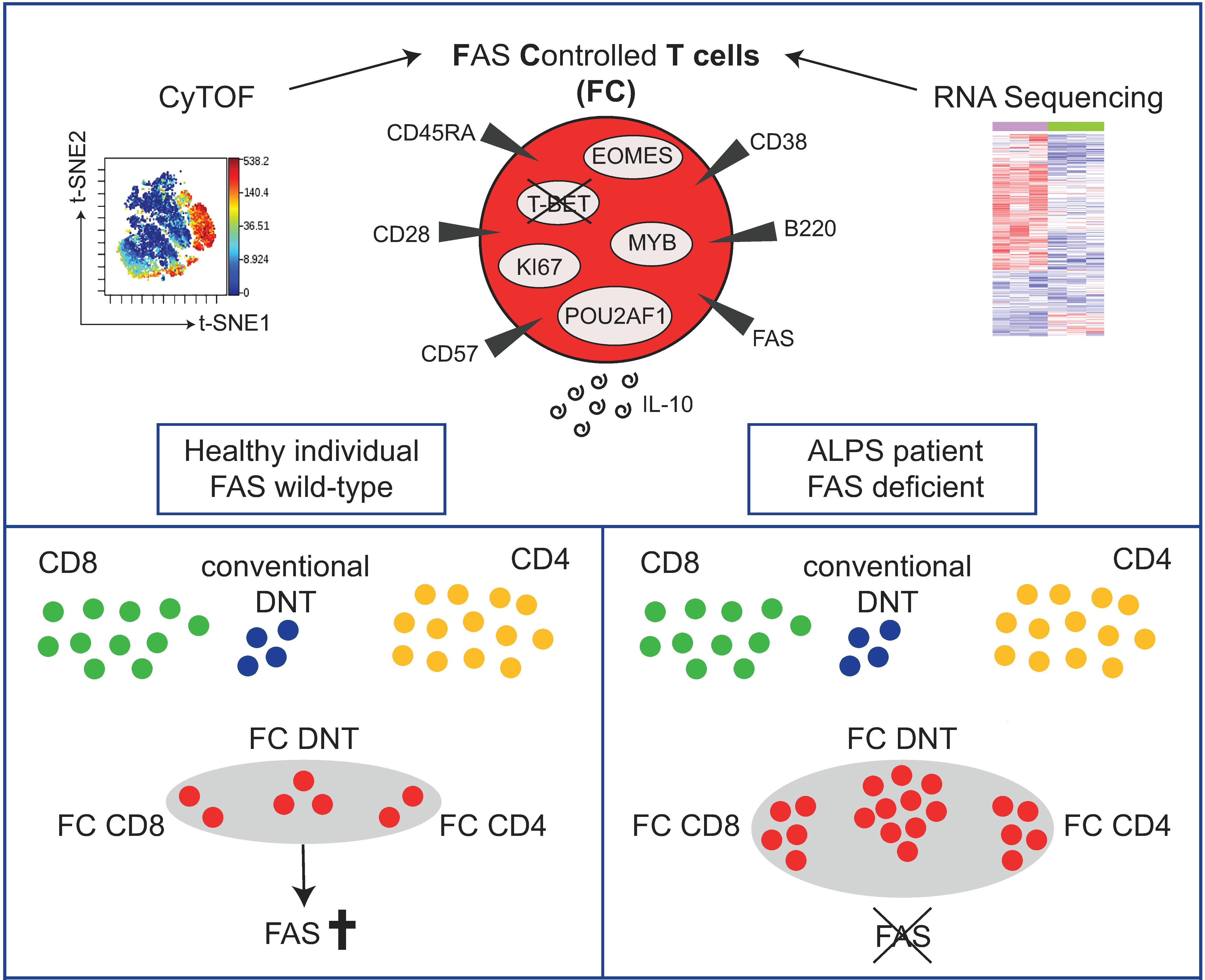
So far, little attention has been paid to so-called double-negative T cells (DNT) in research. They were mainly known from patients with autoimmune lymphoproliferative syndrome (ALPS). In this disease, a genetic defect prevents T cells from receiving a so-called death signal and dying off. "It was assumed that DNT cells are normal T cells that have lost certain cell markers. Due to the disturbed signaling pathway in ALPS patients, they seemed to miss the right time for their scheduled cell death and accumulate in the lymph nodes until they swell like tumors," explains Dr. Anne Rensing-Ehl, scientist at the Center for Chronic Immunodeficiency (CCI) at the Medical Center - University of Freiburg. As part of a research project funded by the Wilhelm Sander Foundation, a team of CCI scientists led by Rensing-Ehl has now discovered, contrary to previous assumptions, that this particular group of immune cells also occurs in healthy people and can only be prevented from uncontrolled proliferation with the help of regulatory mechanisms.
Complex analyses reveal new cell type
Using complex analyses of cell properties, Rensing-Ehl and her colleagues were able to show that, contrary to previous assumptions, DNT cells are a separate form of active, fast-growing cells that presumably do not participate in the usual immune responses against infections. They are already formed in small quantities in newborns. In healthy people, the so-called death molecule FAS causes them to die and thus keeps them in check. If this molecule is produced incorrectly, it leads to ALPS disease with severely swollen lymph nodes. "Our new knowledge of the active signaling pathways and the tumor-like metabolism of DNT cells provides important starting points for the targeted therapy of ALPS patients," says Rensing-Ehl. The researchers now want to investigate in more detail why the human body produces these excessively proliferating T cells, only to send them back to cell death again quickly. "The seemingly non-functional DNT cells still pose some puzzles for us, which we hope will give us further insights into how the immune system works," says Rensing-Ehl.
Wilhelm Sander Foundation: Partner in innovative cancer research
The Wilhelm Sander Foundation is supporting this research project with around 200,000 euros. The purpose of the foundation is to promote medical research, in particular projects in the fight against cancer. Since the foundation was established, a total of around 245 million euros has been disbursed for research funding in Germany and Switzerland. This makes the Wilhelm Sander Foundation one of the most important private research foundations in Germany.
Image: An unusual population of highly proliferative T cells is controlled by the cell death-inducing molecule FAS. In healthy individuals, these T cells exist at a low frequency but are kept in check by FAS. In ALPS patients, however, they proliferate in an uncontrolled manner due to the FAS defect.
Image source: Maccari ME et al, J Exp Med. 2020
Original study title: A distinct CD38+CD45RA+ population of CD4+, CD8+ and double-negative T cells is controlled by FAS
DOI: 10.1084/jem.20192191
Link to the study: https://doi.org/10.1084/jem.20192191
Contact:
Dr. Anne Rensing-Ehl
Center for Chronic Immunodeficiency
Uniklinik - University of Freiburg
Phone: 0761 270-71080
anne.rensing-ehl@uniklinik-freiburg.de
Back
Medical Center - University of Freiburg
Central Information
Phone: 0761 270-0
info@uniklinik-freiburg.de
For press inquiries:
Corporate Communications
Breisacher Straße 153
79110 Freiburg
Phone: 0761 270-84830
kommunikation@uniklinik-freiburg.de