
Mechanism of action of antidepressants elucidated
Freiburg researchers, together with international colleagues, find a new mechanism by which antidepressants act in the brain / Discovery enables the development of new therapies / Publication in the journal Cell
Scientists at the Medical Center - University of Freiburg, together with international colleagues, have shown that antidepressants bind to a previously unknown site in nerve cells and thus unfold their mood-enhancing effect. By binding to the receptor of the so-called brain derived neurotrophic factor (BDNF) on the nerve cells, they lead to improved activity in regions of the brain that are impaired in depressed patients. The effect was particularly good when the cholesterol level in the blood was normal. The findings now enable the targeted search for active substances that bind to the BDNF receptor. The study was published on February 18, 2021 in the renowned journal Cell.
"With the BDNF receptor as a docking site, we can for the first time directly explain how antidepressants work and why it takes so long for the effect to set in," explains Prof. Dr. Claus Normann, research group leader at the Department of Psychiatry and Psychotherapy at the Medical Center - University of Freiburg. Until now, it was assumed that they work by increasing the messenger substance serotonin in the brain; however, it remained completely unclear exactly how this works.
Direct link between molecular and clinical effect for the first time
This is now changing thanks to a study by an international working group led by Normann, Dr. Stefan Vestring and Dr. Tsvetan Serchov from the Department of Psychiatry and Psychotherapy at the Medical Center - University of Freiburg. In their research work, they were able to show in mice that antidepressants bind directly to the receptor for the growth hormone BDNF. This results in improved activity in regions of the brain that are impaired in depressed patients. This applies to different types of antidepressants such as selective serotonin reuptake inhibitors (SSRIs) or ketamine.
Active substances facilitate learning and perception of positive information
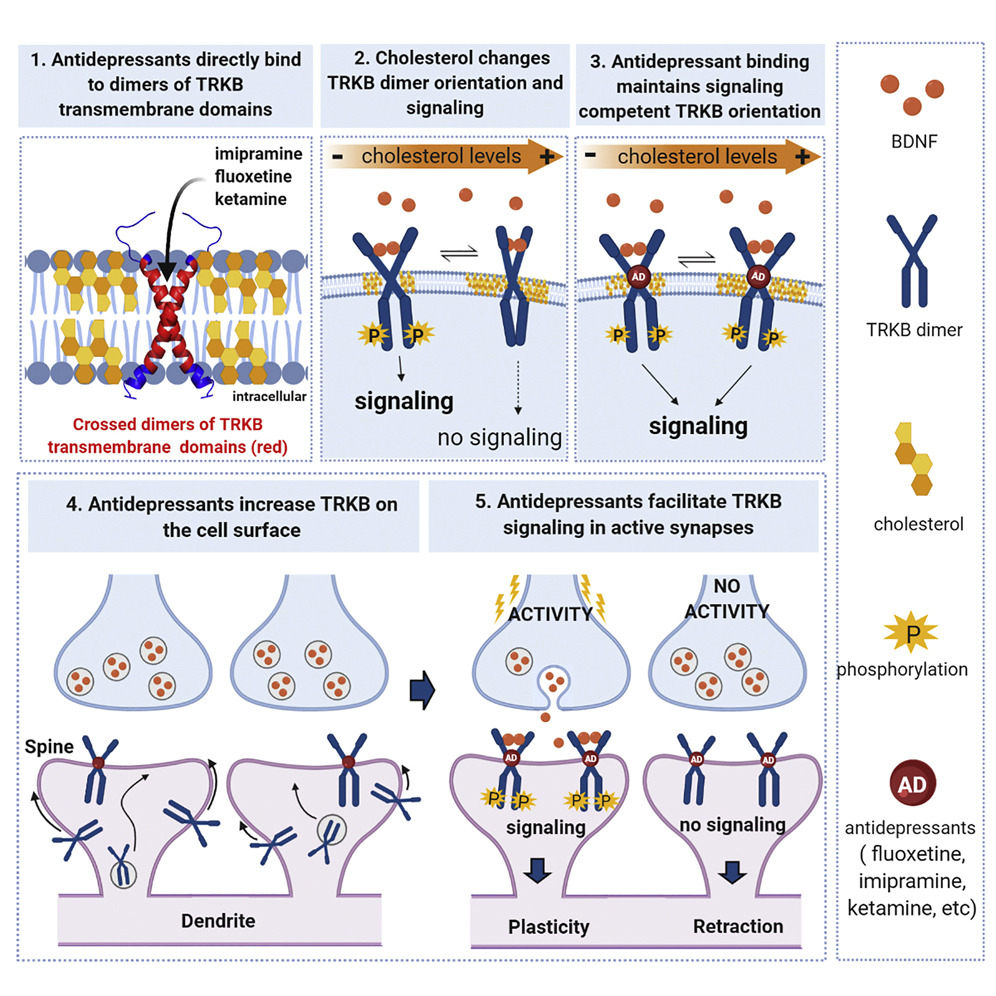
"By stimulating the BDNF, the brain can better absorb new, positive information from the environment or during psychotherapy and recovers from its depressive state," says Normann. The researchers showed that the antidepressants intervene via the BDNF receptor in a central learning and adaptation mechanism of the brain known as synaptic plasticity. "Interestingly, this binding site requires a normal cholesterol level in order to become optimally active." As the team showed, both high and low cholesterol levels deform the BDNF receptor so that the active substances bind less well.
These findings form an important basis for understanding depression and developing new drugs. Targeted therapy could open up new perspectives for treating severe depression with fewer side effects and more effectively.
Original title of the study: Antidepressants act by directly binding to TRKB neurotrophin receptors
DOI: 10.1016/j.cell.2021.01.034
Link to the study: https://authors.elsevier.com/sd/article/S0092-8674(21)00077-5
Caption: Graphic summary: Figure 2 + 3: High cholesterol levels change the shape of the binding site for antidepressants, which is why they then work less effectively.
Image source: Cell / Medical Center - University of Freiburg
Further information:
Research group Prof. Normann "Mechanisms of Depression"
Contact:
Prof. Dr. Claus Normann
Managing Senior Physician
Department of Psychiatry and Psychotherapy
Medical Center - University of Freiburg
Phone: 0761 270-66340
Back
Medical Center - University of Freiburg
Central Information
Phone: 0761 270-0
info@uniklinik-freiburg.de
For press inquiries:
Corporate Communications
Breisacher Straße 153
79110 Freiburg
Phone: 0761 270-84830
kommunikation@uniklinik-freiburg.de