
State-of-the-art imaging for complex heart interventions inaugurated
At the University of Freiburg - Bad Krozingen Heart Center, complex, minimally invasive heart procedures are monitored and performed using new, state-of-the-art imaging / Patients benefit from significantly reduced radiation exposure
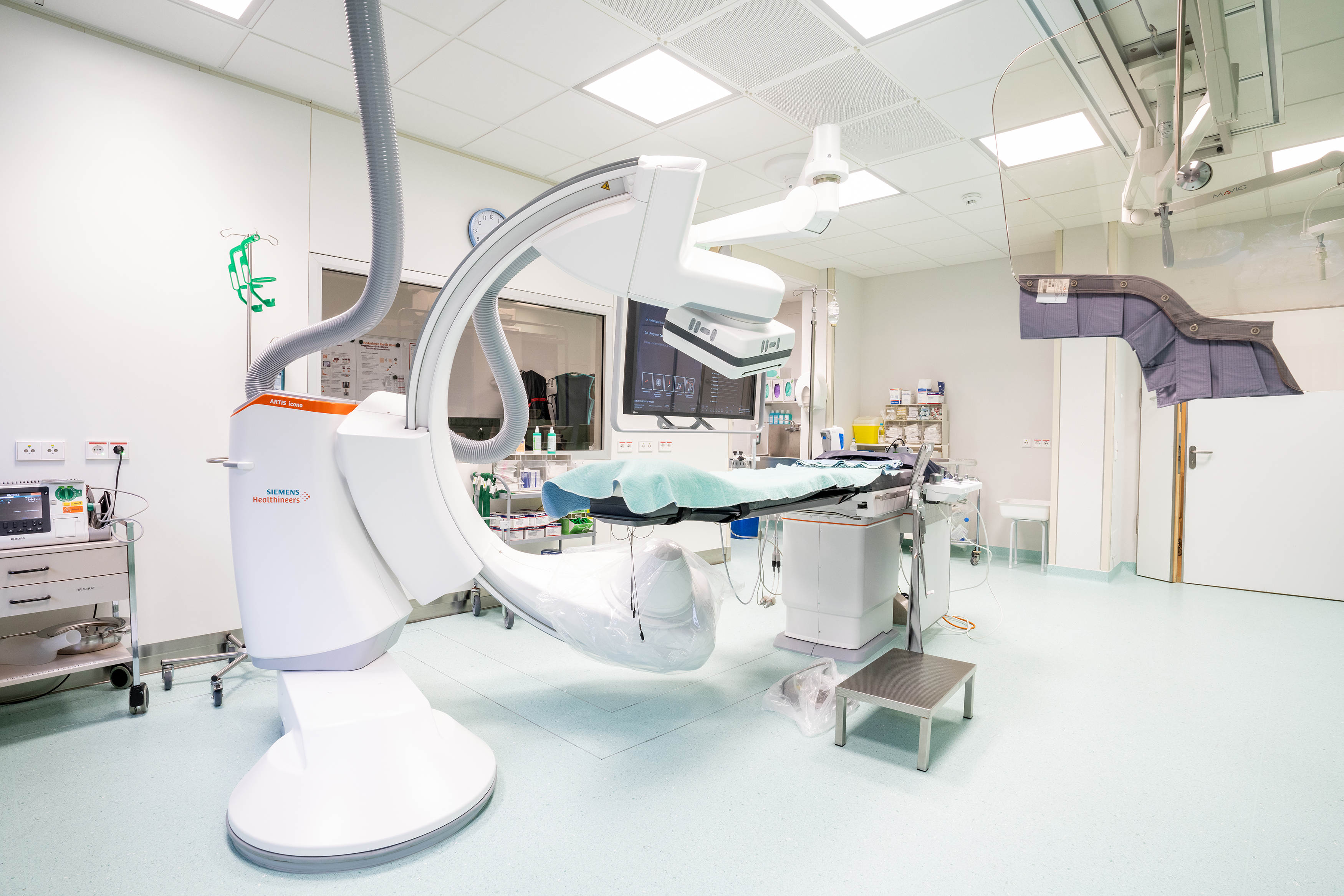
Thanks to rapid developments in minimally invasive cardiology, many patients with cardiovascular and heart valve problems can now be treated with the help of catheter interventions. The University of Freiburg - Bad Krozingen Heart Centerhas now put a new angiography unitwith state-of-the-art imaging into operation at the Bad Krozingen site. Apart from a few test and prototype units, this is the world's first installation of this new technology. In particular, it raises the care of patients requiring very complex and lengthy procedures to a new level.
Radiation dose reduced to a third
The radiation dose of X-ray images can be reduced to a third of the usual intensity. This is particularly relevant for long procedures lasting several hours, during which a series of X-ray images have to be taken. The administration of contrast medium is also reduced thanks to the very sensitive imaging. At the same time, physicians have the option of enlarging specific areas in high resolution. Additional image information such as three-dimensional computed tomography images can be superimposed directly over the live images, giving cardiologists an even better overview. Operating times are also reduced thanks to simplified procedures in the operating room.
"We are now able to perform even the most complex cardiac procedures even more safely and quickly than with the previously available devices," says Prof. Dr. Franz-Josef Neumann, Medical Director of the Department of Cardiology and Angiology II at the University of Freiburg - Bad Krozingen Heart Center. "Another positive effect is that the staff also experience a lower radiation dose," says Neumann.
Around 10,000 patients per year
The most common reason for an angiographic examination is a possible narrowing of the coronary arteries. This leads to circulatory disorders in the heart muscle and, in the worst case, to a heart attack. At the Department of Cardiology and Angiology II at the University of Freiburg - Bad Krozingen Heart Center, around 10,000 patients are examined in 10 cardiac catheterization laboratories every year. More than 3,000 of them receive minimally invasive cardiac catheter treatment.
Small change, big effect
In order not to disrupt hospital operations during the core refurbishment of the cardiac catheterization laboratory, most of the work was carried out through the windows. This included installing a new floor and pouring new foundations for the imaging system. By rotating the operating table and everything that goes with it by an angle of 8 degrees in the room, it was possible to make it much easier for patients to enter and exit the room. "With the combination of small and large changes, we have succeeded in setting a new standard here," says Medical Director Neumann happily.
Picture caption: State-of-the-art imaging allows even the most complex procedures with low radiation exposure.
Image source: Medical Center - University of Freiburg / Britt Schilling
Contact:
Prof. Dr. Franz-Josef Neumann
Medical Director
Department of Cardiology and Angiology II
University Heart Center Freiburg - Bad Krozingen
Phone: 07633 402-2001
Franz-Josef.Neumann@universitaets-herzzentrum.de
Back
Medical Center - University of Freiburg
Central Information
Phone: 0761 270-0
info@uniklinik-freiburg.de
For press inquiries:
Corporate Communications
Breisacher Straße 153
79110 Freiburg
Phone: 0761 270-84830
kommunikation@uniklinik-freiburg.de