
Deep brain stimulation for obsessive-compulsive disorder: Physicians call for better access for patients
Proven efficacy in patients who do not respond to other therapies / Nevertheless, there are major reservations worldwide / Physicians from Freiburg discuss ways to increase acceptance and dissemination of the method in the journal Nature
It is estimated that up to 300,000 people in Germany suffer from an obsessive-compulsive disorder that cannot be treated with behavioral therapies or medication. For some of these severely treatment-resistant people, deep brain stimulation could be an effective therapy. So far, however, only a few of these people make it as far as surgery. On July 15, 2022, experts from the Medical Center - University of Freiburg, together with other international experts, published an article in the journal Nature in whichthey call for better access to this form of therapy for those affected and make suggestions as to how this could be achieved.
"Deep brain stimulation can be very effective for mental illnesses. In contrast to Parkinson's disease, where this form of treatment is now part of the standard treatment for advanced disease, most colleagues are largely unaware of deep brain stimulation for obsessive-compulsive disorder. This is especially true for psychiatrists and psychologists, who are often dismissive of the opportunities and results of such therapy," says Prof. Dr. Volker A. Coenen, Medical Director of the Department of Neurosurgery and Functional Neurosurgery at the Medical Center - University of Freiburg. He was involved in the Nature article together with his colleague Prof. Dr. Thomas Schläpfer, Head of the Department of Interventional Biological Psychiatry at the Department of Psychiatry and Psychotherapy of the Medical Center - University of Freiburg.
Reasons for the lack of acceptance and solutions
The authors of the article discuss the main reasons for this lack of acceptance: historical concerns related to outdated psychosurgical procedures, skepticism due to supposedly low scientific evidence, lack of awareness among psychiatrists and psychologists, lack of appropriately qualified staff to care for patients, restrictions in medical device approval, inadequate cost coverage or non-transparent decisions by insurance companies, unequal partnerships between industry and science. "There are good solutions for all these difficulties that we should urgently address in the interests of patients," says Schläpfer.
"Specialized care for these patients is possible if experts in psychotherapy and drug treatment are involved, as well as a specialized team for deep brain stimulation. We have had very good experience with this in Freiburg," says Prof. Dr. Dr. Katharina Domschke, Medical Director of the Department of Psychiatry and Psychotherapy at the Medical Center - University of Freiburg. She is co-editor of an international guideline for the treatment of obsessive-compulsive disorder, which also includes deep brain stimulation.
Small study with encouraging results
In May 2022, Schläpfer, Domschke and Coenen published a study on the treatment of obsessive-compulsive disorder with deep brain stimulation in the journal Brain Stimulation. The nine patients had suffered from the disorder for an average of 23 years and other therapies had been unsuccessful. In seven patients, the therapy was still clearly effective one year after the procedure.
Procedure has been tried and tested for decades
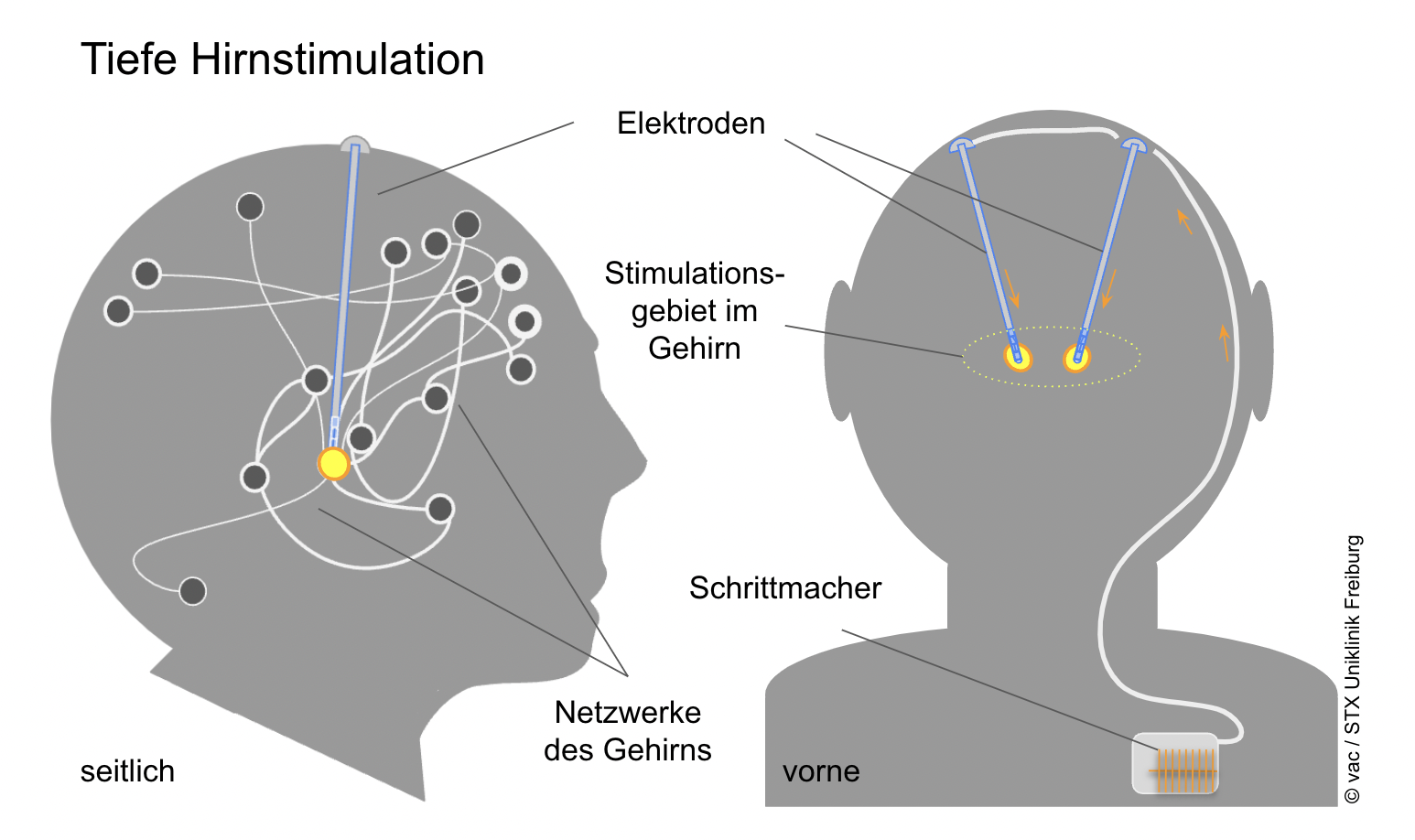
Deep brain stimulation has been used successfully for decades to treat Parkinson's patients. Very good results can also be achieved in some cases for depression. In deep brain stimulation, hair-thin electrodes are inserted into a specific area of the brain. They are connected to a battery in the chest cavity via a thin cable. Regular weak electrical impulses can reduce pathological activity in the brain region and bring it back to a normal state.
Nature publication
Title: Deep brain stimulation for obsessive-compulsive disorder: a crisis of access
DOI: 10.1038/s41591-022-01879-z
Link to the study:www.nature.com/articles/s41591-022-01879-z
Caption: In deep brain stimulation, hair-thin electrodes are inserted into a specific area of the brain.They are connected to a battery in the chest cavity via a thin cable.
Image source: Medical Center - University of Freiburg
Contact:
Prof. Dr. Thomas Schläpfer
Head of the Department of Interventional Biological Psychiatry
Department of Psychiatry and Psychotherapy
Medical Center - University of Freiburg
Center for Deep Brain Stimulation
Medical Center - University of Freiburg
www.uniklinik-freiburg.de/wiss-zentrum-ths
Back
Medical Center - University of Freiburg
Central Information
Phone: 0761 270-0
info@uniklinik-freiburg.de
For press inquiries:
Corporate Communications
Breisacher Straße 153
79110 Freiburg
Phone: 0761 270-84830
kommunikation@uniklinik-freiburg.de