
COVID-19: Different immune response in children and adults persists for a long time
Differences in the immune response in children and adults even after mild or asymptomatic courses / Study by the Unikliniken Baden-Württemberg under the direction of the Unikliniken Freiburg and Ulm University Hospitals
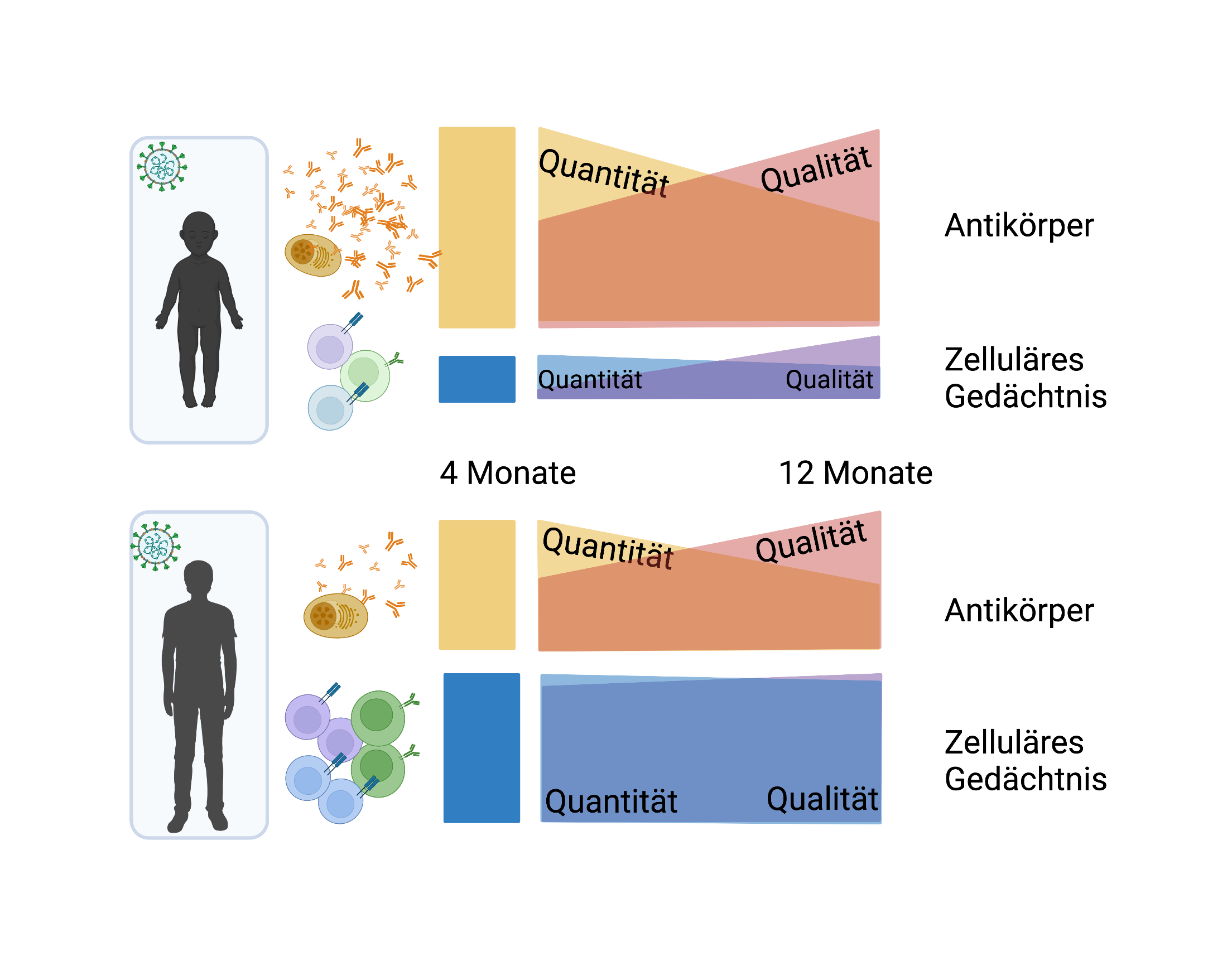
In a joint study, researchers from the University Hospitals of Freiburg, Heidelberg, Tübingen and Ulm investigated the type of immune response that children and adults develop after a mild or asymptomatic infection with SARS-CoV-2. It was found that an immune response was still detectable in children even after twelve months, but that it had lost much of its strength over time. While the immune response in adults is primarily driven by memory B and T cells, specific serum antibodies produced by plasma cells play a central role in children. The study was published on November 28, 2022 in the international journal Nature Communications.
"We found that specific antibodies decreased over the observation period of one year, but neutralizing antibody activity and breadth increased in both age groups. Certain memory cells remain stable and mature over time. Although immunity against SARS-CoV-2 decreases quantitatively, the quality has continuously improved due to maturation, even more so in children than in adults," says Dr. Marta Rizzi, research group leader at the Department of Rheumatology and Clinical Immunology at the Medical Center - University of Freiburg and Professor of Clinical and Experimental Immunology at the Medical University of Vienna. Rizzi led the study together with Dr. Aleš Janda from Ulm University Hospital.
"Our data contribute to the understanding of the development of the immune system in different phases of life. It is very likely that the differences found can also be used to draw conclusions about other viral infections. The COVID-19 pandemic has helped us to better understand the immune system in different age groups," adds Janda, senior physician at the Department of Pediatrics and Adolescent Medicine at Ulm University Hospital. "We are delighted that the funding from the Baden-Württemberg Ministry of Science, Research and the Arts has enabled us to establish this close and effective cooperation between the four university hospitals in Baden-Württemberg," say Rizzi and Janda.
The study is part of the Baden-Württemberg COVID-19 Household Study, a joint initiative of the University Children's Hospitals in Freiburg, Heidelberg, Tübingen and Ulm(www.corona-kinderstudie.de). The researchers analyzed the dynamics of the immune response in 28 families up to 12 months after a mild or asymptomatic infection.
Caption: Which parts of the immune system contribute how much to the immune response to COVID-19 differs in children and adults and changes over time.
Image source: Medical Center - University of Freiburg / Biorender.com
Original title of the study: High antibody levels and reduced cellular response in children up to one year after SARS-CoV-2 infection
DOI: (2022)13:7315
Link to the study:https://www.nature.com/articles/s41467-022-35055-1
Contact:
PD Dr. Marta Rizzi
Group leader
Department of Rheumatology and Clinical Immunology
Medical Center - University of Freiburg
Phone: 0761-270-62170
marta.rizzi@uniklinik-freiburg.de
MUDr. Aleš Janda, M.Sc., Ph.D.
Senior Physician at the Department of Pediatrics and Adolescent Medicine
University Hospital Ulm
Phone: 0731-500-57154
ales.janda@uniklinik-ulm.de
Back
Medical Center - University of Freiburg
Central Information
Phone: 0761 270-0
info@uniklinik-freiburg.de
For press inquiries:
Corporate Communications
Breisacher Straße 153
79110 Freiburg
Phone: 0761 270-84830
kommunikation@uniklinik-freiburg.de