
Significant progress for new imaging in cancer diagnostics
Pioneering method offers a fast and cost-effective way to observe pathological metabolic processes live in the magnetic resonance tomograph / Production of biological contrast agents / Publication in Angewandte Chemie International Edition
A team of scientists from the Medical Center - University of Freiburg, the German Consortium for Translational Cancer Research (DKTK) and other locations has made a decisive advance in being able to observe metabolic processes in the body live using metabolic magnetic resonance imaging (MRI). They have developed a method to modify naturally occurring molecules in the body cheaply, safely and quickly so that they are ten thousand times more visible in MRI. This plays an important role in personalized cancer diagnostics, among other things. The results of their study were published in the journal "Angewandte Chemie International Edition" on July 13, 2023.
"We have found a way to produce biological contrast agents easily, quickly and safely, which even make the metabolism visible. This allows us to observe cancer metabolism in real time, which opens up completely new perspectives for cancer medicine," says study leader Dr. Andreas Schmidt, head of the "Hyperpolarization and Metabolic MRI" research group in the Department of Medical Physics at the Medical Center - University of Freiburg.
How metabolic MRI works
Magnetic properties of molecules are recorded in MRI. During hyperpolarization, these properties are enormously amplified for a certain period of time, so that the signal is significantly better than usual. Biologically, the molecules behave as before. This allows the metabolism of molecules to be observed in a non-invasive way. "The procedure is harmless and does not expose the patient to radiation, and metabolic MRI only takes a few minutes. These are particularly important aspects for patients who require regular follow-up examinations," explains co-study leader Dr. Stephan Knecht, Head of Development at NVision Imaging Technologies GmbH, Ulm.
The results of the study include two important milestones:
- The successful production of highly polarized pyruvate in a compatible, aqueous solution. Pyruvate is a common molecule in the body and is involved in key metabolic processes. The team used the innovative SABRE (Signal Amplification By Reversible Exchange) method to amplify the signal of pyruvate. This process enables the generation of highly sensitive biological contrast agents in just a few minutes, at low cost and without chemical modification. Previously, SABRE was not efficient enough as a method and it was not possible to produce the contrast agents in aqueous solutions with sufficient purity. With the currently established method, the production of contrast media took about an hour or longer and was technically very complex.
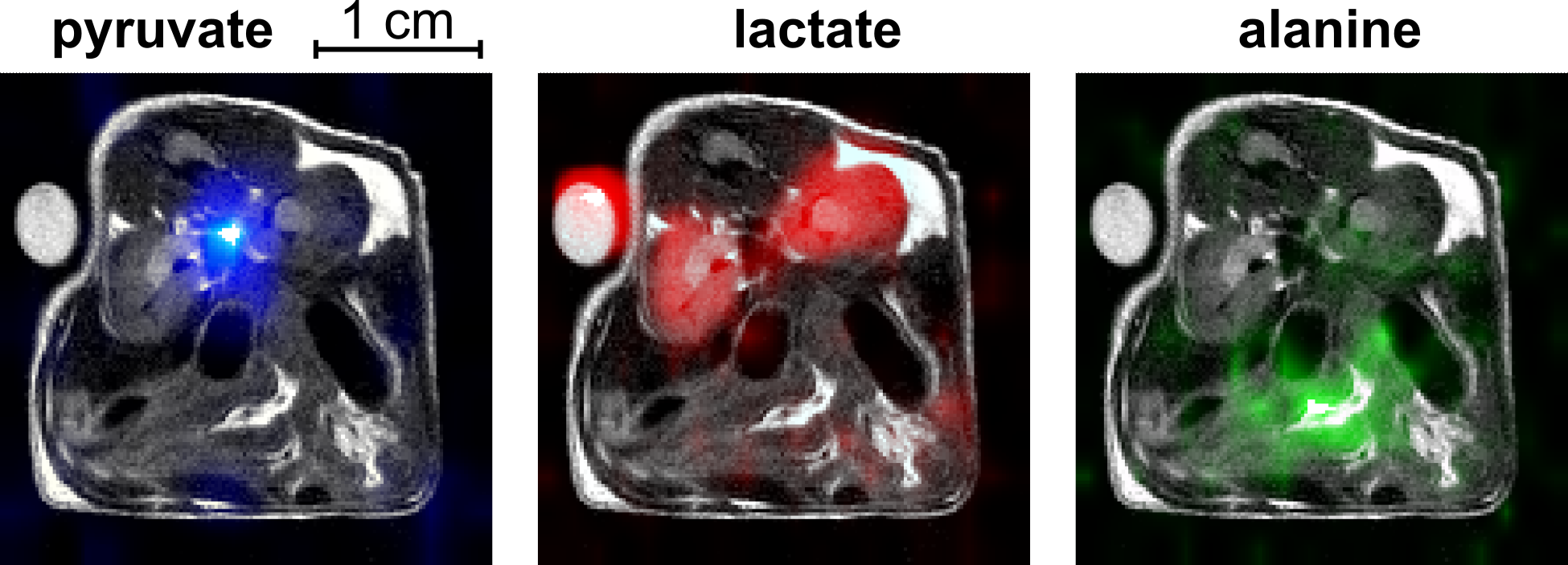
- Using the highly sensitive biological contrast agents developed, the conversion of pyruvate into lactate and alanine could be detected in the animal model. These conversions in energy metabolism have already been identified as a helpful diagnostic marker in earlier studies.
The cooperation between the DKTK sites (Medical Center - University of Freiburg, Klinikum rechts der Isar Munich), as well as the partners in Göttingen (Max Planck Institute for Multidisciplinary Natural Sciences), Kiel (University Medical Center Schleswig-Holstein), Ulm (NVision Imaging Technologies) and Detroit (Wayne State University) has led to this significant progress. "I would like to thank everyone involved in the project for their valuable collaboration and contribution to this groundbreaking research," says Schmidt.
Original title of the publication: In Vivo Metabolic Imaging of [1-13C]Pyruvate-d3 Hyperpolarized By Reversible Exchange With Parahydrogen
DOI: 10.1002/anie.202306654
Link: https://onlinelibrary.wiley.com/doi/10.1002/anie.202306654
Caption: MRI image of a mouse: the hyperpolarized pyruvate (blue) is broken down into lactate and alanine. The time course, location and concentration of the process can be observed in the MRI.
Image source: de Maissin et al, Angew. Chem. Int. ed. 2023 (CC-BY-NC license)
Back
Medical Center - University of Freiburg
Central Information
Phone: 0761 270-0
info@uniklinik-freiburg.de
For press inquiries:
Corporate Communications
Breisacher Straße 153
79110 Freiburg
Phone: 0761 270-84830
kommunikation@uniklinik-freiburg.de