
Strengthening family cohesion
Freiburg research project to strengthen family resilience in cancer receives BMBF funding of 150,000 euros
Every year, around 498,000 people are diagnosed with cancer. All of them have family members, some of them underage children. The new situation is stressful for everyone, but around 20 to 30 percent of children suffer so much that they develop clinically relevant stress symptoms. "Unlike conventional family crises, cancer poses an existential threat. It is drastic and literally pulls the rug out from under the feet of all family members," says Dr. Stefanie Pietsch and her colleagues from their daily work with families in the "Tigerherz ... wenn Eltern Krebs haben" (Tiger heart ... when parents have cancer) program at the Comprehensive Cancer Center Freiburg - CCCF at the Medical Center - University of Freiburg.
A project team led by Pietsch therefore wants to strengthen the resilience of families (family resilience) in families with cancer using a so-called co-design approach. In several steps, patients and their families as well as an interdisciplinary workshop team consisting of social scientists, psycho-oncologists, designers and computer scientists are working together to develop answers and practical solutions to the question: "What makes families strong?".
The special feature of the project entitled "PsyOnGa"(psycho-oncologywith gamification): The families actively participate in the workshops and not only help to develop a concrete support tool. "The development process also serves as a supportive measure for the entire family. It is intended to encourage them to think about their own strategies and solutions within the family and to enter into a constructive and lively exchange with each other," explains Pietsch, adding: "In the workshops, we will work with haptic design methods to get the families into action and design in a very practical and playful way."
What families need
The series of workshops described above, in which all participants work closely together, are an elementary part of the development process. The project team discusses the most important research findings on family resilience with the families, supplements these with the families' practical experiences and engages in a joint exchange.
The interim results will then be analysed, transferred and visualized in order to present them to families as an "exhibition format" in clinics. Pietsch: "This will allow other patients and their families to learn about the project and take away ideas for their own homes."
At the end of "PsyOnGa", a concrete support tool is to be developed and built by designers from Augsburg University of Applied Sciences with the involvement of the families. What the tool might look like has deliberately been kept open so that everyone involved in the development process can participate as freely and interactively as possible. Nevertheless, Pietsch gives a small insight: "Since open communication and family functionality are important for children's well-being, a prototype that promotes communication and interaction within the family and better connects the family would be a good idea."
"PsyOnGa" convinces directly
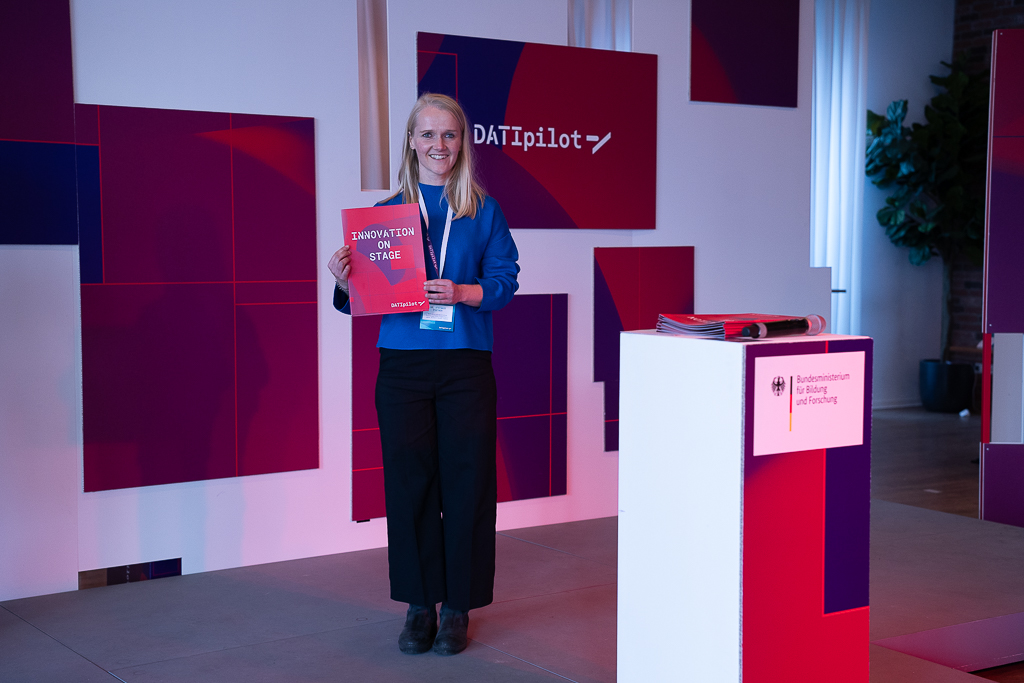
The Federal Ministry of Education and Research (BMBF) received a total of 3,000 applications as part of the DATIpilot funding program; 600 teams were then invited to the DATIpilot roadshows taking place in several cities - including Pietsch. Pietsch presented "PsyOnGa" in a 5-minute pitch and was immediately convincing. She and 152 other projects were directly selected for funding during the roadshow by participant voting. 147 other projects were lucky enough to receive a second chance at funding through a lottery. The "PsyOnGa" project will receive funding of up to 150,000 euros for 18 months.
The DATIpilot funding program aims to simplify and accelerate funding processes. It also acts as an experimental space and a repository of experience and ideas for the German Agency for Transfer and Innovation (DATI), which is currently being established.
Caption: Winner of the participant voting Dr. Stefanie Pietsch at the pitch competition as part of the BMBF funding program DATIpilot
Image source: DATIpilot neues handeln
Back
Medical Center - University of Freiburg
Central Information
Phone: 0761 270-0
info@uniklinik-freiburg.de
For press inquiries:
Corporate Communications
Breisacher Straße 153
79110 Freiburg
Phone: 0761 270-84830
kommunikation@uniklinik-freiburg.de