
Human and Avian Influenza: Genetic Exchange Is Rare Even in the Laboratory
A study from Freiburg examines a possible pathway for the emergence of new flu variants / Even under controlled laboratory conditions, genetic material rarely mixed
New influenza viruses can emerge when animal and human influenza viruses exchange genetic material. Researchers at the Institute for Virology at the Medical Center – University of Freiburg have now shown that this rarely occurs in the laboratory with the current H5N1 avian influenza viruses they studied. Of a total of 2,698 individually isolated and analyzed viruses, only 20 contained genetic material from both parent viruses—about 0.7 percent. This finding, which is consistent with observations in nature, is significant for assessing avian influenza: It shows that a potential pathway for the emergence of new flu variants involving these viruses was rarely observed even under controlled laboratory conditions. The study was published on November 9, 2026, in the journal *Proceedings of the National Academy of Sciences* (PNAS).
“The exchange of genetic material between animal and human influenza viruses can contribute to the emergence of new viral variants. Our results show that this exchange is rare among the avian influenza viruses studied, even under controlled laboratory conditions. This helps us better understand an important process in the development of new influenza viruses,” says Dr. Kevin Ciminski of the Institute for Virology at the Medical Center – University of Freiburg. Ciminski recently received a prestigious ERC Starting Grant from the European Research Council to investigate how animal viruses adapt to the human immune system.
How do new flu variants arise?
All animal and human influenza viruses have a genome consisting of eight separate segments. When different influenza viruses infect the same cell, they can exchange these segments with one another. In this way, new viral variants can emerge. Such an exchange also played a role in previous influenza pandemics.
The Freiburg researchers investigated how frequently this occurs in two current H5N1 variants and human influenza viruses of the H1N1 and H3N2 types. The experiments were conducted under special safety conditions using attenuated viruses in cell culture.
Supplementary experiments showed that certain components of human influenza viruses could enhance the efficiency of the replication machinery for H5N1 genetic material in human cells. Nevertheless, only a few viruses with mixed genetic material emerged. This suggests that other biological factors limit such exchange.
What does this mean for the risk of new influenza viruses?
The mixing of animal and human influenza viruses is one of several ways in which new influenza variants can emerge. This rare mixing in the laboratory is consistent with previous observations: for the H5N1 viruses currently circulating, no such exchange with human influenza viruses has been documented in nature to date.
The study thus provides important insights into the emergence of new flu variants. No increased risk of infection for humans was identified. However, the researchers did not investigate either the transmissibility or the pathogenicity of the resulting viruses. The laboratory results do not allow us to determine how frequently such genetic exchange occurs under natural conditions.
Original title: Rare recovery of reassortants between contemporary clade 2.3.4.4b H5N1 viruses and human influenza A viruses in vitro
DOI: 123 (46) e2631654123
Link:https://www.pnas.org/doi/10.1073/pnas.2631654123
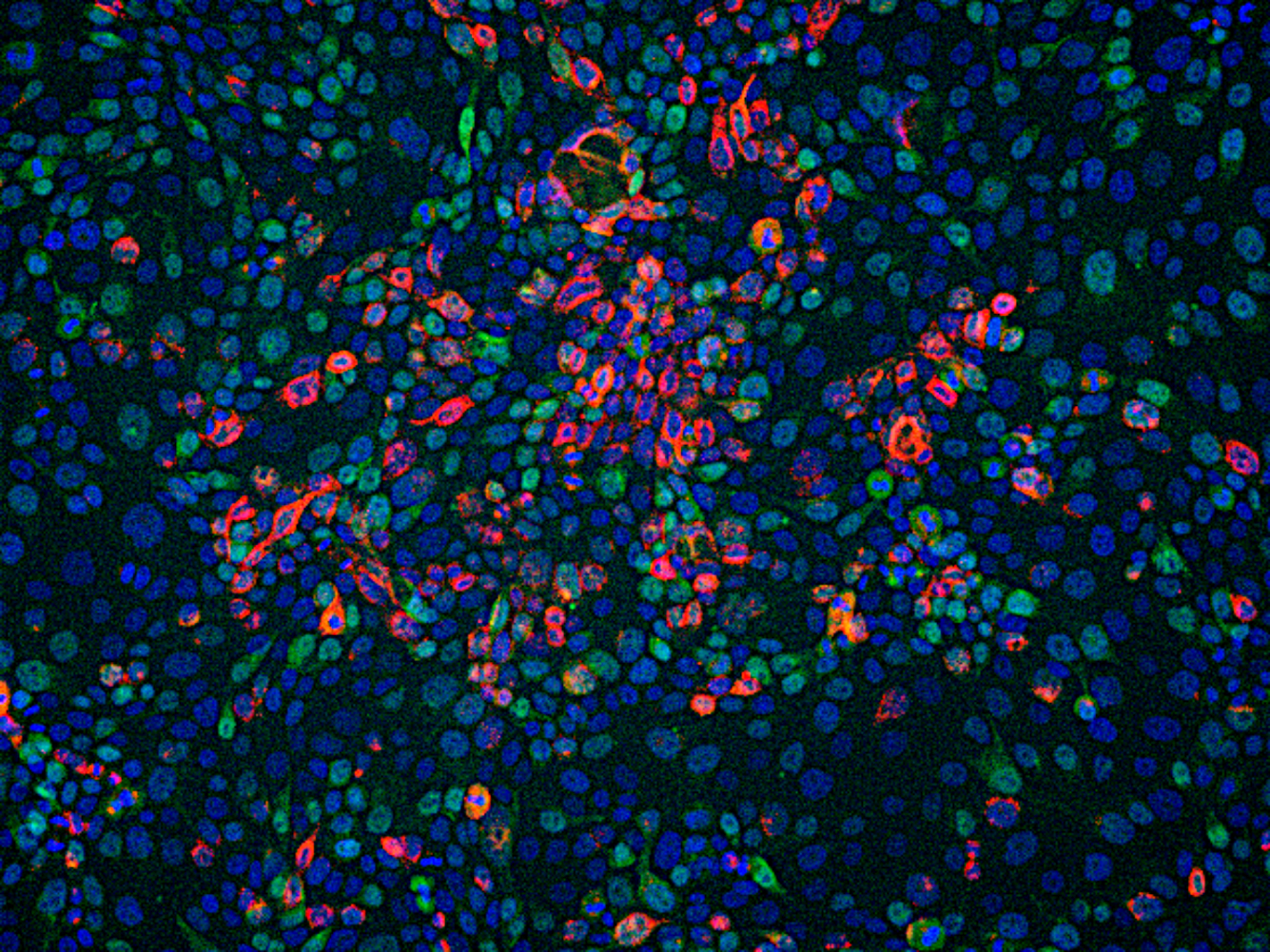
Caption: Microscopic image of infected cells in the laboratory. The different colors indicate the various influenza viruses (red: components of human influenza viruses; green: components of H5N1 avian influenza viruses; blue: cell nuclei). Where colors overlap, cells were infected by both influenza viruses simultaneously (co-infection)—the prerequisite for the mixing of viral genetic material.”
Image source: Medical Center – University of Freiburg
Back
Medical Center - University of Freiburg
Central Information
Phone: 0761 270-0
info@uniklinik-freiburg.de
For press inquiries:
Corporate Communications
Breisacher Straße 153
79110 Freiburg
Phone: 0761 270-84830
kommunikation@uniklinik-freiburg.de