
Rapid help for acute lung failure with the ECMO-Mobile
A special intensive care transport vehicle for patients with acute respiratory failure is now available around the clock at the Medical Center - University of Freiburg - a cooperation with the German Red Cross Freiburg that is unique in Germany
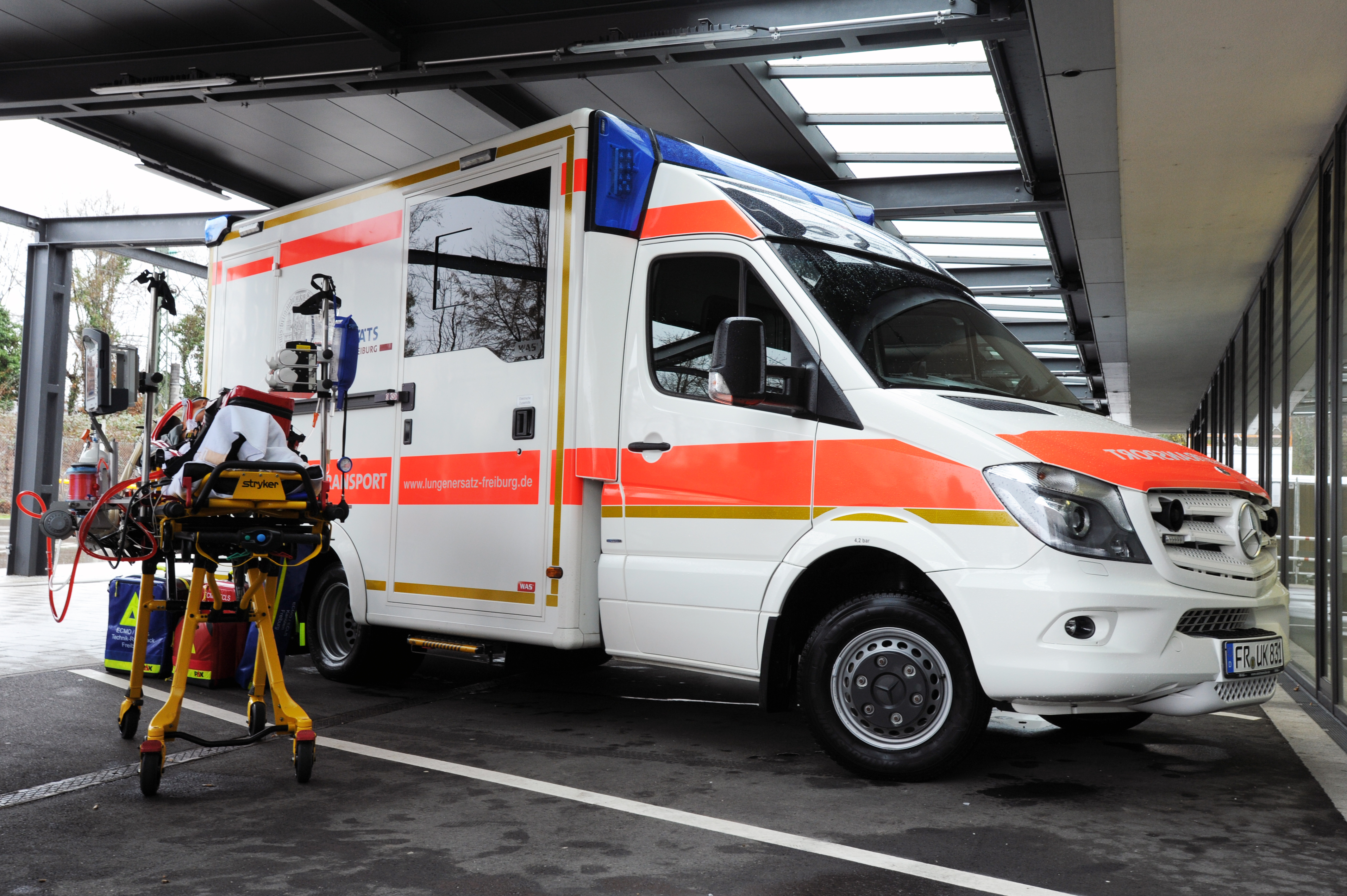
Since the end of 2015, the Medical Center - University of Freiburg has had its own intensive care transport vehicle, which is available exclusively for patients with acute lung failure. Thanks to a special therapy known as extracorporeal membrane oxygenation, or ECMO for short, these patients can now be transported unharmed from the intensive care units of other hospitals to the Lung Replacement Procedure Center at the Medical Center - University of Freiburg for further treatment. This was made possible by exemplary cooperation between the German Red Cross Freiburg, the funding bodies, the responsible departmental committee and the Medical Center - University of Freiburg. They have all directly taken up the wish for optimal care of these critically ill patients by the ECMO Center of the Medical Center - University of Freiburg and have now promoted this extraordinary life-saving transport option through a cooperation agreement between the German Red Cross and the Medical Center - University of Freiburg.
Patients suffering, for example, from simple influenza pneumonia or other diseases that no longer receive sufficient oxygen to maintain the entire organism through standard intensive care ventilators can thus be treated at the invasive lung replacement center of the Medical Center - University of Freiburg. If the damaged lungs are unable to absorb enough oxygen themselves, the ECMO machine takes over the function of the lungs, and in some cases even the function of the heart. However, critically ill patients have to be transferred for this treatment, which is now possible 24 hours a day, 365 days a year with the specially equipped ECMO mobile. The ECMO mobile is therefore of immense importance for the care of people in the region.
The ECMO-Mobile
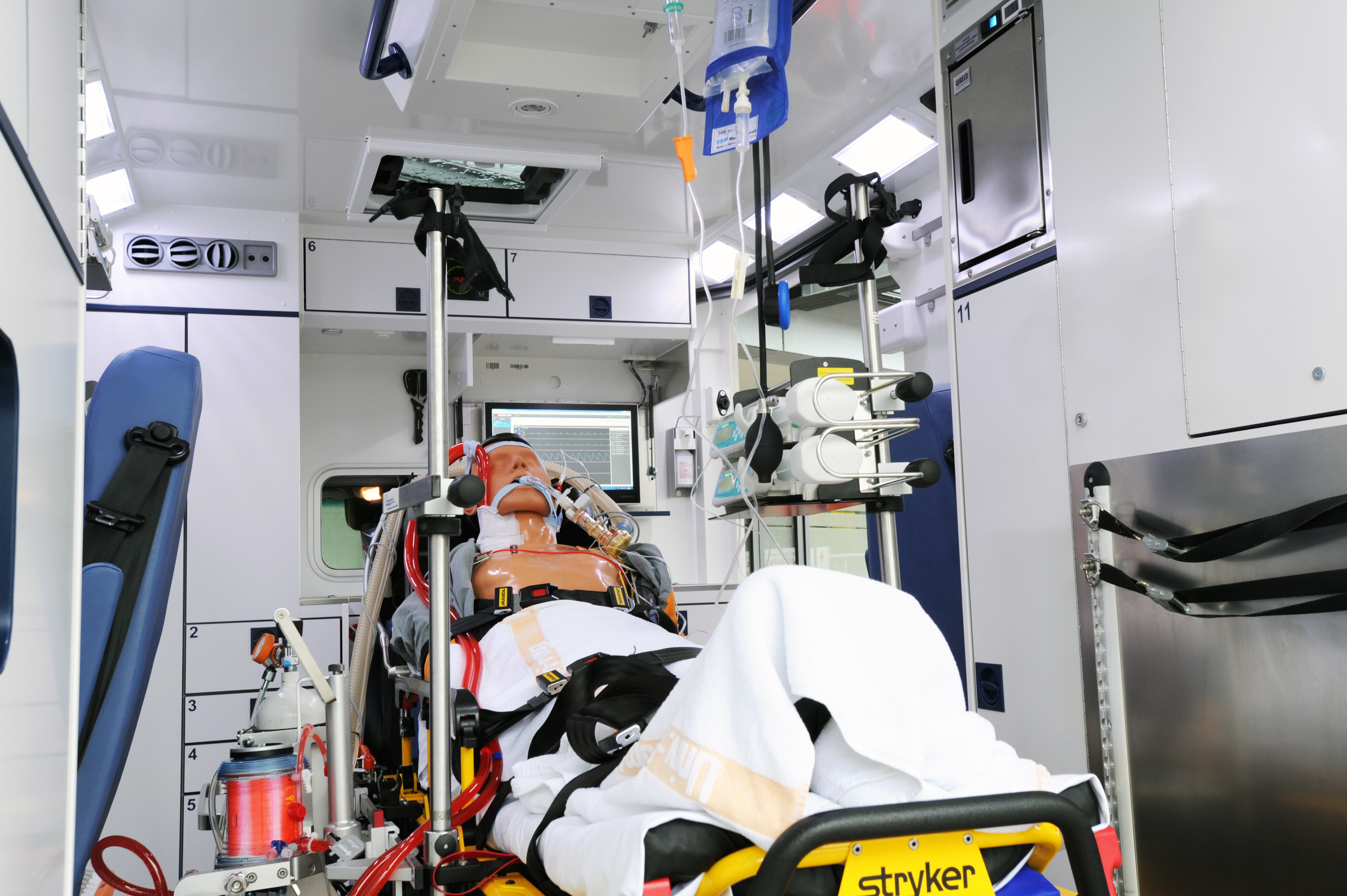
If a patient suffers acute respiratory failure, they should be transferred to an ECMO center as quickly as possible. "Studies have shown that the chances of survival increase significantly if patients are cared for by an experienced, interdisciplinary team in an ECMO center," says Prof. Dr. Hartmut Bürkle, Medical Director of the Department of Anesthesiology and Critical Care. Anesthesiologists, cardiologists, cardiovascular surgeons and cardiotechnicians work closely together at the ECMO Center at the Medical Center - University of Freiburg. Since 2008, a team of three specialists - consisting of an anesthesiologist, a cardiologist and a perfusionist - has been on call 24 hours a day, 365 days a year. If it is requested by another hospital, it has been able to call on the special ECMO mobile since the end of the year. While still in hospital, the patient is connected to the mobile lung replacement machine by the ECMO team and then driven to the ECMO Center at the Medical Center - University of Freiburg for further care in the highly functional intensive care transport vehicle. Unlike conventional transport vehicles, the vehicle has the ability to securely fix the ECMO device and, with large supplies of oxygen and a special energy supply, can also carry out transports lasting hours. A specialized patient monitor system, a modern transport ventilator and infusion pumps are available for this purpose, so that the vehicle is equipped like a treatment station in a modern intensive care unit.
The ECMO mobile was purchased by the Medical Center - University of Freiburg and is intended exclusively for lung replacement transports. Thanks to the cooperation with the German Red Cross (DRK), the transport can be billed to health insurance companies. The Medical Center - University of Freiburg is the only ECMO center in Germany that has its own intensive care transport vehicle for ECMO transports.
The ECMO team is mainly requested in Baden-Württemberg, but there are also supra-regional deployments, for example to Saarland or the Ruhr region. In 2015, the ECMO specialist team was requested by other hospitals around once a week to give critically ill patients with acute lung failure a chance of survival.
The ECMO Center at the Medical Center - University of Freiburg
The Medical Center - University of Freiburg is one of the largest and most renowned ECMO centers in Germany. Already 25 years ago, patients were treated with extracorporeal oxygenators - i.e. invasive lung replacement - in the anesthesiology intensive care unit. In 2009, the Department of Anesthesiology and Critical Care founded the Freiburg Center for Invasive Lung Replacement (iLF) together with the Department of Internal Intensive Care Medicine, the Department of Cardiovascular Surgery and the Department of Cardiotechnology.
With more than 200 bedside procedures (lung and cardiovascular replacement) per year, Freiburg is one of the centers with the greatest expertise in this field in Germany. The extensive experience and interdisciplinary cooperation enable the high quality standard required for a successful lung replacement center.
What is invasive lung replacement - ECMO?
Extracorporeal lung replacement is a reserve procedure that is used exclusively for patients who would not survive lung failure with conventional therapy. In these patients, the lungs are so severely damaged that, despite artificial ventilation, carbon dioxide release or oxygen uptake via the lungs is no longer sufficiently possible. This condition is absolutely life-threatening.
Invasive lung replacement, i.e. extracorporeal membrane oxygenation (ECMO), can be a therapeutic option in these cases. Blood is removed from the body through cannulas in large vessels (cervical, subclavian or inguinal veins), freed of carbon dioxide in a machine via a special plastic membrane and enriched with oxygen. Depending on the clinical picture, the blood is then returned directly to the heart through a large vein or through an artery into the main artery. The machine thus takes over the function of the lungs and, in special cases, even supports the function of the heart. At the same time, the patient's lungs can recover through gentle ventilation of the lungs and treatment of the underlying disease. "If the lungs are irreversibly damaged and the patient is suitable for a lung transplant, invasive lung replacement can also be used to bridge the time until an organ can be transplanted," says Dr. Johannes Kalbhenn, Managing Senior Physician in the Department of Anesthesiology and Critical Care at the Medical Center - University of Freiburg. ECMO therapy can be used for a period of a few days to a few weeks.
Caption 1: The ECMO mobile is also equipped for long journeys: Unlike conventional ambulances, for example, it offers more oxygen supplies and a special energy supply.
Caption 2: The ECMO-Mobile is available around the clock for patients with acute lung failure and transports them to the ECMO Center at the Medical Center - University of Freiburg.
Image rights: Medical Center - University of Freiburg
Further information:
https://www.uniklinik-freiburg.de/anaesthesie/fachgebiete-der-klinik/intensivmedizin/lungenersatz-ecmo.html
www.herzzentrum.de/kliniken-fachbereiche/klinik-fuer-kardiologie-und-angiologie-i/leistungsspektrum/ecmo-zentrum-freiburg
Back
Medical Center - University of Freiburg
Central Information
Phone: 0761 270-0
info@uniklinik-freiburg.de
For press inquiries:
Corporate Communications
Breisacher Straße 153
79110 Freiburg
Phone: 0761 270-84830
kommunikation@uniklinik-freiburg.de