
A trainee program to become a nursing expert
Clinical nursing science(21.01.2025) New roles in nursing: nursing experts with special skills improve care for specific patient groups
Nobody likes being a patient. But some face particularly lengthy or complex treatments. These patients are supported by specialized nursing experts Advanced Practice Nurses (APNs) at the University Medical Center Freiburg. "Our specialists support patients with a risk of delirium or with tumors in the mouth, jaw or facial area, for example," explains Dr. Lynn Leppla, who manages the establishment of new role profiles in nursing in the Clinical Nursing Science, Quality and Development Unit.

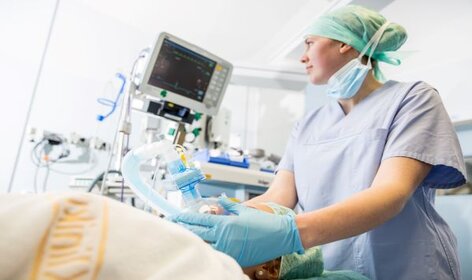
APN support for patients means an enormous leap in the quality of care, as everyone involved in the transplant process has a central point of contact. ©iStock
Tailor-made care
While nursing experts used to be more generalist and responsible for entire clinics, Master's graduates can now focus on patient groups with specific symptoms, diagnoses or therapies in a trainee program and help to establish new care structures. "We spend two semesters developing the future role as an APN, which is then implemented and established over a year and a half with close mentoring support," explains Leppla. At the Tumor Center Freiburg - CCCF, she herself successfully introduced and evaluated an APN-supported care concept for patients with stem cell transplants. She is currently supporting eleven APN trainees in the development of their new clinical roles; further trainee positions are advertised regularly.
Support for liver transplant patients
Ronja Pazouki is one of the first APN trainees and accompanies patients who require a liver transplant. She coordinates the examinations in the specialist departments involved, checks the findings and accompanies the entry on the waiting list for a transplant. "At the same time, I build up a relationship with the patients and listen to their questions and fears," says Pazouki, describing her role before the transplant. "For us doctors, APN support for patients means an enormous leap in the quality of care, as everyone involved in the complex transplant process has a central point of contact. This means that no important information is lost," explains Prof. Dr. Tobias Böttler, who heads the Gerok Liver Center at the University Medical Center Freiburg.
The newly established role is having an effect
For the time after the transplant, Pazouki would like to develop a program to promote self-management as a dissertation project: "I would like to support patients and relatives in coping with the change of life and the challenges of the therapy and to prevent possible complications." The nursing scientist reports enthusiastically: "It's great to be able to apply the content of my studies directly in the clinic, to contribute to professional development and to learn something new every day." The newly established role is having an impact: "The more efficient preparation can be seen in the transplant figures and clearly shows how specialized nursing experts contribute to the further development of care," says Helmut Schiffer, Director of Nursing at the University Medical Center Freiburg.
More interesting articles

Medical Center - University of Freiburg
Central InformationPhone: 0761 270-0
info@uniklinik-freiburg.de
Corporate Communications
Breisacher Straße 15379110 Freiburg
Phone: 0761 270-84830
kommunikation@uniklinik-freiburg.de