
Solar Eclipse: Looking at the sun without protection can cause permanent damage to the retina
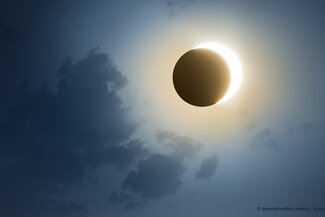
On Wednesday, August 12, 2026, a partial solar eclipse will be visible in Freiburg in the evening. At its peak, around 8:17 p.m., approximately 90 percent of the sun’s disk will be obscured by the moon. However, the visible crescent of the Sun will still be so bright that looking at it without protection can damage the retina. The Eye Center at the Medical Center – University of Freiburg therefore advises observing the solar eclipse only with certified, undamaged solar eclipse glasses.
“Even when the Sun is almost completely obscured, the protective glasses must not be removed. The remaining crescent of the sun can cause permanent damage to the area of the eye responsible for sharpest vision. This usually occurs without pain and is therefore often not noticed until later,” says Dr. Felicitas Bucher, senior physician at the Eye Center at the Medical Center – University of Freiburg.
Concentrated light damages the area of sharpest vision
The cornea and the lens focus the incoming light onto the retina. When looking directly at the sun, the radiant energy is concentrated on a very small area. The macula—the area of the retina responsible for the sharpest vision—is particularly at risk. This central area of the retina is responsible for reading, recognizing faces, and perceiving fine details.
Even when the sun is 99 percent obscured, the light from the remaining crescent strikes the retina with high intensity. Natural glare and the blink reflex do not provide reliable protection. The retina itself has no pain receptors. “Damage can occur without the eye feeling any pain while looking at the sun,” Bucher emphasizes.
According to current knowledge, so-called solar retinopathy is primarily caused by photochemical processes. High-energy light can form reactive molecules. These attack the light-sensitive photoreceptors and the supporting cell layer of the retina.
Symptoms often appear with a delay
“Those affected sometimes notice the effects immediately, but often not until hours or a day later. Longer delays are also possible,” says the ophthalmologist at the Medical Center – University of Freiburg. Typical symptoms include:
- blurred or unfocused vision,
- a gray, dark, or blind spot in the center of the visual field,
- distorted or wavy-looking lines,
- persistent afterimages,
- altered color perception,
- increased sensitivity to light.
Since the macula on the retina is usually affected, the visual defects often occur right in the center of the visual field. Those affected may, for example, still be able to make out the general shape of a text but can no longer clearly recognize individual letters. Faces may also appear obscured or distorted in the central area.
“Anyone who experiences such symptoms after observing a solar eclipse should have their eyes examined by an ophthalmologist as soon as possible. If there is a significant deterioration in vision, an immediate examination is necessary,” recommends Bucher. The symptoms may also have other causes that require treatment. Self-diagnosis is therefore not possible.
Full recovery is not guaranteed
For some of those affected, vision improves within weeks or months. However, a full recovery is not guaranteed. There is no proven treatment that can restore retinal cells that have already been damaged. “It is therefore crucial to prevent solar retinopathy through consistent eye protection,” says the eye specialist.
Regular sunglasses are not sufficient
Only special solar eclipse glasses designed for this purpose and compliant with the DIN EN ISO 12312-2 standard are suitable for looking directly at the sun. The filters must not have any scratches, holes, or other damage. Regular sunglasses, soot-blackened lenses, CDs, emergency blankets, X-ray film, or homemade viewing filters do not provide adequate protection.
Binoculars, telescopes, and cameras are particularly dangerous to the eyes because they further concentrate the sun’s light. Wearing solar eclipse glasses does not provide protection when using such devices.
Medical Center - University of Freiburg
Central InformationPhone: 0761 270-0
info@uniklinik-freiburg.de
Corporate Communications
Breisacher Straße 15379110 Freiburg
Phone: 0761 270-84830
kommunikation@uniklinik-freiburg.de