
More safety for liver interventions
Internal medicine(26.03.2021) Freiburg researchers have developed an evaluation scheme that can be used to assess the success of a common liver procedure much better than before.
The liver is the largest organ in the human body. It is the central metabolic organ and is essential for the detoxification, excretion and storage of many substances. Almost 2,000 liters of blood flow through the liver every day, around 1.5 liters per minute. However, prolonged high alcohol consumption or an unhealed viral infection can permanently damage the liver and lead to dangerous liver cirrhosis. This causes the liver to scar, shrink and form more connective tissue.
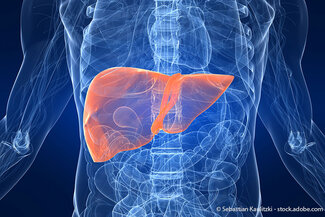
Liver cirrhosis can lead to life-threatening high blood pressure. A minimally invasive procedure can help here. © Sebastian Kaulitzki - stock.adobe.com
"The liver can then no longer fulfill its tasks properly. In addition, the blood flow through the liver with its altered connective tissue is significantly restricted. The accumulated blood can lead to life-threatening complications," says Dr. Dominik Bettinger, senior physician at the Department of Medicine II at the Medical Center - University of Freiburg and fellow of the Berta Ottenstein Program for Advanced Clinician Scientists. Typical consequences are bleeding varicose veins in the oesophagus and the development of abdominal fluid, known as ascites.
A detour relieves the life-threatening blood congestion
"In a situation like this, an interventional procedure can be useful. We then create a kind of detour for the blood at the liver," explains Bettinger. This detour leads the blood from the portal vein, which supplies the liver with blood, directly into the hepatic vein, so that part of the blood flow is diverted past the liver. The detour reduces the pressure in the vascular system in front of the liver and varicose veins in the oesophagus and abdominal fluid retention usually improve quickly.
The procedure was developed and improved in Freiburg
This so-called transjugular intrahepatic portosystemic shunt (TIPS) was developed more than 30 years ago by Prof. Dr. Martin Rössle at the Department of Medicine II of the Medical Center - University of Freiburg. "We use this method for around a third of our liver cirrhosis patients. This makes us one of the centers in Germany with the most TIPS treatments. Accordingly, our physicians have a great deal of experience with the procedure," says Prof. Dr. Robert Thimme, Medical Director of the Department of Medicine II at the Medical Center - University of Freiburg.
All-round care from the liver experts
The procedure is performed at the Medical Center - University of Freiburg by specially trained liver specialists. They know the patient's condition best and look after them before, during and after the procedure. This is essential because the procedure is not an option for every patient with liver cirrhosis. "Before we decide whether to use a TIPS, we have to examine the patient's initial situation very carefully. Many patients benefit from the procedure in the long term; in individual cases, however, there are also reasons that speak against a TIPS procedure If the liver is already too severely damaged, the only option is a liver transplant," explains Dr. Michael Schultheiß, who heads a working group on the procedure together with Bettinger. In a large national, multicenter observational study with 1,871 patients, they were recently able to prove that advanced age and severely impaired kidney and liver function have a negative impact on the prognosis after a TIPS procedure.
Increasing safety for patients
Based on this data, Bettinger and Schultheiß developed a new prognosis score for TIPS patients, the so-called Freiburg Index of post-TIPS survival (FIPS). "With the help of the FIPS score, we can predict very well to what extent patients are suitable for TIPS and which aftercare programs make sense for them individually. At the same time, we can specifically identify high-risk patients for whom a liver transplant should be considered at an early stage, says Bettinger. For patients, the new prognosis tool now means even more safety and more individualized aftercare.
More interesting articles
Medical Center - University of Freiburg
Central InformationPhone: 0761 270-0
info@uniklinik-freiburg.de
Corporate Communications
Breisacher Straße 15379110 Freiburg
Phone: 0761 270-84830
kommunikation@uniklinik-freiburg.de