
Emmy Noether Group - Systems Ophthalmology
Using cutting-edge omics technology to decode the molecular landscape of retinal diseasesRetinal diseases like age-related macular degeneration and diabetic retinopathy represent the most common cause of irreversible blindness and are estimated to affect about 500 million people by 2040. The complex mechanisms are still poorly understood and for many patients, especially in early disease stages, there is still no therapy available.
Technological advances now allow to simultaneously measure thousands of molecules (such as genes, transcripts and proteins) in a single sample and by analyzing and integrating these large amounts of data, our Systems Ophthalmology approach aims to comprehensively model the function of the human eye.
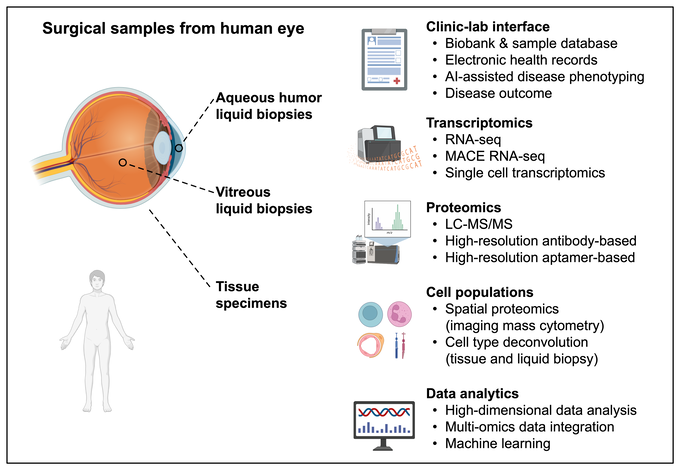
We have developed expertise in applying cutting-edge multi omics technology (e.g. RNA-sequencing, mass spectrometry-based proteomics, highly multiplexed antibody- and aptamer-based proteomics, spatially resolved single-cell analysis using imaging mass cytometry) with a particular focus on the specific needs of clinical samples from the human eye. In addition, our experience with computational and machine learning tools in combination with clinical expertise is fundamental for the comprehensive analysis of this multidimensional data. These disease models enable us to assess molecular and cellular disease states and to uncover novel insights into disease mechanisms with direct translational impact.
Our Systems Ophthalmology approach has helped us to provide new insights into the pathophysiology of ocular diseases and to better understand how this is reflected by different mouse models. We identified novel biomarkers and therapeutic targets for retinal diseases, such as age-related macular degeneration and developed the Human Eye Transcriptome Atlas, which provides web-based access to our gene expression profiles of currently more than 200 diverse ocular specimens to the scientific community.

Dr. med. Julian Wolf, MD, MSc, FEBO
julian.wolf@uniklinik-freiburg.de
Emmy Noether Research Group Leader
Dr. med. (Bochum), M.Sc. (Stanford), PostDoc (Stanford)
Publications
>45 peer-reviewed publications: Google Scholar
Funding
- Emmy Noether-Programm der Deutschen Forschungsgemeinschaft (DFG)
- Helmut Ecker Stiftung
- Kinder Augen Krebs Stiftung
- Volker Homann Stiftung
Selected awards
- Retina Research Award, German Society of Ophthalmology, 2024
- Prof. Lommatzsch Research Award, German Retina Society, 2024
- Research Award of the VitreoRetinal Surgery Foundation, USA, 2023
- Helmholtz Research Award, German Society of Ophthalmology, 2022
- Henning-Zügel-Stiftung Research Award, University of Freiburg, 2021
Selected Publications
- Wolf J, Rasmussen DK, Sun YJ, Vu JT, Wang E, Espinosa C, Bigini F, Chang RT, Montague AA, Tang PH, Mruthyunjaya P, Aghaeepour N, Dufour A, Bassuk AG, Mahajan VB. Liquid-biopsy proteomics combined with AI identifies cellular drivers of eye aging and disease in vivo. Cell. 2023 Oct 26;186(22):4868-4884.e12. doi: 10.1016/j.cell.2023.09.012. Epub 2023 Oct 19. PMID: 37863056.
- Wolf J, Boneva S, Schlecht A, Lapp T, Auw-Haedrich C, Lagrèze W, Agostini H, Reinhard T, Schlunck G, Lange C. The Human Eye Transcriptome Atlas: A searchable comparative transcriptome database for healthy and diseased human eye tissue. Genomics. 2022 Mar;114(2):110286. doi: 10.1016/j.ygeno.2022.110286 Epub 2022 Feb 3. PMID: 35124170.
- Wolf J, Schlecht A, Rosmus DD, Boneva S, Agostini H, Schlunck G, Wieghofer P, Lange C. Comparative transcriptome analysis of human and murine choroidal neovascularization identifies fibroblast growth factor inducible-14 as phylogenetically conserved mediator of neovascular age-related macular degeneration. Biochim Biophys Acta Mol Basis Dis. 2022 Apr 1;1868(4):166340. doi: 10.1016/j.bbadis.2022.166340. Epub 2022 Jan 12. PMID: 35032596.
- Wolf J, Boneva S, Rosmus DD, Agostini H, Schlunck G, Wieghofer P, Schlecht A, Lange C. In-Depth Molecular Profiling Specifies Human Retinal Microglia Identity. Front Immunol. 2022 Mar 18;13:863158. doi: 10.3389/fimmu.2022.863158. PMID: 35371110.
- Wolf J, Auw-Haedrich C, Schlecht A, Boneva S, Mittelviefhaus H, Lapp T, Agostini H, Reinhard T, Schlunck G, Lange CAK. Transcriptional characterization of conjunctival melanoma identifies the cellular tumor microenvironment and prognostic gene signatures. Sci Rep. 2020 Oct 12;10(1):17022. doi: 10.1038/s41598-020-72864-0. PMID: 33046735.
- Wolf J, Franco JA, Yip R, Dabaja MZ, Velez G, Liu F, Bassuk AG, Mruthyunjaya P, Dufour A, Mahajan VB. Liquid Biopsy Proteomics in Ophthalmology. J Proteome Res. 2024 Feb 2;23(2):511-522. doi: 10.1021/acs.jproteome.3c00756. Epub 2024 Jan 3. PMID: 38171013.
- Lapp T, Kammrath Betancor P, Schlunck G, Auw-Hädrich C, Maier P, Lange C, Reinhard T, Wolf J. Transcriptional profiling specifies the pathogen-specific human host response to infectious keratitis. Front Cell Infect Microbiol. 2024 Jan 11;13:1285676. doi: 10.3389/fcimb.2023.1285676. PMID: 38274739.
- Pauleikhoff L, Boneva S, Boeck M, Schlecht A, Schlunck G, Agostini H, Lange C*, Wolf J*. Transcriptional Comparison of Human and Murine Retinal Neovascularization. Invest Ophthalmol Vis Sci. 2023 Dec 1;64(15):46. doi: 10.1167/iovs.64.15.46. *contributed equally. PMID: 38153746.
- Boneva S, Schlecht A, Böhringer D, Mittelviefhaus H, Reinhard T, Agostini H, Auw-Haedrich C, Schlunck G, Wolf J*, Lange C*. 3' MACE RNA-sequencing allows for transcriptome profiling in human tissue samples after long-term storage. Lab Invest. 2020 Oct;100(10):1345-1355. doi: 10.1038/s41374-020-0446-z. Epub 2020 May 28. *contributed equally. PMID: 32467590.
- Wolf J, Hajdu RI, Boneva S, Godbole I, Stürzbecher L, Auw-Haedrich C, Lagrèze WA, Agostini H, Reinhard T, Tholen S, Schilling O, Schlunck G, Bengsch B, Lange C. A proteotranscriptomic approach to dissect the molecular landscape of human retinoblastoma. Front Oncol. 2025 May 6;15:1571702. doi: 10.3389/fonc.2025.1571702. PMID: 40395327.
Collaborations
- Prof. V. Mahajan, MD PhD, Department of Ophthalmology, Stanford University, USA
- Prof. Dr. Dr. C. Lange, Department of Ophthalmology, St. Franziskus Hospital, Münster, Germany
- Prof. Dr. Dr. B. Bengsch, CyTOF-Facility, Clinic for Internal Medicine II, University of Freiburg, Germany
- Prof. Dr. O. Schilling, Institute of Surgical Pathology, University of Freiburg, Germany
- Prof. Dr. P. Wieghofer, Cellular Neuroanatomy, Institute of Theoretical Medicine, University of Augsburg, Germany
- Prof. Dr. T. Lapp, Department of Ophthalmology, St. Franziskus Hospital, Münster, Germany