Origin of central immune cells in brain vessels elucidated
Cells form independently of the rest of the immune system / 30-year assumption disproved / Significance for multiple sclerosis, Alzheimer's and HIV / Study published in the journal Nature ImmunologyMacrophages, also known as phagocytes, protect the brain as part of the blood-brain barrier, among other things. For around 30 years, it was assumed that these brain macrophages originate from the blood and are regularly replaced. Now researchers at the Institute of Neuropathology at the Medical Center - University of Freiburg have discovered in mice that the cells migrate into the brain once during embryonic development and multiply there independently throughout life. In future, researchers could use the pathway now identified to introduce cells into the brain, for example to treat neurodegenerative diseases such as Alzheimer's. The study was published on May 2, 2016 in the journal Nature Immunology.
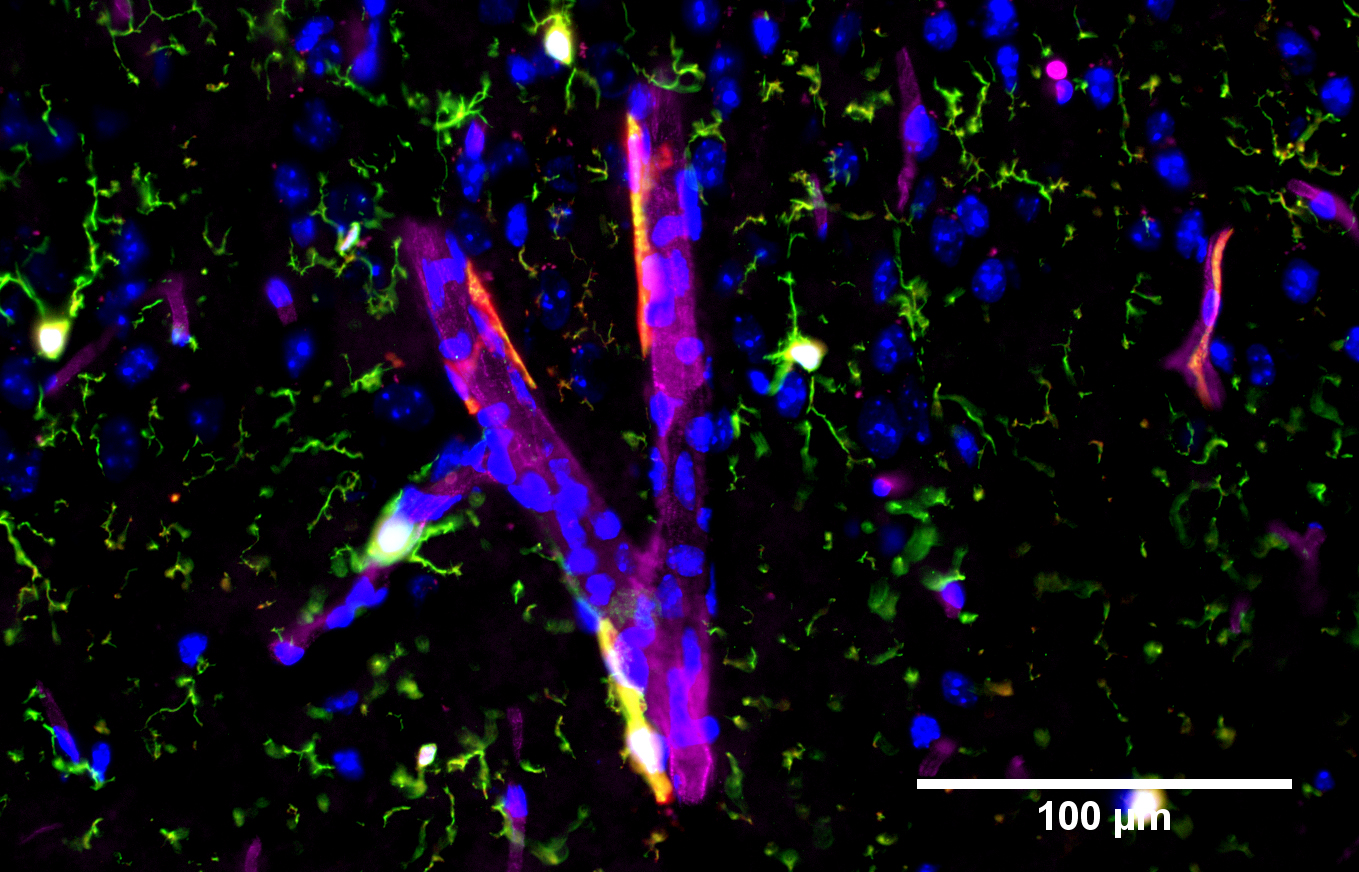
In the brain, macrophages are found in strategically important places: on the meninges on the surface of the brain, around the blood vessels, in the plexus epithelium and at the border of the brain, the so-called blood-brain barrier. There they not only take on important guardian functions, but can also repair injured blood vessels and ward off germs in bacterial and viral infections.
From the yolk sac to the brain
"We were able to show that brain macrophages develop largely independently of the formation of normal immune cells," says study leader Prof. Dr. Marco Prinz, Medical Director of the Institute of Neuropathology at the Medical Center - University of Freiburg. Together with the biologists and first authors of the study Dr. Tobias Goldmann, Dr. Peter Wieghofer and Marta Joana Costa Jordão , he demonstrated that the precursors of brain macrophages make a long pilgrimage through the body at the beginning of embryonic development: from the stem cell-forming yolk sac of the embryo to the brain.
The researchers were also able to identify the exact point at which the cells migrated into the brain. "We have thus found a kind of weak point in the brain's defenses, through which we could introduce cells into the brain in the future," says Prof. Prinz. This knowledge could also be important for the treatment of diseases such as HIV, multiple sclerosis and Alzheimer's, in the development of which macrophages are likely to be involved.
Possible significance for leukemia treatment
The results are also exciting for blood cancer research. This is because some leukemia patients receive bone marrow cell transplants. "Whether the macrophages on the vessels and the meninges are also exchanged as a result is of great importance for the therapy. If we understand this better, we will be able to prevent the neurological side effects that sometimes occur," said haematologist Prof. Dr. Robert Zeiser, research professor at the Department of Medicine I (Specialties: Haematology, Oncology and Stem Cell Transplantation) at the Medical Center - University of Freiburg, who was involved in this study. The next step is to check whether the results of the animal study can be confirmed in humans.
Title of the original study: Origin, fate and dynamics of macrophages at central nervous system interfaces
DOI: 10.1038/ni.3423
Link to the study: www.ncbi.nlm.nih.gov/pubmed/27135602
Further information:
PM: Why influenza and other viral infections cause depression
PM: Freiburg neuropathologist receives one million euros in innovation funding from the DFG
Caption: Border control: The blood vessels (purple) in the brain are used to check exactly what is allowed to penetrate the brain cells (green) and what is not. Special macrophages (yellow, reddish), which line the blood vessels and are only found in the brain, play an important role in this process. (Blue: nuclei of different cells)
Image source: Medical Center - University of Freiburg
Contact:
Prof. Dr. Marco Prinz
Medical Director
Institute of Neuropathology
Medical Center - University of Freiburg
Phone: 0761 270-51060
marco.prinz@uniklinik-freiburg.de