
An almost normal life
Thanks to treatment at the Center for Chronic Immunodeficiency, Kai has his rare immune disease under control
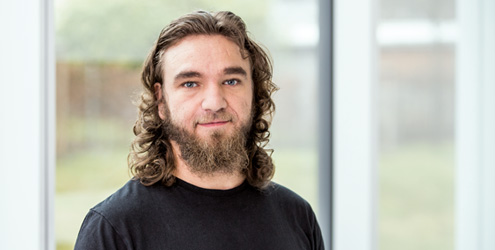
At the very beginning, Kai was not supposed to be older than five. Kai was constantly seriously ill and nobody knew why. A total of six HIV tests were carried out because this seemed to best explain the constant pneumonia, asthma attacks, skin rashes and fungal infections. Hyper-IgE syndrome was first suspected at the age of two, but it wasn't until 20 years later that it was confirmed by a genetic test. Today, Kai is 26 and he knows for sure that his STAT-3 gene on the 21st chromosome is defective and causes his body to produce too many of a certain antibody (immunoglobulin E) against parasites and too few of other antibodies against bacteria, viruses and fungi.
There are less than 1000 cases of hyper-IgE syndrome in the world. The disease is not only rare, the symptoms are also very different. What all patients have in common is that their milk teeth do not fall out and have to be extracted. Kai also has very severe allergies to milk protein products, nuts, mold, non-precious metals and polyester, and his bones are constantly breaking: almost all of his fingers, several toes, both collarbones, an ankle joint and even the base of his skull. He didn't even notice the broken kneecap.
At elementary school, Kai would have preferred it if nobody had known about his illness, but a teacher blabbed and from then on he was really ostracized. He became more and more of a loner. It wasn't until he moved to Freiburg that things changed. Here he leads an almost normal life as a physics student in a shared flat. This works because the Center for Chronic Immunodeficiency (CCI) at the Medical Center - University of Freiburg has found the right therapy mix.
Kai receives immunoglobulin therapy once a month, he constantly takes an antibiotic and an antifungal, he applies ointments when needed and he can always call his physician Prof. Dr. Bodo Grimbacher, Scientific Director at the CCI, on his cell phone. He moved to Freiburg from Giessen mainly for this individual care. He was no longer able to continue his studies there because the disease had become too severe. Nevertheless, the start in Freiburg was once again not easy. The BAföG office did not want to recognize that he was lagging behind in his physics studies due to his illness and did not pay for a year. It was only shortly before the court hearing that the office relented and paid everything in arrears.
In the meantime, it's not far to his bachelor's degree and Kai has plans. He wants to go to Japan for "work and travel". He wants to learn Japanese and train in Aikido, maybe do a Master's degree later, work as a physicist and adopt two children. There is a 50% chance that he would pass on his genetic defect to a biological child. He doesn't want that, but there is still one very important item on his list. The CCI is currently conducting research into gene scissors that could disable his defective gene. Kai would be cured. It has already worked on single-celled organisms. Next up are the mice. "If it comes to a study on humans, I'll be the first to sign up," says Kai. Until then, he wants to stay in Freiburg. He has enough time to wait.
Corporate Communications
Breisacher Straße 153
79110 Freiburg
Phone: 0761 270-84830
Fax: 0761 270-9619030
kommunikation@uniklinik-freiburg.de