
"The kidney grows with its tasks"
Kidney failure - this diagnosis changed everything. From then on, Christian Dages' life was dominated by dialysis appointments. His mother wanted to donate a kidney to him, but it turned out that she had a different blood group. PD Dr. Przemyslaw Pisarski and his team from the Department of General and Visceral Surgery nevertheless made a transplant possible.
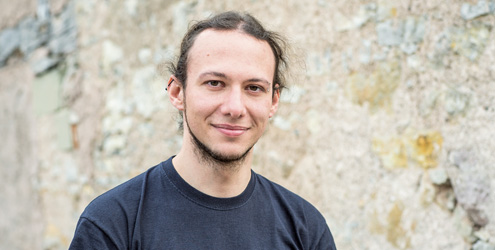
Christian Dages had finally passed his last technician exam. He was tired and exhausted. But that didn't worry him, as he had had a very strenuous few weeks. What was unusual, however, was that his vision was poor and he felt a headache. His ophthalmologist diagnosed a crushed optic nerve and referred Christian to the Medical Center - University of Freiburg for immediate clarification. "I was examined the same day in Freiburg," recalls the 28-year-old "The suspicion that a blood clot or tumor could be the cause of the contusion turned out to be wrong." However, his blood pressure was worryingly high. The doctors then tested his keratin value, which allows conclusions to be drawn about the function of the kidneys. This was 7.1 - a value of less than 1.2 is normal.
Christian went to the emergency room. "I told my grandpa, who had accompanied me to Freiburg, to go home and calm grandma down." Christian lives with his girlfriend in his grandparents' house, in an idyllic location on the edge of the southern Black Forest. While his grandfather drove home, the young man underwent further examinations before being admitted to hospital. It soon became clear that the kidney was only working to a limited extent. The residual function was 13 percent. The diagnosis was glomerulonephritis, an autoimmune disease that leads to inflammation of both kidneys.
Preventing rejection of the new kidney
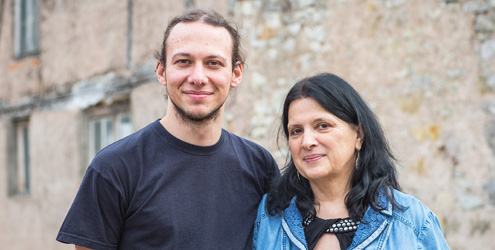
In late spring 2014, Christian underwent drug treatment to save his kidney, but without success. He had to start dialysis in late summer. "That changed everything for me. I had to go to dialysis three times a week for four and a half hours each time. Actually, my whole life revolved around it." His only treatment option was a kidney transplant. "My mother wanted to donate a kidney to me and I am very grateful to her for that. But it turned out that we have different blood groups," says Christian.
During a transplant, the antibodies in the recipient's blood recognize a foreign blood group in the donor organ and trigger a severe rejection reaction. The result is the loss of the organ. However, the Freiburg Transplant Center has been successfully using a procedure for years that enables so-called AB0-incompatible living kidney donation. "We prevent a rejection reaction by removing the antibodies from the recipient's blood before the procedure," explains PD Dr. Przemyslaw Pisarski, Head of the Transplantation Section. "This procedure is also necessary a further two weeks after the transplant. By then, the immune system will have become accustomed to the new organ and further treatment can be carried out as after a normal transplant."
Transplantation had to be postponed
The transplant was due to take place in June 2015. But then, shortly before the operation date, Christian fell ill with a sinus infection, which dragged on for some time. This was followed by months of preparation for the new transplant date. In mid-February 2016, the time had come. Christian's mother was wheeled into the operating room at 7.30 am, and he himself at 10.30 am. Four hours later, they were both back in their rooms. The operation had gone well. "I felt so good that I was even able to write to my girlfriend." Two weeks after the operation, Christian suffered a kidney blockage, but this could be treated and he recovered quickly.
"Today I take 9.5 tablets a day, but what is that compared to almost 15 hours of dialysis a week?" And his mother? "Her kidney values were elevated after the operation, but that wasn't unusual as one kidney now had to do all the work. The physicians said that the kidney grows with its tasks and fortunately he was right." He and his mother still go for regular check-ups. Both are doing well today.
Corporate Communications
Breisacher Straße 153
79110 Freiburg
Phone: 0761 270-84830
Fax: 0761 270-9619030
kommunikation@uniklinik-freiburg.de