
Ways out of the antibiotics trap
G20 Health Ministers' Meeting on May 19 and 20, 2017 with a focus on antibiotic resistance / An advanced training and a research project at the Medical Center - University of Freiburg show how the problem of antibiotic resistance could be tackled
On May 19 and 20, 2017, the health ministers of the 20 most important industrialized and emerging countries will meet in Berlin for the first time. One focus of this G20 conference will be the fight against antibiotic resistance. This is because many pathogens have developed resistance to the majority of available drugs. Increasingly, even the simplest bacterial infections are no longer treatable and can lead to the death of the patient. In order to better train physicians and pharmacists in the use of antibiotics, a unique training program was launched at the Medical Center - University of Freiburg in 2010, which has since been successful nationwide. In addition, a European study led by the Medical Center - University of Freiburg is currently investigating how resistant pathogens spread regionally and across national borders.
Successfully training physicians in the use of antibiotics
"If antibiotics continue to be prescribed as indiscriminately as in the past, we risk a relapse into the pre-antibiotic era. We can and must avoid this," says Prof. Dr. Winfried Kern, Head of the Department of Infectiology at the Medical Center - University of Freiburg. "Unfortunately, physicians have often lacked the necessary knowledge about when and how antibiotics can be used in a more targeted manner and how their use can be reduced without endangering the patient." This is why the infectiologist launched the first training initiative on the sensible use of antibiotics, the "Antibiotic Stewardship" program, at the Medical Center - University of Freiburg back in 2009. In several stages, participants learn everything from the basics of the development of resistance and the treatment of serious infections to the comprehensive planning and implementation of their own measures to reduce the use of antibiotics in hospitals.
By mid-2017, over 500 physicians and pharmacists had been trained as "antibiotics experts" in this program, which is unique in Germany. Around 800 participants are currently taking part in the advanced training, which is now offered at nine locations in Germany. "The aim is to have a team of trained physicians and pharmacists at small and medium-sized acute hospitals who can advise the physicians there and monitor the use of antibiotics. At least another 500 such experts are needed," says Prof. Kern. The program was supported by the German Federal Ministry of Health in 2010-2013 and presented to the heads of state and government of the seven most important industrial nations as an example of best practice at the G7 summit in 2015.
Weather map for resistant pathogens
Only those who know how resistant bacteria spread can specifically stop or even prevent transmission. Prof. Dr. Hajo Grundmann, Head of the Infection Prevention and Hospital Hygiene Section at the Medical Center - University of Freiburg, is researching exactly how these pathways spread. "We know from previous studies that resistant pathogens initially spread primarily within regional care networks, for example between hospitals and physicians in private practice," says Prof. Grundmann. But so far there are no comprehensive figures on how patients move within and across such networks and thus spread resistant pathogens.
Under the leadership of Prof. Grundmann, researchers from 36 countries in Europe are therefore analyzing the entire genome of resistant pathogens using DNA sequencing. This allows related pathogens to be identified and then plotted on a map. "In future, physicians or authorities will be able to recognize how pathogens that are difficult to treat spread across national borders, comparable to a storm front on a weather map. In the best case scenario, countermeasures could be taken in good time," says Prof. Grundmann. The project data is already publicly available on a website.
The two projects show promising ways to push back antibiotic resistance. "However, networks between clinics, physicians in private practice and pharmacists need to be established in order to spread the successes. So far, there has often been a lack of money here. That has to change," says Prof. Grundmann.
Further information:
www.uniklinik-freiburg.de/infektiologie.html<link infektiologie.html>Department of Infectiology, Medical Center - University of Freiburg
<link iuk infektionspraevention-und-krankenhaushygiene.html>www.uniklinik-freiburg.de/iuk/infektionspraevention-und-krankenhaushygiene.html Section for Infection Prevention and Hospital Hygiene, Medical Center - University of Freiburg
www.antibiotic-stewardship.de Continuing education program Antibiotic Stewardship
http://www.microreact.org/project/EkUvg9uY?tt=rc Electronic map for infectious pathogens
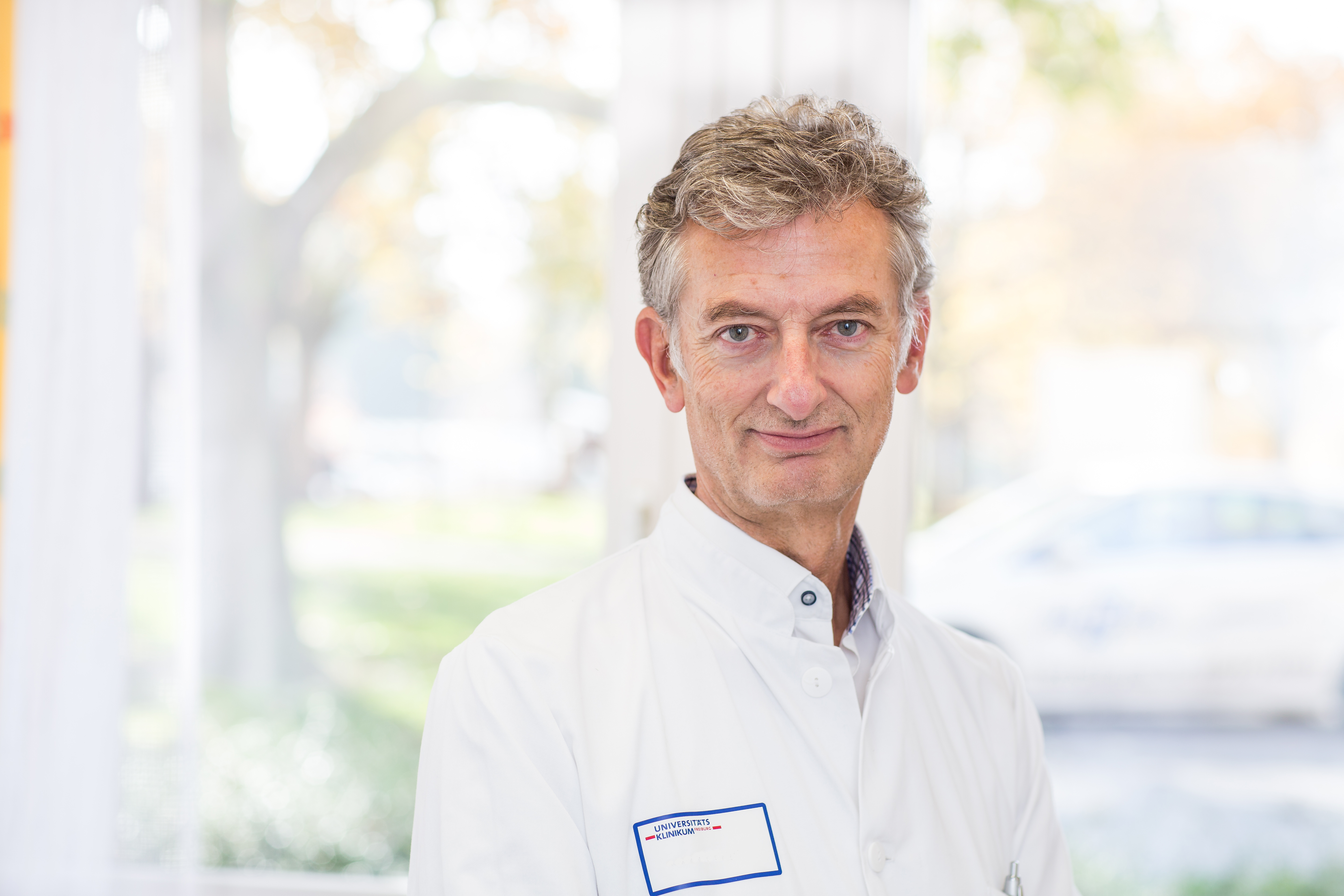
Image 1: Prof. Dr. Winfried Kern
Image 2: Prof. Dr. Hajo Grundmann
Image rights: Medical Center - University of Freiburg/Britt Schilling
Contact:
Prof. Dr. Winfried Kern
Head of the Department of Infectiology
Department of Medicine II
Medical Center - University of Freiburg
Phone: 0761 270-18190
winfried.kern@uniklinik-freiburg.de
Prof. Dr. Hajo Grundmann
Head of the Infection Prevention and Hospital Hygiene Section
Uniklinikum Freiburg
Phone: 0761 270-82750
hajo.grundmann@uniklinik-freiburg.de

Back
Medical Center - University of Freiburg
Central Information
Phone: 0761 270-0
info@uniklinik-freiburg.de
For press inquiries:
Corporate Communications
Breisacher Straße 153
79110 Freiburg
Phone: 0761 270-84830
kommunikation@uniklinik-freiburg.de