
Artificial intelligence improves colorectal cancer screening
AI-based system at the Medical Center - University of Freiburg detects up to ten percent more colorectal cancer precursors during a colonoscopy / Colorectal Cancer Awareness Month in March to promote screening
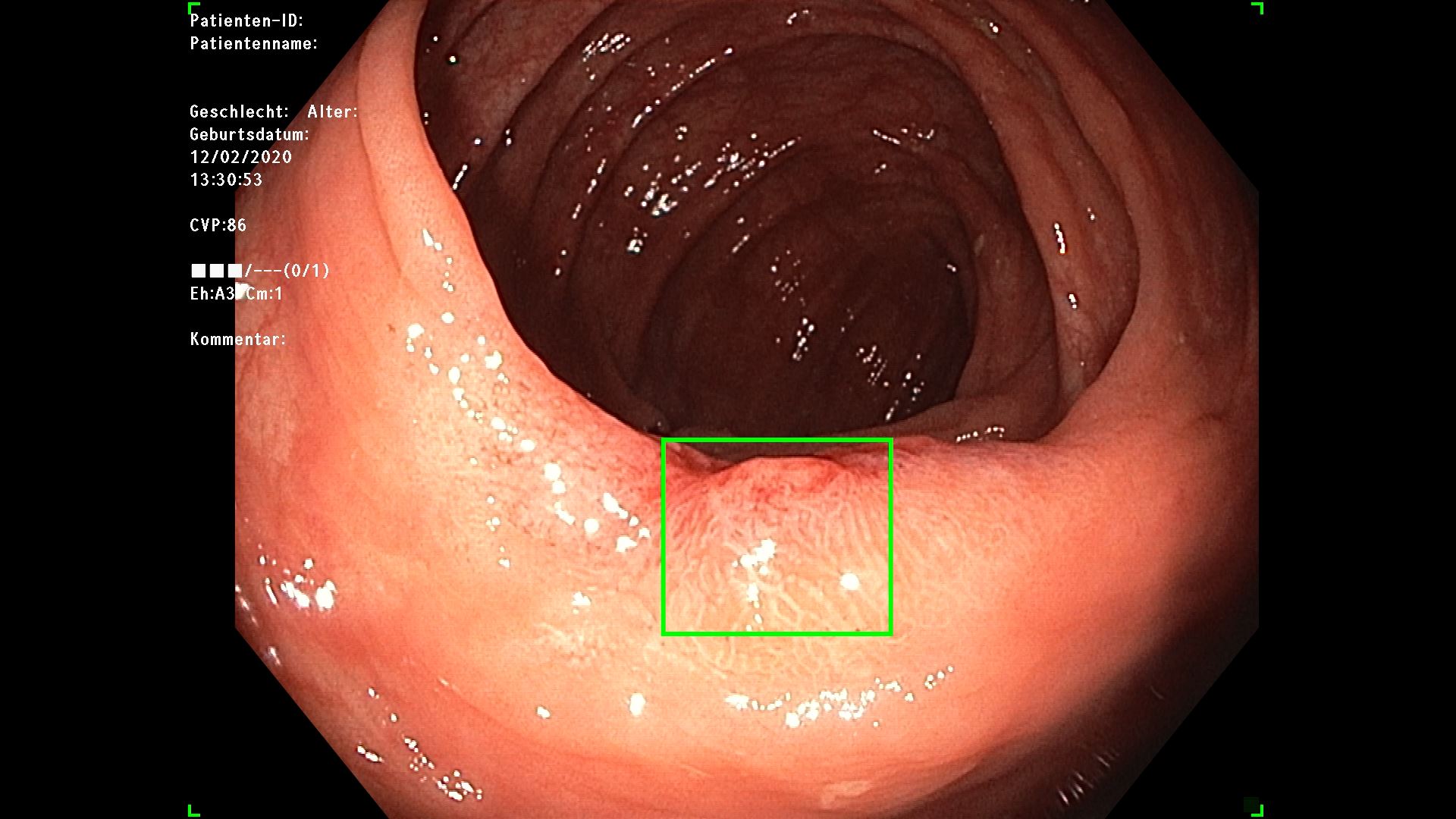
Endoscopy experts at the Medical Center - University of Freiburg are now using artificial intelligence (AI) to reliably detect even more and smaller precancerous lesions during a colonoscopy. During the colonoscopy, the system analyzes the live video images and marks suspicious areas on the monitor with a green rectangle. Studies show that physicians find around ten percent more precancerous lesions than without AI support. Since the beginning of the year, all screening colonoscopies at the Medical Center - University of Freiburg have been carried out with the help of the new system. More than 50 people have already been successfully examined in this way. This makes Medical Center - University of Freiburg the first university hospital in Germany to use the new technology on a regular basis.
"With the support of artificial intelligence, we can offer our patients even greater safety in colorectal cancer screening," says PD Dr. Arthur Schmidt, Head of Interdisciplinary Endoscopy at the Department of Medicine II at the Medical Center - University of Freiburg. The system can help even very experienced doctors to detect abnormal tissue structures more reliably. "This allows us to detect and remove very small precursors even more reliably," says Schmidt.
The system was trained using several thousand images of suspicious precancerous lesions using the deep learning method. The software developed its own search patterns, with which the success rate for detecting these tissues was particularly high. As the optical markers are superimposed on the colonoscopy image immediately during the examination, physicians do not need any training. "While the human eye always focuses on one point in the image, the AI has the entire image in view at all times. Ultimately, of course, we humans assess and decide whether something needs to be removed," says Schmidt.
Colonoscopy: one of the most effective tools for early cancer detection
Around 60,000 people are diagnosed with bowel cancer in Germany every year. Regular screening examinations could prevent the majority of these diseases. This is because screening colonoscopy is considered one of the most effective tools for the early detection of cancer. It is paid for by health insurance companies every ten years from the age of 55. For people with an increased risk of developing the disease, such as those with a family history of bowel cancer, an earlier examination may also be advisable.
During a colonoscopy, physicians examine the condition of the colon. A special endoscope is inserted, which immediately provides a moving and illuminated image of the inside of the body. If suspicious tissue is detected, it can be removed directly with a wire loop and sent to the laboratory for further examination. March has been "Bowel Cancer Awareness Month" for several years. Among other things, this is intended to draw attention to the importance of preventive screening.
Caption:
Using artificial intelligence, the software recognizes suspicious tissue during the colonoscopy and thus supports the endoscopy experts. Medical Center - University of Freiburg
Video information:
As soon as suspicious tissue appears on the monitor, it is marked with a green rectangle. The marking remains fairly accurate even when the camera moves. Medical Center - University of Freiburg
Contact:
PD Dr. Arthur Schmidt
Medical Director of Endoscopy
Department of Medicine II
Medical Center - University of Freiburg
Phone: 0761 270-25424
arthur.schmidt@uniklinik-freiburg.de
Back
Medical Center - University of Freiburg
Central Information
Phone: 0761 270-0
info@uniklinik-freiburg.de
For press inquiries:
Corporate Communications
Breisacher Straße 153
79110 Freiburg
Phone: 0761 270-84830
kommunikation@uniklinik-freiburg.de