
Virtual reality as preparation for everyday surgery
Development of a VR trainer for surgical assistants at the Medical Center - University of Freiburg / Around 300,000 euros in funding from the Federal Ministry of Education and Research
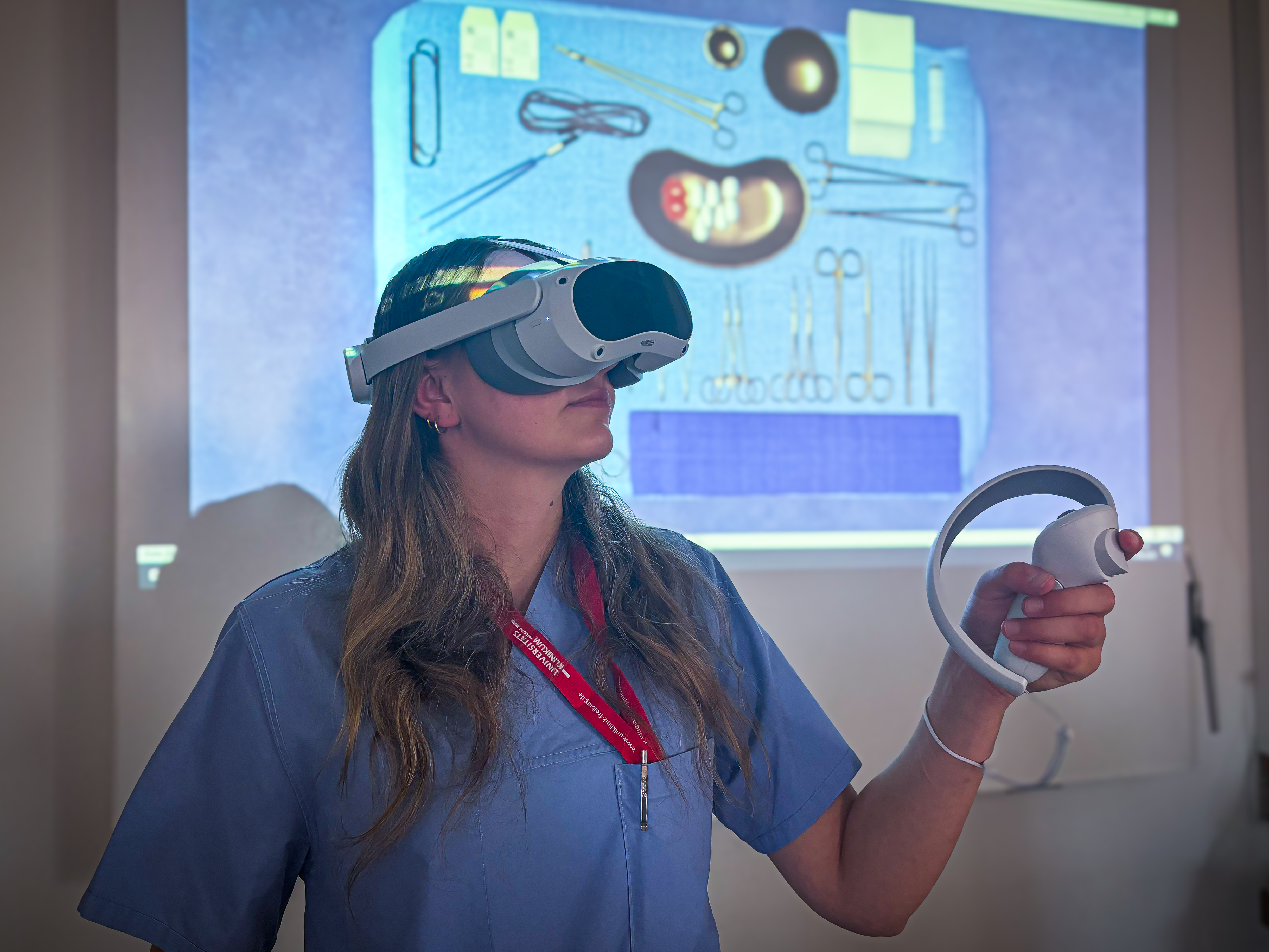
An interactive and practical learning environment thanks to virtual reality: the Medical Center - University of Freiburg is working with Furtwangen University and the start-up VIRTUAPIXEL to develop an innovative VR program for training surgical assistants (OTAs). Virtual reality (VR) enables trainees to learn important skills such as handing surgical instruments in a realistic, digital environment. The project is being funded by the Federal Ministry of Education and Research (BMBF) with around 300,000 euros for a period of 18 months until March 2026. During this time, an initial prototype is to be developed into a comprehensive training program for prospective OTAs.
"With the VR program, we want to give the trainees a protected environment in which to play through various scenarios and thus internalize important hand movements and procedures without real patients being involved," says Helmut Schiffer, Nursing Director of the Medical Center - University of Freiburg.
Precise feedback and learning hand movements
In an initial prototype of the VR trainer, trainees can already practise selecting the correct instrument and arranging it correctly on the instrument table. In addition, the trainees can use a virtual magnifying glass to view the instruments in detail, which deepens their understanding of the tools and their handling.
"Our aim is to develop this prototype into a fully comprehensive VR trainer that includes all the important modules to optimally prepare the trainees for their everyday work," says Marisa Birkenmeier, main practice instructor for the central operating theaters at the Medical Center - University of Freiburg. The planned modules include getting to know the instruments, preparing an instrument table, assisting during operations, mastering stressful situations and receiving real-time feedback. Dealing with errors is also to be improved.
DATIpilot funding program
The Federal Ministry of Education and Research (BMBF) received a total of 3,000 applications as part of the DATIpilot funding program; 600 teams were then invited to the DATIpilot roadshows taking place in several cities. After a 5-minute pitch, the VR trainer was able to convince directly.
Caption: Selecting the right instrument and arranging it correctly on the instrument table - these exercises are already possible in a first prototype of the VR trainer.
Image source: Medical Center - University of Freiburg
Back
Medical Center - University of Freiburg
Central Information
Phone: 0761 270-0
info@uniklinik-freiburg.de
For press inquiries:
Corporate Communications
Breisacher Straße 153
79110 Freiburg
Phone: 0761 270-84830
kommunikation@uniklinik-freiburg.de