
When Metabolism Causes Liver Disease
Internal Medicine(November 25, 2026) Fat deposits in the liver often go unnoticed for a long time, but they can cause inflammation and scarring. The Department of Medicine II at the Medical Center – University of Freiburg combines expertise in liver and metabolic diseases and offers patients a specialized MASLD outpatient clinic.
Specialized Outpatient Clinic for Metabolic Liver Diseases at the Medical Center – University of Freiburg
The MASLD Outpatient Clinic at the Gerok Liver Center at the Medical Center – University of Freiburg provides care for people with metabolic liver diseases. The clinic, led by PD Dr. Dr. Natascha Röhlen, is open on Friday mornings.
To schedule an appointment: 0761 270-33080 | More information about the Gerok Liver Center
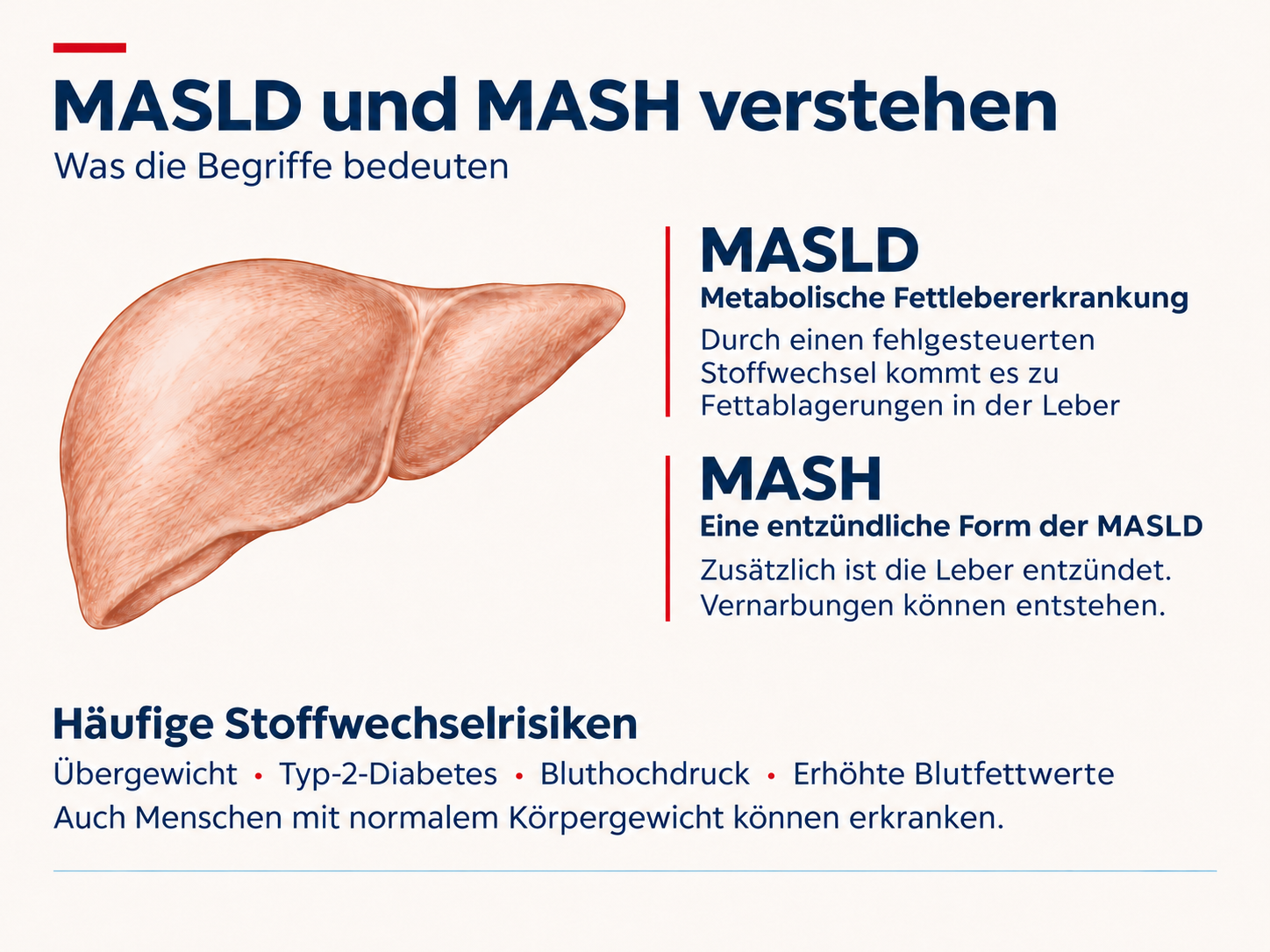
The liver can accumulate fat and become inflamed without the person affected noticing anything. However, if left untreated, this can lead in the long term to scarring in the form of liver fibrosis and even liver cirrhosis. That is why it is important to regularly screen patients at increased risk for metabolically-related fat accumulation in the liver—such as those with type 2 diabetes—for the presence of liver fibrosis.
What is metabolic liver disease?
- MASLD—metabolic fatty liver disease: The full name is metabolic dysfunction-associated steatotic liver disease. Fat deposits in the liver are caused by metabolic dysregulation, which occurs particularly in patients who are overweight, have diabetes mellitus, or have a lipid metabolism disorder. The condition was previously referred to as non-alcoholic fatty liver disease (NAFLD).
- MASH – the inflammatory form: Metabolic dysfunction-associated steatohepatitis is a progression of MASLD in which fat deposits cause liver inflammation. This can lead to scarring (liver fibrosis), which over the years can progress to cirrhosis and an increased risk of liver cancer.
Who is particularly at risk?
MASLD is particularly common in people with type 2 diabetes or who are overweight. Other risk factors are often present as well, such as elevated blood lipid levels and high blood pressure. When multiple metabolic disorders are present simultaneously, experts refer to this as metabolic syndrome. However, even people with a normal body weight can develop the condition. [1][2]
“A holistic treatment approach is important for patients with metabolic liver diseases. In addition to the risk of significant liver damage, these patients usually also have a significantly increased risk of cardiovascular disease,” says Röhlen, senior attending physician at the Department of Medicine II at the Medical Center – University of Freiburg. “The goal of diagnosis is to identify the primary risk for each individual patient and to treat it in a targeted manner.”
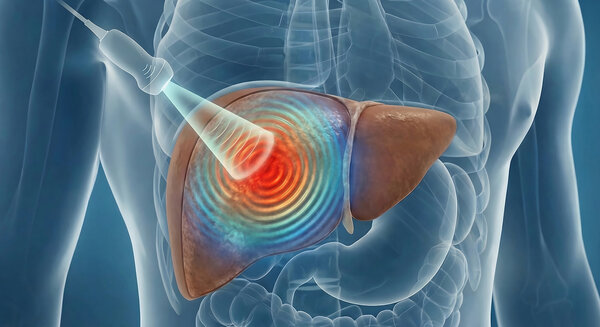
Elastography is a specialized form of ultrasound examination. It is used to measure the stiffness of the liver, which provides evidence of scarring.
How can liver damage be detected?
MASLD often causes no clear symptoms. Fatigue or a feeling of pressure in the upper right abdomen may occur, but these symptoms are nonspecific. Fatty liver is often detected during an ultrasound exam or through abnormal liver function test results. Even normal liver function test results do not definitively rule out advanced disease. [1][2]
The key factor is the extent to which the liver is already scarred: The degree of fibrosis provides important insights into the risk of future complications. To assess the risk of fibrosis, physicians outside of specialized centers (e.g., primary care physicians) can, for example, calculate the FIB-4 index based on age and blood test results. If the values are elevated, a follow-up examination is necessary to confirm the suspicion. This can be done, for example, through a specialized ultrasound examination called elastography: It measures the stiffness of the liver and provides evidence of scarring. [1][2]
What helps with MASLD and MASH?
Diet, exercise, and the treatment of comorbid conditions form the basis of therapy. European guidelines recommend: [1]
- Weight loss: In overweight individuals, even a 5 percent weight loss can reduce liver fat; a 7 to 10 percent weight loss can improve inflammation. An even greater reduction can have a beneficial effect on scarring.
- Eat a balanced diet: A Mediterranean-style diet is recommended, with plenty of vegetables, legumes, and plant-based oils instead of highly processed foods and sugary drinks.
- Regular exercise: Aim for at least 150 minutes per week of moderate-intensity exercise—adjusted to your personal fitness level.
- Treat comorbid conditions and avoid alcohol: It is important to maintain well-controlled blood sugar, blood pressure, and blood lipid levels. In cases of advanced fibrosis or liver cirrhosis, complete abstinence from alcohol is recommended.
- Specific medication options: For adults with MASH who already have moderate to advanced liver fibrosis but have not yet developed cirrhosis, the active ingredient resmetirom has been approved in the EU since August 2025. It acts on a receptor that influences fat metabolism in the liver and complements dietary therapy and exercise. Eligibility for treatment is assessed on a case-by-case basis. [6]
What sets the treatment in Freiburg apart?
At the Department of Medicine II at the Medical Center – University of Freiburg, not only the liver disease but also the patient’s entire metabolic risk profile is assessed by physicians specifically trained in hepatology and diabetology. State-of-the-art diagnostic techniques, particularly in the fields of ultrasound and elastography, also enable comprehensive, non-invasive risk stratification as a basis for evaluating new pharmacological treatment approaches. Eligible patients may also participate in clinical trials. [3]
How do treatment and research work together?
Röhlen not only cares for patients but also leads a research group at the Translational Experimental Immunology Lab of the Department of Medicine II. Her team investigates how certain changes in liver cells influence the development of liver cancer and how these cells respond to immunotherapy. [4]
“When clinical practice and research work hand in hand, questions arising from treatment can be directly incorporated into scientific projects—with the goal of developing new therapies. At the same time, findings from research can be applied more quickly to patient treatment and diagnosis. The strength of liver research in Freiburg lies in the close collaboration between experts in hepatology, immunology, and cancer research,” says Prof. Dr. Robert Thimme, Medical Director of the Department of Medicine II at the Medical Center – University of Freiburg. [7]
One example is the EPITIME research project, approved in 2026, which Röhlen coordinates. The focus is on “epithelial plasticity”: the ability of liver cells to change their properties. The researchers are investigating whether such changes in MASH-related liver cancer help tumors evade the immune system. To this end, they are using, among other things, three-dimensional cell models and investigating the cell-adhesion protein claudin-1. In the long term, these findings could lead to new approaches for immunotherapies.
When is it advisable to see a doctor at the outpatient clinic?
If you have a known fatty liver and there is suspicion of liver fibrosis or significantly elevated liver enzyme levels, you should discuss further evaluation with your treating physicians. This also applies if the cause of liver disease is unclear. [1][2]
The following information is helpful for your appointment:
- existing lab and ultrasound results
- a current list of medications
- Information on past medical history, previous treatments, and alcohol consumption
The MASLD Outpatient Clinic at the Medical Center – University of Freiburg offers patients a specialized point of contact to jointly address liver disease and associated metabolic conditions.
Contact person and scientific review of the article by:
PD Dr. Dr. Natascha Röhlen, Senior Physician at the Department of Medicine II, Gerok Liver Center, and Head of the Röhlen Research Group at the Medical Center – University of Freiburg.
Prof. Dr. Robert Thimme, Medical Director of the Department of Medicine II at the Medical Center – University of Freiburg.
[1] EASL, EASD, EASO. Clinical Practice Guidelines on the Management of MASLD. Journal of Hepatology, 2024. doi.org/10.1016/j.jhep.2024.04.031
[2] Brouwer WP et al. Steatotic liver disease trajectory: A holistic EASL guidance. JHEP Reports, 2026. doi.org/10.1016/j.jhepr.2026.101798
[3] Gerok Liver Center at the Medical Center – University of Freiburg: www.uniklinik-freiburg.de/medizin2/leber.html
[4] Röhlen Research Group at the Medical Center – University of Freiburg: www.uniklinik-freiburg.de/medizin2/forschung/experimentelle-forschung/translational-experimental-immunology-lab/ag-roehlen.html
[5] DFG Project EPITIME, Project Number 585809685: juser.fz-juelich.de/record/1064104
[6] European Medicines Agency: Rezdiffra (Resmetirom), Approval and Indications. www.ema.europa.eu/en/medicines/human/EPAR/rezdiffra
More Interesting Articles

Medical Center - University of Freiburg
Central InformationPhone: 0761 270-0
info@uniklinik-freiburg.de
Corporate Communications
Breisacher Straße 15379110 Freiburg
Phone: 0761 270-84830
kommunikation@uniklinik-freiburg.de