
A Discovery in Freiburg Makes Cancer Immunotherapy Better Tolerated
Cell therapy using treated white blood cells has shown an improvement in severe side effects in 96 percent of evaluable patients / European approval granted less than two years after the publication of the mechanism of action
A discovery made in Freiburg opens up new treatment options for cancer patients worldwide: Researchers at the Medical Center – University of Freiburg have discovered how severe side effects of cancer immunotherapies can be alleviated using a specialized cell therapy involving treated white blood cells. A Phase II clinical trial involving 30 patients, led by researchers in Freiburg, has yielded important results: In 96 percent of the evaluable participants, symptoms improved partially or completely within twelve weeks. The results were published on October 23, 2026, in the journal *Nature Communications*. In February 2025, they had already published the underlying mechanism of action. Now, less than two years later, the European approval granted by the BSI for the medical device in question has been expanded to include the treatment of side effects from immunotherapy.
“From the very beginning, our goal was to treat severe side effects of cancer immunotherapy without compromising the desired anti-cancer effect. The fact that our research has contributed to an additional approved treatment option in such a short time is a major success—especially for patients for whom previous therapies have not been sufficiently effective,” says study leader Prof. Dr. Robert Zeiser, Deputy Medical Director of theDepartment of Medicine I (specializing in hematology, oncology, and stem cell transplants) at the Medical Center – University of Freiburg. The Department of Dermatology and Venereology and the Department of Medicine II at the Medical Center – University of Freiburg were also particularly involved in the study.
When Immunotherapy Triggers Inflammation
Modern cancer immunotherapies help the immune system recognize and fight tumor cells. However, the heightened immune response can also attack healthy tissue. Possible consequences include severe inflammation of the intestines, liver, or skin. These can be so severe that cancer treatment must be interrupted.
Normally, patients are given corticosteroids to curb the inflammation. However, in about 40 percent of patients, this is not effective enough. Other medications, in turn, can impair the desired immune response against the cancer.
This is where so-called extracorporeal photopheresis (ECP) comes into play—a type of cell therapy using treated white blood cells. In this procedure, white blood cells are collected, treated with a light-sensitive agent and UVA light, and then returned to the body. The goal is to calm the excessive immune response without completely suppressing the immune system.
Freiburg Research Explains the Mechanism
Photopheresis has long been used to treat other diseases. The Freiburg research team led by Robert Zeiser has made a decisive contribution to investigating its application against the side effects of cancer immunotherapies. In February 2025, the scientists published a study in the journal *Cancer Cell* showing that the body’s own molecule, adiponectin, plays a key role in the treatment’s anti-inflammatory effect. This allowed them to explain how the treatment can specifically alleviate inflammation.
The new Phase Ib/II clinical trial was conducted at the University Hospitals of Freiburg, Essen, and Regensburg. A total of 30 patients participated, all of whom had not experienced sufficient relief from side effects with cortisone.
After twelve weeks, symptoms had partially or completely subsided in 26 of 27 evaluable patients. The majority were able to stop taking cortisone entirely. No serious side effects attributable to photopheresis occurred. Additional tests also showed that pro-inflammatory immune cells and markers of inflammation decreased during treatment.
From Research to an Additional Treatment Option
The research findings have helped to open up a new application for photopheresis in cancer patients. In October 2026, the responsible regulatory agency, the BSI, confirmed that a photopheresis system—which is approved as a medical device—may now also be used in adult patients experiencing immune-mediated side effects from cancer immunotherapy.
This provides an additional treatment option, particularly for patients for whom corticosteroids are not sufficiently effective. However, the previous study, which included 30 participants, was relatively small and lacked a direct control group. Larger, randomized studies must therefore still demonstrate how effective photopheresis is compared to other available treatments.
Original title of the study: Extracorporeal photopheresis for the treatment of steroid-refractory immune-related adverse events from immune checkpoint inhibitor therapy: a multicenter phase Ib/II clinical trial
Journal: Nature Communications
DOI: 10.1038/s41467-026-78897-9
Link:https://www.nature.com/articles/s41467-026-78897-9
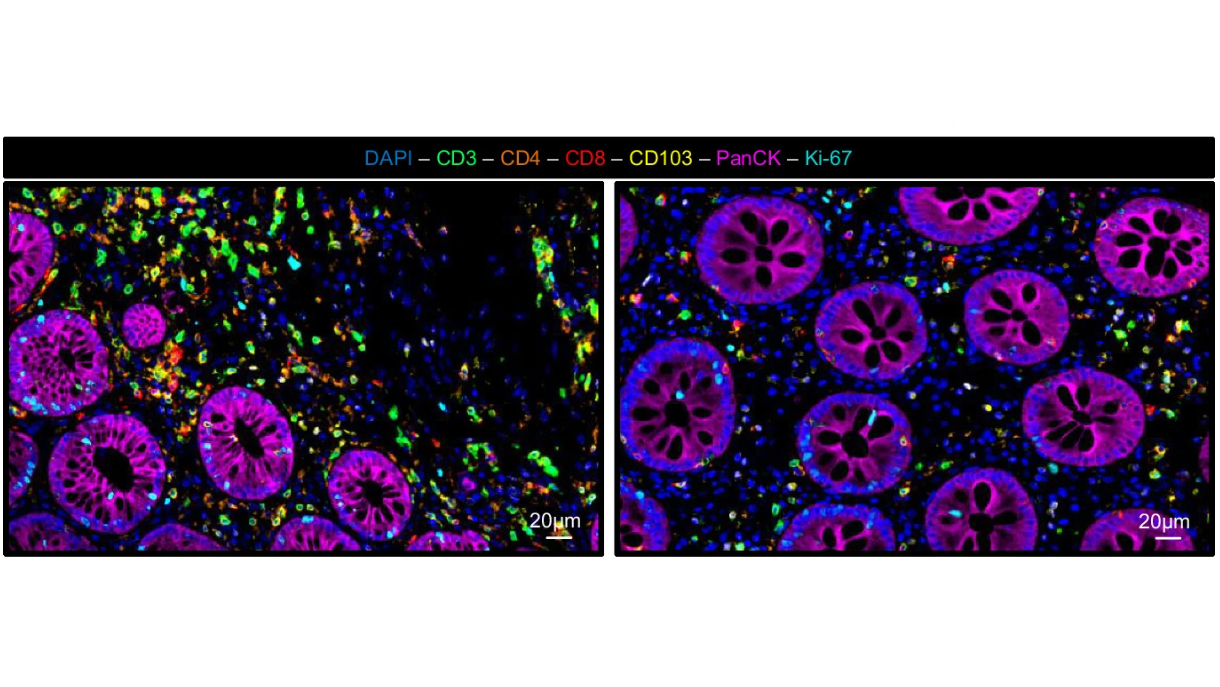
Caption: Intestinal tissue from a patient with severe intestinal inflammation before (left) and after therapy. The immune cells are colored green, orange, red, and yellow in the immunofluorescence staining.
Image source: Medical Center – University of Freiburg
Back
Medical Center - University of Freiburg
Central Information
Phone: 0761 270-0
info@uniklinik-freiburg.de
For press inquiries:
Corporate Communications
Breisacher Straße 153
79110 Freiburg
Phone: 0761 270-84830
kommunikation@uniklinik-freiburg.de