Interventional Radiology Section
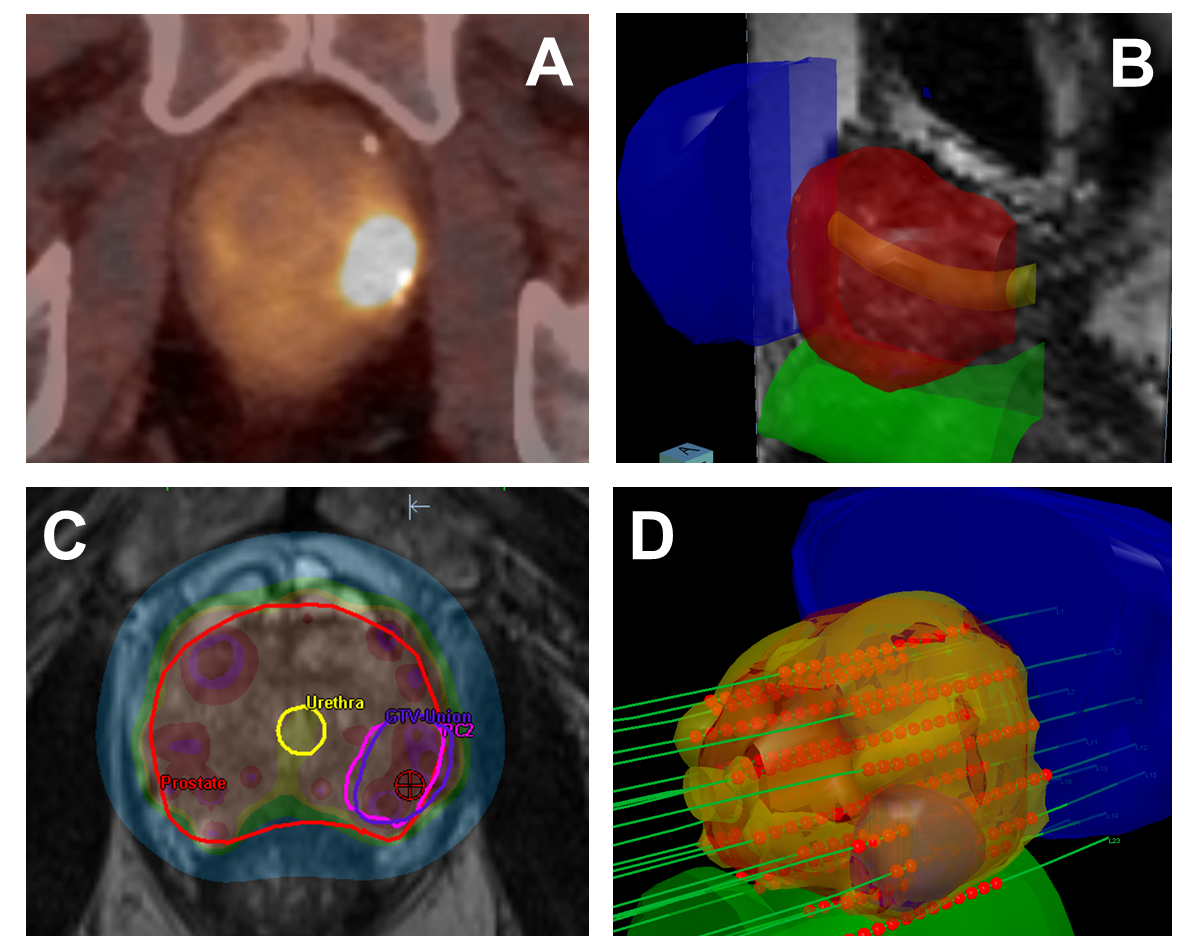
HDR brachytherapy is a highly effective and minimally invasive treatment method for patients with prostate cancer. Using modern diagnostic imaging techniques such as PSMA PET/CT and magnetic resonance imaging (MRI), the tumor within the prostate can be detected. Figure A shows a PSMA PET/CT image of the prostate with a tumor lesion in the lower right corner. At our institute, the information from the diagnostic imaging is fused (overlaid) with the live ultrasound image during brachytherapy. The result of this process can be seen in Image B (red = prostate, blue = bladder, green = intestine). This allows the exact location of the tumor to be visualized during the procedure, enabling the hollow needles to be placed precisely. Image C shows the radiation dose for a patient. The fused MRI image shows the tumor focus in the lower right corner. A higher dose is applied to this area than to the rest of the prostate. Image D shows the 3D distribution of the radiation dose along with the positions of the needles; here, too, it is clear that the tumor mass receives a higher radiation dose.
The Division of Interventional Radiotherapy at the Department of Radiation Oncology at the University Medical Center Freiburg is the first division of its kind in all of Germany. A highly specialized team of physicists, nurses, and physicians ensures safe and effective treatment for patients. Through innovative research projects, the latest technological advances directly benefit patients.
The section employs a special form of high-precision radiation therapy: high-dose-rate brachytherapy (from the ancient Greek βραχύς, brachys, meaning “short, close”), also known as internal radiation therapy or interventional radiation therapy. Brachytherapy is a form of radiation therapy in which sealed radioactive sources are placed inside or in the immediate vicinity of the area of the body to be irradiated. Our clinic frequently uses brachytherapy as an effective treatment method for cancers of the uterus, cervix, prostate, breast, and skin. Brachytherapy can be used alone or in combination with other forms of therapy, such as external beam radiation therapy (EBRT) and/or chemotherapy. Our clinic uses what is known as high-dose-rate (HDR) brachytherapy. In this procedure, the radiation source is guided into and/or onto the tumor via hollow needles (interstitial brachytherapy, for example in prostate cancer) or via an applicator (intracavitary brachytherapy, for example in uterine cancer) under computer control. In the case of interstitial brachytherapy, this may be performed under general anesthesia to minimize pain as much as possible. To ensure that radiation delivery during a brachytherapy session is highly accurate and precise, our clinic uses state-of-the-art diagnostic procedures (such as computed tomography [CT] or magnetic resonance imaging [MRI]) to precisely determine the tumor’s location.
Since the radiation effect in brachytherapy affects only a very limited area around the radiation source, radiation exposure to healthy tissue and tissue located further away from the radiation sources is reduced. Thus, the tumor can be treated with high-dose, localized radiation while reducing the likelihood of unnecessary damage to the healthy surrounding tissue. Consequently, brachytherapy represents an effective treatment option for many types of cancer. Treatment outcomes have shown that cure rates for cancer are comparable or better with brachytherapy than with surgery or external beam radiation therapy.
Innovative research projects are utilizing novel technological methods such as artificial intelligence and robotics. For example, the Section for Interventional Radiotherapy has developed a methodology in which tumor foci in the male prostate can be automatically detected and mapped with very high precision using artificial intelligence. This achievement aids in the precise positioning of hollow needles during brachytherapy. Furthermore, modern robotic systems are being investigated to assist physicians in positioning the needles.
Please contact the Interventional Radiotherapy Section if you have any questions: