
Endoscopy of the bile ducts (ERCP)
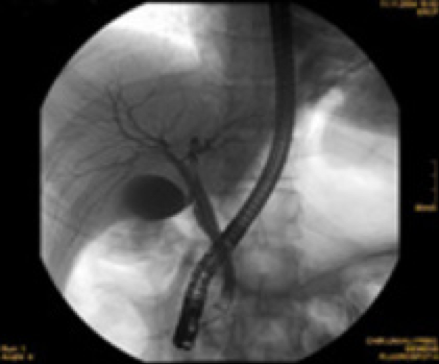
X-ray imaging of the normal bile ducts after endoscopic injection of contrast medium
The name sounds complicated at first: endoscopic retrograde cholangiopancreatography, or ERCP for short. This examination makes it possible to visualize the bile ducts and the pancreatic duct system. It can be used to detect and treat gallstones and obstructions, for example.
The examination begins with an endoscopy of the oesophagus, stomach and duodenum. An X-ray contrast medium is then injected into the mouth of the bile duct and the pancreatic duct. This allows X-ray imaging of these duct structures.
Additional procedures can be carried out during the examination: for example, a widening incision at the mouth of the bile duct to remove bile duct stones or the insertion of endoprostheses or metal stents to overcome obstructions in the bile duct or pancreatic duct.
Before the examination
For a good assessment of the upper digestive tract, it must be free of food residues. It is therefore important not to eat or drink anything for six hours before the examination and to stop smoking.
Medication should only be taken after consultation with the physician. If medically justifiable and not expressly ordered otherwise by the physician, anticoagulant medication in particular, such as aspirin, should be discontinued ten days before the examination. If other anticoagulants such as Marcumar or heparin are used, the physician must be consulted beforehand.
After the examination
After the examination, you must remain fasting for about twelve hours and may only drink liquids again after about six to eight hours. In individual cases, irritation of the pancreas may occur, which is usually transient.
You will usually stay in hospital for a day. If you develop a fever, discharge of blood or pain, please inform a physician immediately.