
Endoscopic examinations
Endoscopic examinations and treatments
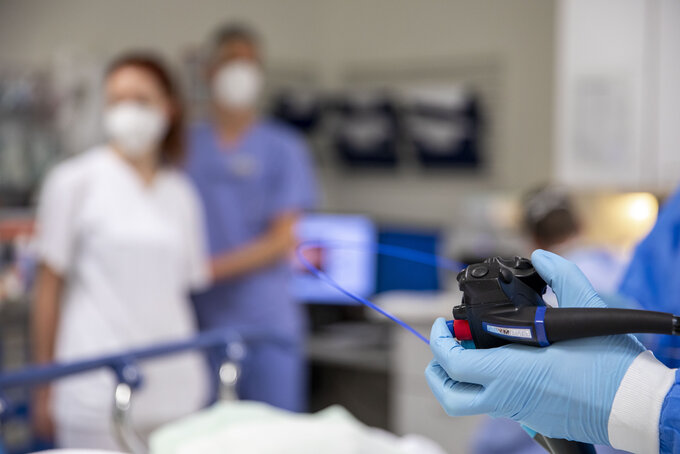
State-of-the-art flexible, high-resolution endoscopes are used to examine the gastrointestinal tract. At the tip of these small probes are tiny cameras that transmit the image of the inside of the body directly to a monitor. Before each examination, the physician will inform you about the examination, possible complications and alternative examination procedures.
Endoscopy enables a more precise diagnosis of many diseases of the gastrointestinal tract. However, colonoscopy is also particularly important in tumor screening, which is why it is generally recommended from the age of 55.
By closely examining the mucous membranes, pathological changes such as tumors, polyps or inflammatory changes can be detected at an early stage and examined by taking tissue samples. Many changes can even be treated during the examination. For example, polyps can be removed with a snare or bleeding from ulcers can be stopped. Stones in the bile duct can also be effectively removed endoscopically.
Gentle endoscopy
We generally perform endoscopic examinations using a short anesthetic administered via the vein, known as sedation. This means that the patient's consciousness is switched off for the entire duration of the examination. The examination is practically "slept through". The routine use of carbon dioxide (CO2) instead of air ensures a particularly gentle examination with significantly less abdominal discomfort after the procedure.
After the short anesthesia, you will be monitored by our specialist staff in a specially equipped recovery room until you are fully awake and oriented again. Depending on the medication used and the dose, this usually takes between 30 minutes and two hours. In any case, you must not actively participate in road traffic, make important decisions or carry out dangerous activities for 24 hours afterwards. For this reason, it is advisable to bring an accompanying person with you for outpatient examinations to take you home safely.
- Gastroscopy (gastroscopy)
- Colonoscopy and removal of polyps (colonoscopy and polypectomy)
- Examination of the anal canal (proctoscopy)
- Recto-/sigmoidoscopy
- Endoscopy of the bile ducts (ERCP)
- Treatment of bile stasis using external drainage (PTCD)
- Endoscopic ultrasound (endosonography)
- Treatment of constrictions in the gastrointestinal tract (bougienage and balloon dilatation)
- Liver puncture and sonography-guided punctures/drainages
- Acid and reflux measurement in the esophagus (24-hour pH measurement and impedance measurement)
- Pressure measurement in the esophagus (high-resolution manometry)
- Percutaneous endoscopic gastrostomy (PEG, insertion of a feeding tube)
- Removal of larger polyps (EMR, endoscopic mucosal resection)
- Removal of large polyps/tumors in one piece (ESD)
- Endoscopic full-thickness resection (FTRD)
- Treatment of achalasia (POEM)
- Tunneling technique for tumors under the mucosa (STER)
- Treatment of Zenker's diverticula in the esophagus
- Radiofrequency ablation in the esophagus
- Direct endoscopy of the bile ducts (cholangioscopy)
- Drainage of pseudocysts and necrosectomy (treatment of severe pancreatitis)
- Therapy for reflux disease
- Single balloon enteroscopy (examination of the small intestine)
- Capsule endoscopy (examination of the small intestine)
- Transjugular liver biopsy
- Endoscopic gastroenterostomy (EUS-GE)
- Endosonography-guided gallbladder drainage (EUS-CD and EUS-HGS)