
Practical training
Together, we provide you with intensive support and guidance throughout your practical training at the Medical Center – University of Freiburg.
Over 200 professionally trained and continuously educated practical instructors are available to assist you in the wards, outpatient clinics, and operating rooms. In addition, experienced head practical instructors and nursing education managers ensure that your practical training maintains a consistently high level of structure and quality. In close cooperation with the Academy for Medical Professions, a sustainable framework concept has been developed that guarantees and continuously strengthens the requirements and quality of the training.
To make your training period with us particularly attractive and trustworthy, we offer you a wide range of services: Special concepts for training wards, innovative training projects, and realistic simulations ensure that you can learn under the best possible conditions. These services are regularly carried out, evaluated, and further developed by multi-professional teams.
We accompany you competently and with commitment on your journey and support you in your personal and professional development – so that you can start your future tasks well prepared!
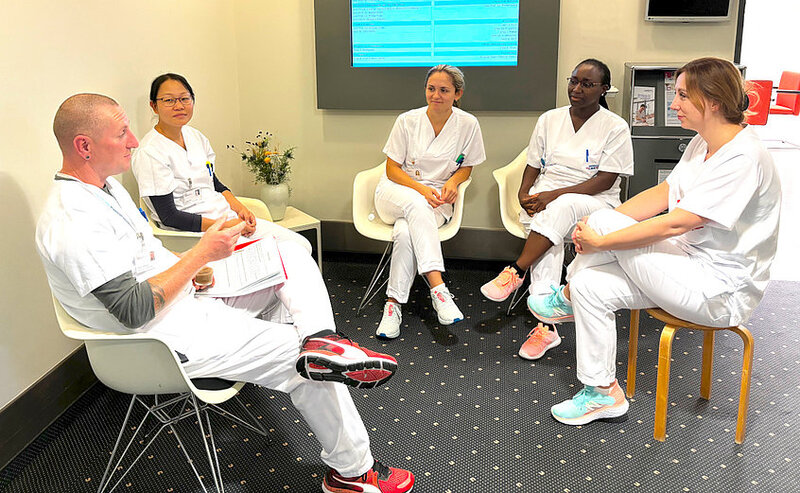
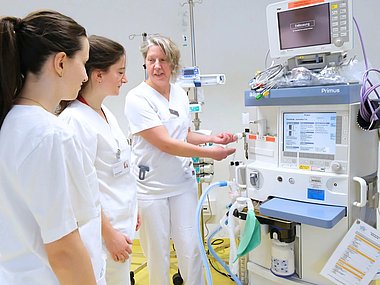
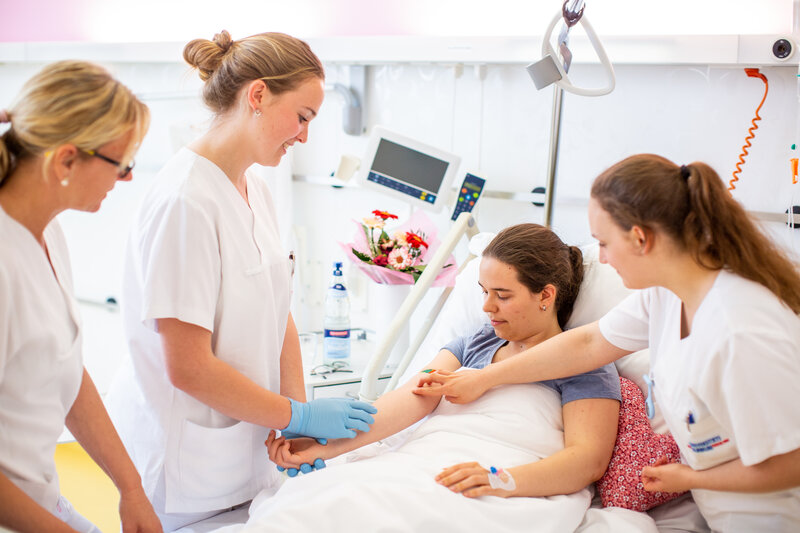
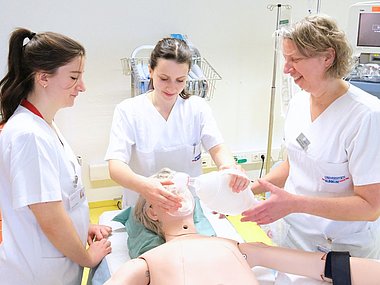
We support you in your practical training!

In our training wards, as a third-year nursing trainee, you will take on the independent care of patients and the organization of everyday ward life. With close support from the nursing staff in the wards, the responsible practical instructors, and with the involvement of the multi-professional treatment team, you will be thoroughly prepared for your future responsibilities. The preparation of trainees for these projects is carried out in close coordination with the course instructors and practical instructors based on the requirements of the respective specialist departments. After an induction phase, the trainees will care for patients independently.
Similar to general nursing training, we also offer practical instructor days and subject-specific learning islands, enabling a transfer of theory into practice where trainees can deepen their theoretical knowledge in a practical context. In addition, to make the transition into everyday working life easier, you can take part in our Competence Weeks (KoWo) concept. Here, trainees learn organizational and administrative tasks. They also get to try out working independently.
To promote team building and collaborative work in everyday operations, we hold learning island days together with the surgical assistants on the topics of pressure ulcer prevention, hygiene in the operating room, and a joint OTA-ATA learning island. Here, the specific features of the other disciplines are highlighted in a cross-disciplinary manner.
You can get an insight into training as an anesthesia technical assistant here.
In the central operating room at the Medical Center – University of Freiburg, we offer our trainees varied and innovative practical instruction. In addition to practical instruction days and learning islands, we enrich the training with a special movement concept for surgical assistant trainees. In this learning island, job-related movement sequences and preventive approaches are taught in a practical manner. For interprofessional learning, we also enable participation in a training operating room together with PJ students of surgery. Here, the focus is on deepening independent operating room management and actively promoting cooperation between different professional groups.
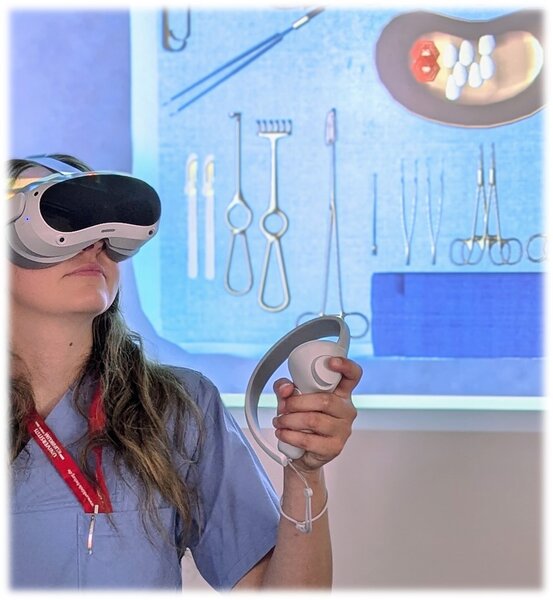
In the course of advancing digitalization, we offer our trainees the opportunity to learn about instruments in a flexible and innovative way using a VR prototype – completely independent of time and place. In this way, we create optimal conditions for modern and well-founded training.
To promote team building and collaboration in everyday surgical work, we hold learning island days together with the anesthesia technicians on the topics of pressure ulcer prevention, hygiene in the operating room, and a joint OTA-ATA learning island. These sessions highlight the specific features of the other disciplines.
You can get an insight into training as a surgical assistant here.
There is the option of shadowing specially trained staff in nursing care. For nursing care trainees, regular shadowing opportunities are planned with wound experts, stoma therapists, nursing care experts, the central admissions department, and operating room staff, in order to learn about the work of our specialists through specific learning tasks.

The term "interprofessional" means that different professional groups work closely together in the treatment of patients. In our interprofessional training wards (e.g., in neurosurgery), nursing and medical trainees work together to care for patients in a ward. Trainees in the nursing professions and medical students in their practical year (PJ) who are at an advanced stage of their training are eligible to participate. They take on patient care as independently as possible and are accompanied and trained by experienced staff/practical instructors.
A learning island consists of at least one practical instructor, a group of patients, and several trainees from as many different courses as possible. This enables you to learn together and engage in self-directed learning.
The learning opportunities are determined by the department. This enables clear, subject-specific learning and goal agreements to be made with you. In addition to specialist knowledge, you will also learn about organizational processes and be encouraged to engage in interprofessional collaboration.
Learning tasks offer you and us a suitable opportunity to anchor knowledge application and reflection directly in your professional activities. Practical instructions can be guided and reinforced through learning tasks. A combination of different learning tasks is possible. The implementation is planned by our practical instructors and nursing professionals.
Through the practical instructor day and the completion of learning tasks, we support not only your practical skills but also the development of job-specific competencies. The learning opportunities are based on the specialist focus of the ward. From this, subject-specific learning and target agreements are recorded. Theoretical focus areas are determined individually with the trainees.
Find out here how our practical instructors accompany and support you during your practical training.
In our KOMPRA practical project, our trainees working in the Department of General and Visceral Surgery are prepared for comprehensive patient care and the organizational tasks involved in everyday nursing. They care for a group of patients in cooperation with other trainees under supervision. The trainees plan and carry out nursing procedures in accordance with their level of training. The practical instructors support them in this. Before the actual nursing situation is carried out, those involved (trainees, practical instructors) can discuss the procedure as needed.
Skills and simulations are training units in which you can learn and consolidate skills using models or simulations in a virtually "real" environment. This allows us to prepare you for real-life situations and enables you to develop practical skills before you come into contact with our patients.
As part of the theoretical training, you will visit a clinic/department with your course instructors. Here you will learn how the theoretical knowledge is put into practice. You will be introduced to the various specialist areas of the clinic/department by the practical instructors present. This allows you to compare the knowledge you have acquired with practical experience and gives you the opportunity to ask questions in a practical context. Furthermore, we can use a telepresence robot during the teaching phases to explain the procedures and care for specific issues on site.
At the University Emergency Center, you will work alongside trainees from all nursing training programs, e.g., surgical technicians, anesthesia technicians, nursing specialists, and emergency paramedics. Together with practical instructors, you will spend a day in small groups working on topics and learning tasks that have been agreed upon in advance by the practical instructors and trainees.
Have we convinced you to join our team?

You are welcome to submit your application online. Start your online application here.
We look forward to receiving your application!
If you have any questions, please feel free to contact us personally.
Contact us if you have any questions
Medical Center – University of Freiburg
Mr. Daniel Martin y Simon
Certified Nursing Educator (FH)
Central Practical Instructor for the Entire Medical Center
daniel.martin.y.simon@uniklinik-freiburg.de
Stefanie Bieberstein
Phone: +49 (0)761 270-34000
stefanie.bieberstein @uniklinik-freiburg.de
André Doherr
Phone: +49 (0)761 270-18961
andre.doherr@uniklinik-freiburg.de
Nursing Administration
Breisacher Straße 153
79110 Freiburg
Phone 0761 270-73390
pflegedirektion@uniklinik-freiburg.de