Courses/Seminars in the Preclinical Phase
As part of the “Special Funding Line for Teaching,” the teaching project “Introduction to Clinical Medicine” was developed at the Faculty of Medicine – University of Freiburg under the leadership of the Office of the Dean of Studies and is currently being implemented by staff members of the Institute of General Medicine. It serves to integrate general medicine into the medical curriculum on a longitudinal basis and is mandatory for all students.
This teaching project thus follows the “Recommendations for the Further Development of Medical Education in Germany” issued by the German Science Council and sets a positive example for developments under the “Master Plan for Medical Education 2020.”
Teaching
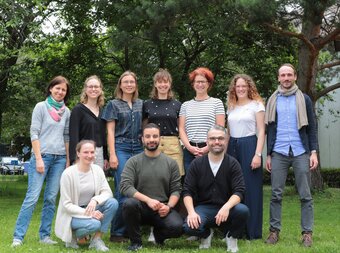
The EKM team consists of a group of young physicians who contribute both their fresh experiences from their own studies and their existing experiences from daily medical practice to the continuous improvement of teaching and the development of innovative teaching and examination formats. The following courses are integrated into this teaching project:
Course “Introduction to Clinical Medicine”
- Target audience: Pre-clinical medical students
- Content: Learning basic practical skills for performing a physical examination (divided into a total of 5 thematically structured modules) as well as patient-centered communication techniques. All courses are supported by student tutors and medical supervision.
- Optional supplement: Tutor-guided skills training to reinforce the examination techniques learned, materials and self-assessments for the nursing practicum, as well as prompts for self-reflection and self-assessment regarding examination techniques in the “U-Course Manual.”
- In the “Digital Learning Materials” section, you will find further information and a link to the “train-a-med” learning platform, including the online offerings “Examination Course” and “Learning Videos.”
Full-Body Status and Clinical Rotation Readiness Exam
- Target audience: Medical students in their first clinical semester
- Content: Practical course on taking a full-body status and learning symptom-based physical examinations, practical exam on the examination techniques learned (clinical rotation readiness exam)
- Optional supplement: Tutor-supervised skills training to reinforce the examination techniques learned
Interprofessional Examination Course
- Target group: Nursing students and medical students
- Content: Practical course on learning basic practical skills for conducting a physical examination, practical exam on the examination techniques learned (clinical rotation readiness exam)
In addition, there are various e-learning offerings available across all courses, which are continuously developed by the EKM team. These include, for example, the examination course and the instructional videos on the train-a-med learning platform.
Research
For educational research, we utilize analyses of the evaluations of our individual courses as well as the exams. Members of the EKM team, for example, regularly attend the annual conferences of the “Society for Medical Education” or the “German Society of General Practice” to participate in discussions about teaching methods used nationwide and current medical guidelines.
Awards
- “Teaching Award for Innovative Teaching Projects” from the Society for Medical Education (2016)
- “Teaching Award for Outstanding Courses in the Human Medicine Program at the Faculty of Medicine” from ALU Freiburg (2016)
The project is coordinated in close collaboration with experienced specialists from the Institute of General Medicine.
Project Coordinator: Uta Zipfel
Course Overview:
- Elective course for students in their 2nd or 3rd preclinical semester
- Offered each summer semester
- Practical topics in 10 small-group seminars over 1 semester
Content:
- Basic skills: Fundamentals of medical history and physical examination, blood collection, injections, indwelling catheters, applying bandages, wound suturing
- Technical examinations, ECG, ultrasound, pulmonary function
- "Theory": Fundamentals of general medical practice, evidence-based medicine
Description:
The aim of the course is to offer students, within the framework of the general practice mentoring program, a practice-oriented education from the perspective of a family physician. From the start of their studies, students should develop a basic understanding of the specific features of general practice approaches as well as the healthcare landscape in the outpatient sector. The program aims to ensure that, by the end of their training, students have mastered defined basic skills required (not only) for primary care in general practice. For this reason, practical skills such as performing an ECG, simple ultrasound exercises, wound care, injection techniques, etc., are taught in small groups.
The required proof of performance is demonstrated through the written preparation of a biographical medical history of an older adult.
Application:
Only through the Office of the Dean of Studies
astrid.steeger@uniklinik-freiburg.de
Contact person for questions regarding course content:
Dr. Stefan Blaser
Health Depends on Climate Protection!
We are all becoming increasingly aware of the health impacts of climate change, as they are becoming palpable and the consequences are far-reaching and dramatic. Respiratory diseases caused by air pollution, heat waves, water and food shortages, migration, and mental health issues are just a few examples of how climate change can threaten lives and health on both local and global scales. In recent years, the emerging field of “Planetary Health” has provided many insights into the drastic consequences of climate change on human health. The field of general medicine plays a particularly important role here, as family physicians can fulfill a key function as the first point of contact in providing medical advice to their patients on leading a healthy and climate-friendly lifestyle (“co-benefits”).
To raise your awareness of this relevant topic early in your studies, we will be offering this elective for the first time for the preclinical phase starting in the summer semester of 2024.
Together, we will explore the relevant connections between climate change and health and develop actionable strategies for physicians, patients, and students.
Through specialized lectures, expert discussions, and group work, we aim to familiarize students with selected topics related to planetary health, such as nutrition, heat, and sustainability in the healthcare sector.
The elective requires participation in in-person sessions, as well as the preparation of a short presentation on a self-selected topic related to planetary health.
The elective is open to and academically enriching for students from other disciplines as well. It is currently part of the elective modules for dental students and the elective track for students pursuing the Certificate in Sustainability.
Contact and registration:
Expertise meets patient-centered care in everyday practice
Target Audience
This elective is designed for first-cycle students who wish to gain practical insight into general practice outside of hospitals at an early stage. It offers a realistic picture of general practice in rural areas and is particularly interesting for those who can envision a future career in primary care.
Description:
Everyday life in a rural family practice: What is it really like?
Here, students gain diverse insights directly from experienced general practitioners who are passionate about working in rural areas. They share their medical knowledge with students—ranging from preventive care to acute treatment and palliative medicine—and demonstrate what makes the profession so special: real patient stories, practical skills, diagnostics, and therapy in everyday practice. As part of this elective, students also develop valuable “soft skills” such as communication, empathy, and resilience, which are essential for their future careers.
Students experience the reality of the medical profession in a rural region. In doing so, they gain insights that will benefit them throughout their studies and in their future careers.
To deepen this knowledge, there is the option of a one-day internship at a rural medical practice.
The elective is expected to consist of 8 sessions spread out over the summer semester. At the start of the semester, the subsequent sessions (usually Wednesday afternoons) will be scheduled together.
Assessment:
Regular and active participation, as well as a short oral presentation on a topic related to rural medical practice at the end of the course, are required for assessment.
Maximum number of participants: 20
Application:
Through the Office of the Dean of Studies
Contact persons for questions regarding course content: