
Adoptive T-cell Transfer against Viral Infections
In healthy individuals, persistent viruses like Cytomegalovirus (CMV), Adenovirus (AdV) and Epstein-Barr virus (EBV) are often asymptomatic or cause mild symptoms. However, stem cell transplantation exposes patients to periods of marked immunosuppression, during which viral infections are an important cause of morbidity and mortality. Developments in basic immunology have led to a greater understanding of the nature of protective immunity in immunocompetent donors and this knowledge is now being used to direct immunotherapeutic protocols: Protective T-cell immunity could be restored by means of a procedure known as Adoptive T-cell Transfer.
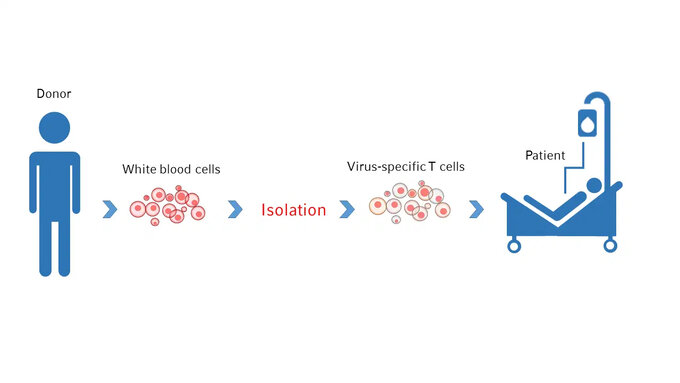
Therefore functional virus-specific T cells are directly isolated from a seropositive donor: The donor’s white blood cells are isolated from peripheral blood using a procedure called leukapheresis. From these cells, virus-specific T-cells are selected via the Cytokine Capture Approach (see T-cell Product). Virus-specific T-cells are then directly infused into the patient where they are re-stimulated by the viral infection leading to expansion and induction of viral clearance as well as sustained protection.