
Neuroimmune Systems Biology
Dr. Emile WogramWe study how organelle networks in brain cells and neuroimmune interactions sustain brain health and how their breakdown drives neurodegeneration
The human brain depends on tightly coordinated interactions between neurons, glial cells, and immune cells to maintain lifelong homeostasis. Among these, microglia play a central regulatory role, but they operate within a complex cellular ecosystem. Increasing genetic and functional evidence indicates that dysfunction across multiple brain cell types contributes to neurodegenerative disorders such as Alzheimer’s disease. Yet, the intracellular principles that govern how brain cells maintain functional stability — and how this stability collapses — remain poorly defined.
Our research addresses this fundamental question by investigating the subcellular architecture of brain cells, with a particular focus on microglia while extending to other neural and glial populations. We study how organelles — specialized intracellular compartments such as mitochondria, lysosomes, and phagosomes — form dynamic networks that coordinate metabolism, immune signaling, and intercellular communication. We hypothesize that disruption of these organelle networks represents an early and decisive step in neurodegeneration.
To test this, we combine human stem cell technologies with organelle-resolved multiomic profiling, enabling molecular analysis of proteins, lipids, and metabolites directly within isolated compartments. By integrating high-resolution datasets with computational modeling and mechanistic experimentation, we aim to define the intracellular logic that safeguards brain homeostasis and to identify fundamental cellular vulnerabilities that drive brain disease.
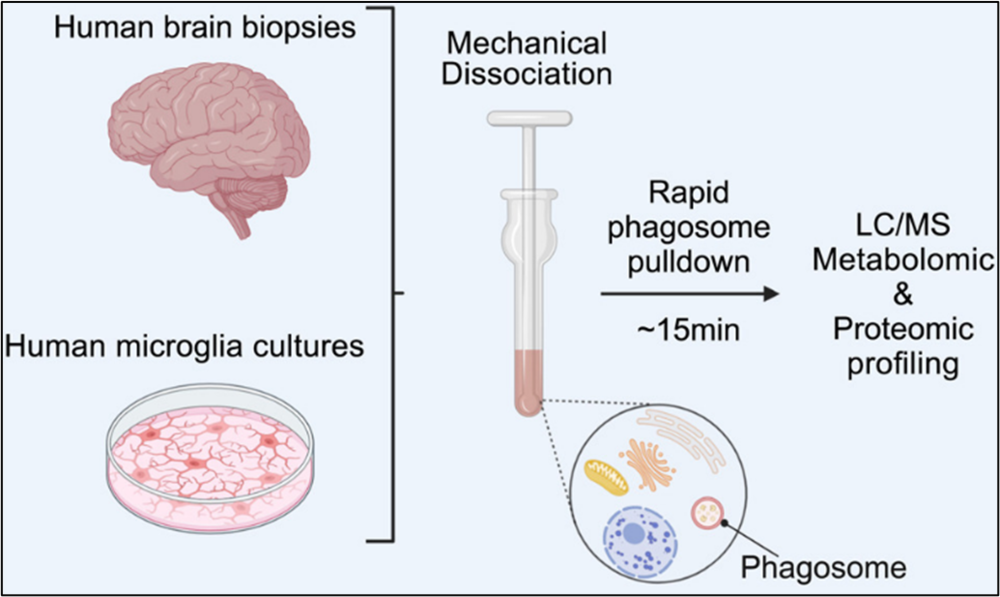
Our previous work established a method to isolate intact human microglial phagosomes. Multiomic profiling
revealed a highly dynamic compartment enriched in proteins linked to synapse regulation and
neurodegenerative disease. We further identified the phagosome as a metabolic hub for de novo NAD⁺
biosynthesis in the brain. Together, these findings define the microglial phagosome as a central regulator
of CNS homeostasis and pathology.
(Wogram et al., Immunity, 2024).
Curriculum Vitae
Professional Education
• MD and Group Leader, Institute of Neuropathology - University Clinic Freiburg, Germany (since 2021)
• Postdoctoral fellow, Whitehead Institute for Biomedical Research, USA (2017-2021)
• Dissertation in Medicine (2017)
• Medical School, University of Heidelberg, Germany (2010-2017)
Honors & Awards
• Elite Programme for Postdoctoral Researchers, Baden-Württemberg Foundation (2025)
• Research Fellowship (Forschungsstipendium), German Research Foundation (DFG) (2017)
• MD Fellowship, Boehringer Ingelheim Fonds (2012)
• Scholarship, Studienstiftung des deutschen Volkes (German National Academic Foundation) (2011)
Members
• Lukas Faber, PhD Student
• Jeanne König-Wacheux, PhD Student
• Eva Paul, Cand. med.
• Anton Schoser, Cand. med.
• Lea Franz, Cand. med.
• Sonja Beckschulte, Cand. med.
JOIN US!
• Master Thesis: Please send a CV (pdf) to emile.wogram@uniklinik-freiburg.de
• PhD: Please send a cover letter, CV, and contact information for two or three references (PDFs) to emile.wogram@uniklinik-freiburg.de
Publications
https://scholar.google.com/citations?user=bjsOl80AAAAJ&hl=en&oi=ao

Dr. Emile Wogram
Medical Center - University of Freiburg
Institute of Neuropathology -IMITATE-
Breisacher Straße 113
79106 Freiburg
Tel.: +49 761 270 50740
emile.wogram@uniklinik-freiburg.de