

The VORTEX Project - funded by Carl Zeiss Stiftung
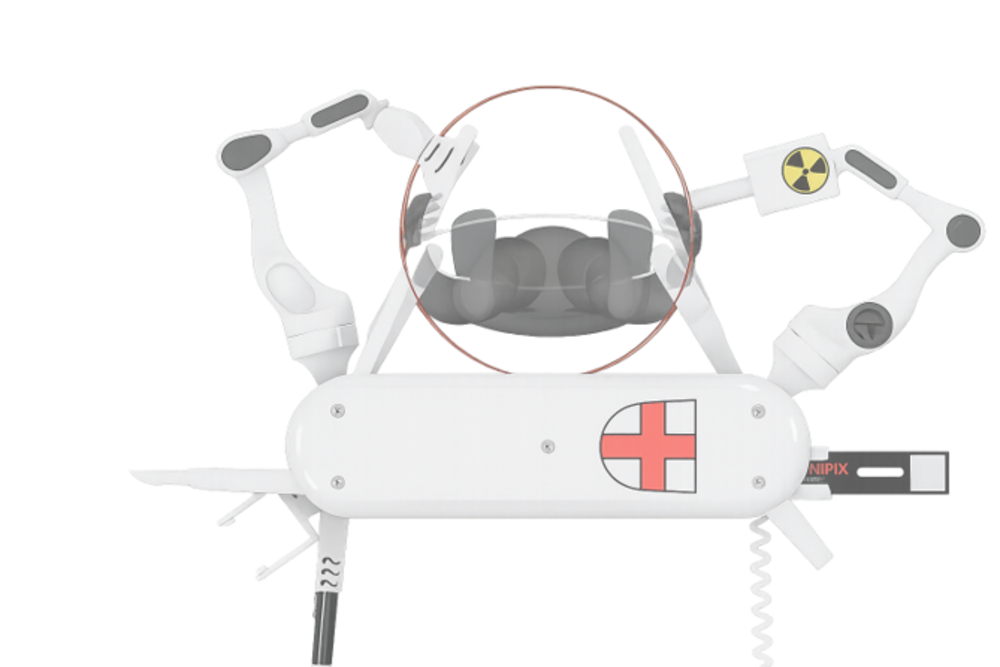
VORTEX in concept: like a Swiss Army knife for medical imaging, multiple diagnostic modalities deploy from a single compact platform. The central body (Hybrid Pixel Detector) supports molecular gamma imaging, spectral CT, and impedance-based methods through interchangeable robotic detector arms.
Versatile, Open-source Resource for Tomographic and Extendable medical imaging
The Challenge
Modern clinical imaging — CT, MRI, PET, SPECT — delivers extraordinary diagnostic information,
but only under highly controlled conditions: stationary infrastructure, specialized staff, and
time that emergency or mobile care situations often do not afford. The result is a persistent gap
between where imaging is needed and where it is available.
VORTEX closes this gap. We are developing a compact, portable, open-source multimodal imaging
platform that combines the physical principles of photon-counting CT, Compton-camera molecular
imaging, Positron Emission Tomography (PET), and Electrical Impedance Tomography (EIT) on a
single shared hardware architecture — the Hybrid Pixel Detector (HPD).
Technology
How VORTEX Works:
At the core of VORTEX is the Hybrid Pixel Detector (HPD) — a photon-counting detector
technology capable of recording individual photons with energy resolution, sub-nanosecond
timing, and single-photon sensitivity. By sharing one detector architecture across modalities,
VORTEX achieves:
- Spectral CT: low-dose, flexible trajectory, Region-of-Interest scanning
- Compton camera imaging: collimator-free 3D gamma imaging with 4pi acceptance
- PET: coincidence photon detection, high-resolution ROI scanning
- Electrical Impedance Tomography (EIT) and magnetically enhanced impedance methods
The Robotic Gantry as Imaging Component:
A key design principle of VORTEX is that the robotic detector gantry is not a support
structure — it is an active imaging component. Non-standard acquisition trajectories,
ROI scanning, and multi-modal synchronization are only possible with active robotic guidance.
This makes VORTEX a genuinely robot-native imaging system.

VORTEX system visualization: the HPD-based robotic gantry enables compact full-body imaging. Robotic arm positioning defines the CT acquisition trajectory, Compton search-mode geometry, and PET coincidence detection window — all from a single portable unit.
Applications
- Emergency medicine: Rapid triage imaging without fixed CT infrastructure.
- Mobile and home care: Portable follow-up imaging for oncology patients.
- Rehabilitation: Functional impedance imaging for recovery monitoring.
- Remote and rural settings: Standalone diagnostics without hospital access.
Partners and Funding
- Funded by: Carl-Zeiss-Stiftung (750,000 EUR + overhead)
- Project partner: Hochschule Furtwangen University (HFU)


Dr. Martin Peter Pichotka
Scientific Lead of the Spectral CT Research Group
Tel.: +49 761 270-39220
E-Mail: martin.pichotka@uniklinik-freiburg.de
Medical Center – University of Freiburg
Dept. of Radiology · Medical Physics
Killianstr. 5a
79106 Freiburg